


National HealthCare earnings and dividend draw fresh investor focus
National HealthCare (NHC) just posted third quarter results that combined higher revenue with sharply lower profit, while also affirming its regular cash dividend for early 2027.
National HealthCare’s share price has eased over the past month, with a 30 day share price return of 5.58% and a 90 day share price return of 3.10%. This comes as investors weigh stronger revenue figures, softer earnings and the confirmed dividend against a longer record that includes a 66.68% 1 year total shareholder return and a very large 3 year total shareholder return of about 3x.
Scan how National HealthCare compares with other defensively positioned operators by reviewing our hand picked list of 29 resilient stocks with low risk scores before you decide where to allocate capital for potential returns.
National HealthCare now trades well above its historical levels while the intrinsic value estimate implies a discount of about 57%. So where does fair value really sit between the recent share price run and that wide range of estimates?
Price-to-earnings of 28.5x: Is it justified for National HealthCare?
National HealthCare screens as expensive on a simple P/E check, with a 28.5x multiple against peers on 24.1x and the broader US Healthcare group on 24.9x, even though the share price closed at $208.85 and the SWS DCF model suggests a large gap to intrinsic value.
The P/E ratio compares what you pay per share to the earnings that National HealthCare generates per share. For a defensive healthcare operator with skilled nursing, assisted living, hospice and related services, that yardstick often reflects how confident investors feel about the durability and quality of profit rather than rapid expansion.
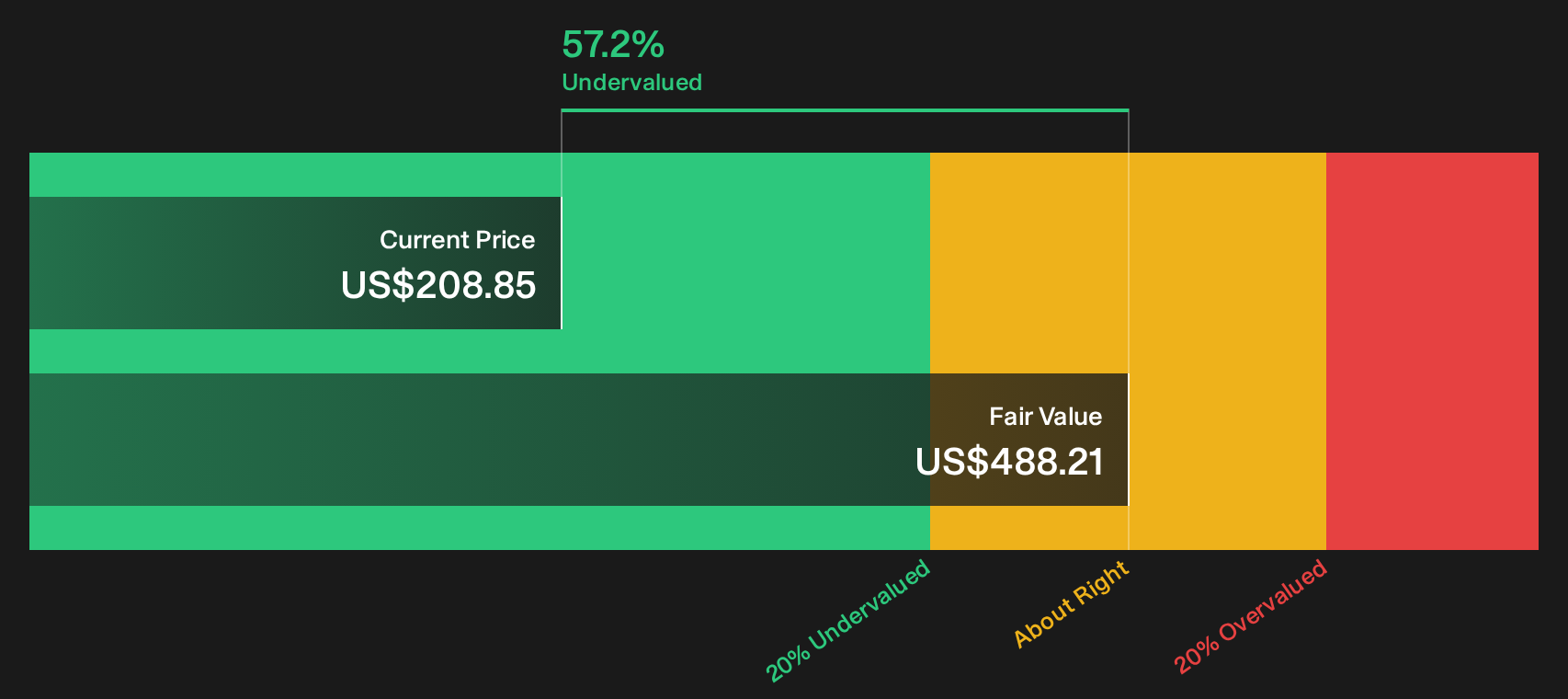
Here the market is attaching a richer multiple than the peer and industry averages, which suggests investors are willing to pay more per dollar of earnings. That sits alongside several data points, including high quality earnings, 10.4% annual profit growth over five years, net profit margins at 7.2% versus 6.7% a year ago, and a DCF estimate that places future cash flow value at $488.21 per share, or about 57.2% above the current price.
When you compare National HealthCare directly with the US Healthcare sector, the P/E gap is clear and runs in one direction. A 28.5x multiple against a 24.9x industry average indicates the stock carries a premium valuation that the wider market is not giving to the group as a whole.
See what the numbers say about this price — find out in our valuation breakdown.
Result: Price-to-earnings of 28.5x (OVERVALUED)
Still, the rich P/E and large gap to the SWS DCF estimate leave little room for error if National HealthCare faces reimbursement pressure or higher operating costs.
Find out about the key risks to this National HealthCare narrative.
Another view on National HealthCare’s value
On the flip side of that rich P/E, the SWS DCF model points to a future cash flow value of $488.21 per share for National HealthCare compared with the current $208.85 price. This suggests the stock screens as heavily undervalued based on that framework.
That is a wide gap for any investor to weigh. The key question becomes which signal you trust more when earnings quality, sector premiums and long term cash flow all point in slightly different directions.
Look into how the SWS DCF model arrives at its fair value.
Simply Wall St performs a discounted cash flow (DCF) on every stock in the world every day (check out National HealthCare for example). We show the entire calculation in full. You can track the result in your watchlist or portfolio and be alerted when this changes, or use our stock screener to discover 39 high quality undervalued stocks. If you save a screener we even alert you when new companies match - so you never miss a potential opportunity.
Next Steps
Mixed signals on National HealthCare’s valuation and fundamentals can push sentiment in either direction, so move quickly, test the numbers yourself and let the 2 key rewards and 1 important warning sign guide your next round of research.
Looking for more investment ideas beyond National HealthCare?
If National HealthCare has sharpened your focus on quality and valuation, do not stop here. Use the Simply Wall Street Screener to spot your next opportunity.
- Target reliable income by reviewing 8 dividend fortresses that may offer meaningful yield alongside resilient fundamentals.
- Hunt for potential mispricing by scanning 19 high quality undiscovered gems before other investors start paying attention.
- Prioritise financial strength by filtering for companies in the list of solid balance sheet and fundamentals (24 results) that could better handle shocks.
Have feedback on this article? Concerned about the content? Get in touch with us directly. Alternatively, email editorial-team@simplywallst.com