


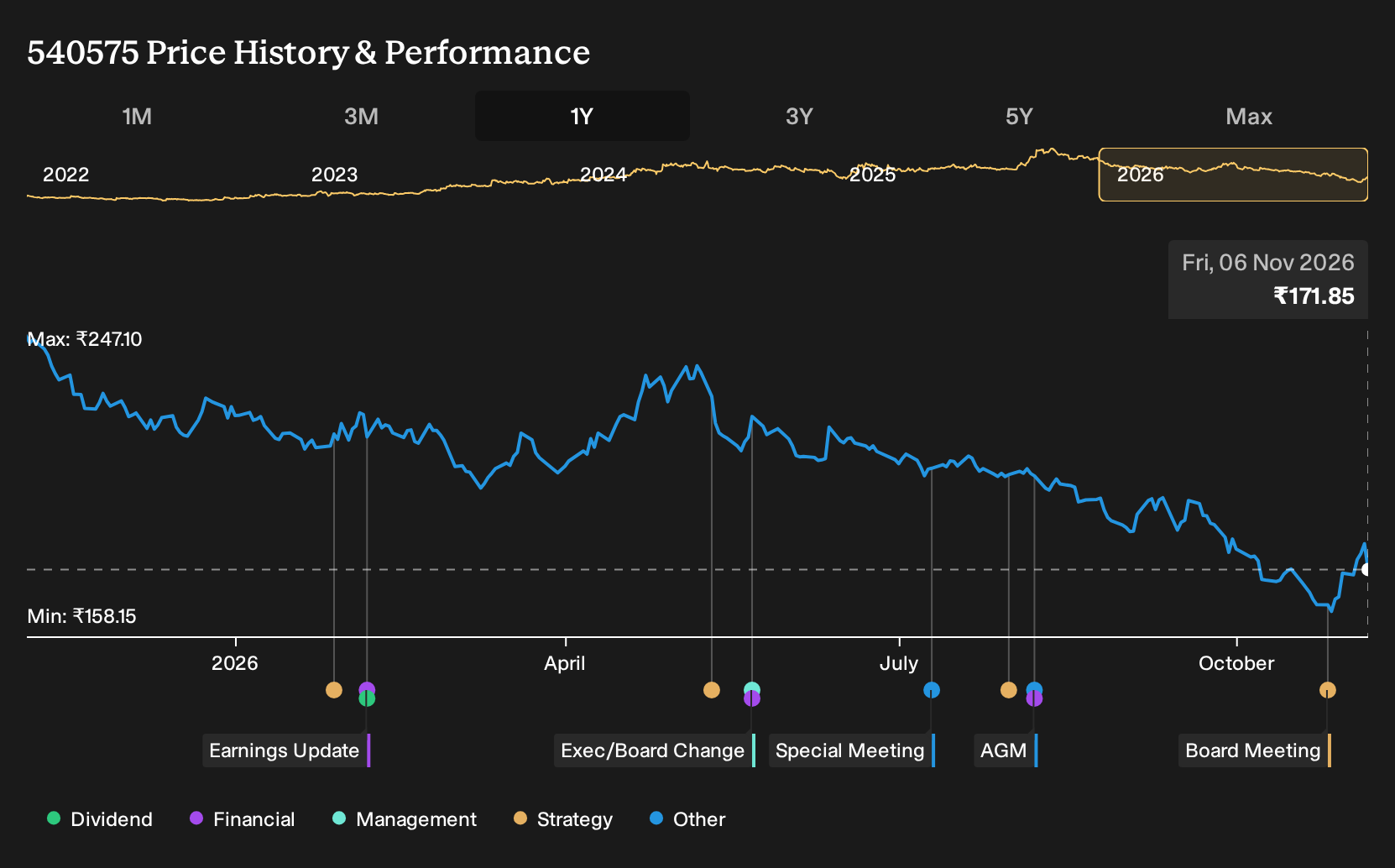
If you had looked at Star Cement in late 2025 and decided to pass because the debate between bullish expansion hopes and subsidy risk felt too messy, what exactly did you sidestep? Investors who held Star Cement over the past year are down 30.1%, including dividends. With fresh results now showing revenue at ₹9,428.889m but a lower net margin, which early warning sign or optimistic assumption would you focus on first?
If the move has made Star Cement harder to judge, start where the gap is still open and scan 224 high quality undervalued stocks.
The Argument You Would Have Been Weighing On Star Cement
The shares cost ₹246 at the start of the period, and anyone watching Star Cement had to choose which story felt more realistic.
The bullish narrative pinned a Fair Value of ₹275, a price implied by forecasts that rewarded aggressive expansion. It leaned on Northeast urbanisation and infrastructure demand, plus assumptions that revenue could compound and profit margins rise as green energy cut power costs.
The bearish view pointed to a Fair Value of ₹125, a much lower implied price driven by concern over subsidy dependence. It treated concentrated exposure to Northeast India and the risk of changing state incentives as potential pressure on future margins and earnings stability.
What The Results Changed For The Star Cement Debate
The clearest new fact for Star Cement is the Q1 2027 result. Revenue was ₹9,428.889m against ₹9,119.925m a year earlier, while net income slipped to ₹747.166m from ₹984.549m and net margin moved from 10.8% to 7.9%. That mix of higher sales but weaker profitability challenged the bullish margin story and supported the more cautious case.
The lesson is simple. When a thesis leans on operating leverage and cleaner energy to lift earnings, it is important to track net margin alongside revenue. If sales grow but profitability per rupee stalls or drops, treat the upbeat narrative as unproven until the margin line starts to move in the promised direction.
What You Would Be Paying For In Star Cement Today
Star Cement now trades at ₹172, after a 30.1% loss over the past year. The selected Narrative sees Fair Value above that level, built on a story of new capacity, broader geography and tighter costs rather than on subsidy support.
If you see the fall as a possible opportunity rather than a warning, the key assumption to test is whether expansion, green power and logistics can offset lower subsidies and tougher Northeast competition.
"The main factor that has to go right is that Star Cement offsets structurally lower subsidy income and potential Northeast price pressure by executing its cost optimisation, green power and logistics plans while scaling higher value trade and premium cement and building solutions volumes."
One Narrative has put a figure on that disagreement. → See the Narrative with its higher Fair Value, assumptions and all
Looking Beyond Star Cement
Star Cement stays focused on building materials you can see on site. You might also consider what supplies the metals inside that structure.
One large miner is targeting more copper, aluminum and lithium. Here, the interest lies less in cement demand and more in electrification and urban development.
These materials support power grids, electric vehicles and expanding data networks. The same group is pressing efficiency and cost discipline across its operations.
Large resource projects face ESG attention and community expectations. Depending on how that balance evolves, its importance in supplying critical inputs could shift significantly.
That argument has a Narrative and a number behind it. → See the company one Narrative values 20% above its price
Have feedback on this article? Concerned about the content? Get in touch with us directly. Alternatively, email editorial-team@simplywallst.com