


- Ecolab reported third quarter 2026 revenue of US$4,694.8 million and net income of US$551.3 million, with nine month revenue of US$13,176.3 million and net income of US$1,518.8 million.
- The business paired higher year to date sales with guidance for 12% to 14% reported sales growth in the fourth quarter of 2026 and highlighted ongoing demand across its portfolio.
- This article will examine how Ecolab's investment narrative around growth engines and margins interacts with the strong fourth quarter sales guidance.
Scan beyond Ecolab and compare its guidance story with a curated group of companies posting strong top line profiles in our 39 high quality undervalued stocks.
Ecolab Investment Narrative Recap
Ecolab appeals to shareholders who buy into the idea that compounding small efficiency gains across water, hygiene and pest control can support steady earnings over time. The third quarter showed solid revenue at US$4,694.8 million and slightly softer quarterly profit, so the near term question is how much operating leverage really shows up in the fourth quarter.
The short term catalyst is clear. Management is calling for 12% to 14% reported sales growth in the fourth quarter of 2026. This puts execution of the One Ecolab and growth engine story under the microscope. The biggest near term risk remains pressure on margins from higher input costs, heavy capital spending and softness in some industrial end markets.
The fourth quarter 2026 sales guidance looks most relevant here. Ecolab expects reported revenue to rise 12% to 14% in that period. This puts a spotlight on segments like Global Water, Institutional & Specialty, Pest and Life Sciences and how well value based pricing and volume hold up across each.
For you as an investor, that guidance ties directly to the key catalysts around One Ecolab, digital platforms such as 3D TRASAR and the margin potential in Life Sciences. Delivery against the fourth quarter target would help support the longer term goal of stronger operating margins and returns, although heavy capital expenditure and tariffs still hang over near term cash generation.
Ecolab's narrative projects US$20.7b revenue and US$3.3b earnings by 2029. This assumes 7.2% yearly revenue growth and an earnings increase of about US$1.2b from US$2.1b today.
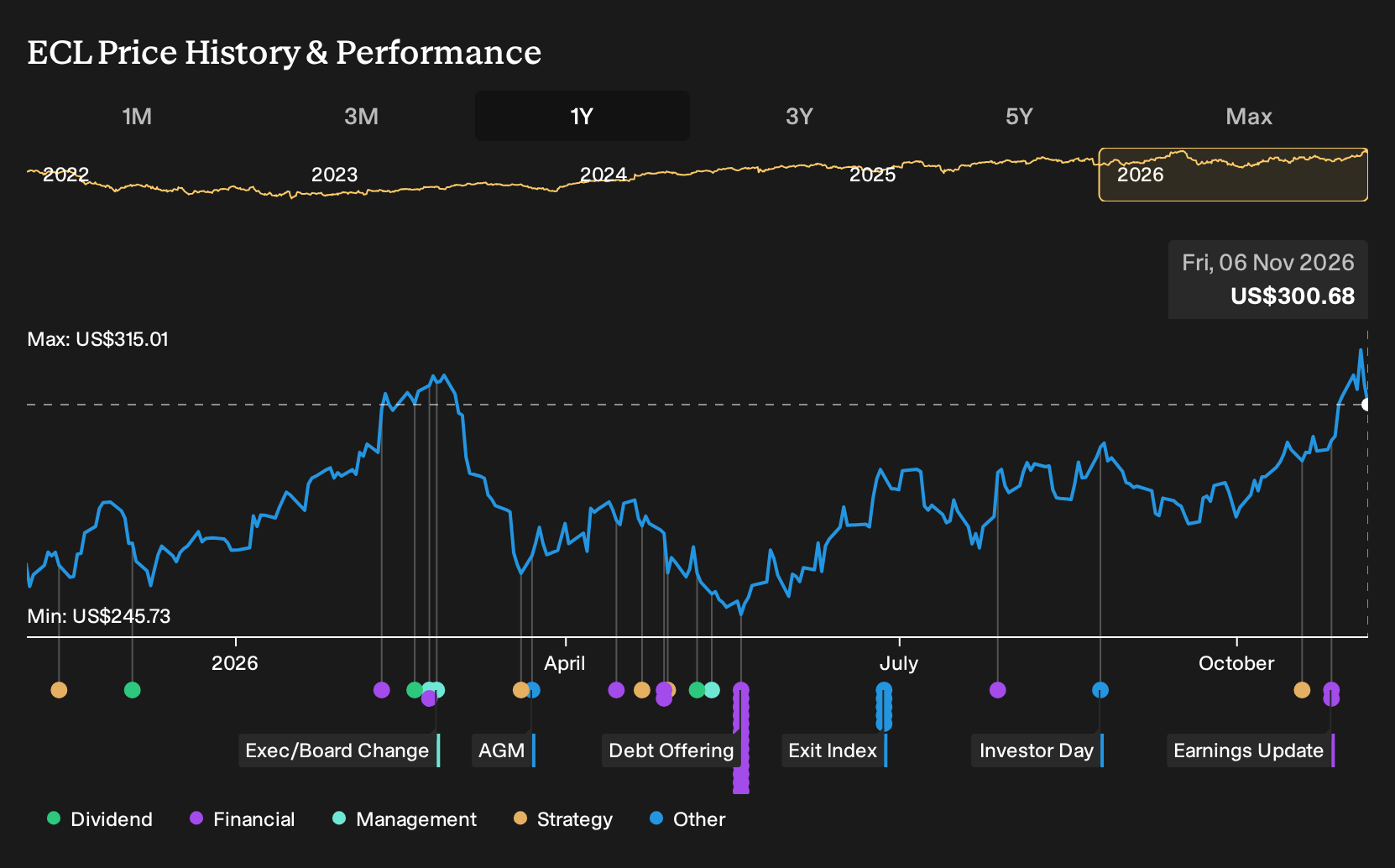
Uncover how Ecolab's fair value indicates an 8% potential upside to its current price before the market closes that gap.
Exploring Other Perspectives
Two fair value estimates from the Simply Wall St Community span roughly US$233 to US$325 per share, which is a wide gap for only a pair of views and shows how far apart private investors can be on Ecolab. When you set that against risks around tariffs, elevated capital spending and softer heavy industrial demand, you see why it pays to compare multiple viewpoints before leaning on any single narrative.
Explore another Ecolab fair value estimate, including one that suggests as much as 23% downside from the current price.
Decide For Yourself
Don't just follow the ticker. Dig into the data and build a conviction that's truly your own.
- A great starting point for your Ecolab research is our analysis highlighting 2 key rewards and 2 important warning signs that could impact your investment decision.
- See our latest analysis for Ecolab. The report includes a comprehensive fundamental analysis summarized in a single visual, the Snowflake, making it easy to evaluate Ecolab's overall financial health at a glance.
Looking For More Investment Ideas Beyond Ecolab?
If Ecolab's guidance and fair value debate has your attention, use that same curiosity to build a wider watchlist. The Simply Wall St Screener can help you quickly surface other candidates that fit different risk and income preferences.
- If capital preservation is your first filter, start with a set of 29 resilient stocks with low risk scores that score well on resilience and balance sheet strength.
- For investors who want income on top of potential price moves, scan for 8 dividend fortresses that combine higher yields with detailed payout data.
- When you want to broaden your horizon and see what else might be worth a closer look, run your eye over a 19 high quality undiscovered gems that currently sit off most investors' radar.
Have feedback on this article? Concerned about the content? Get in touch with us directly. Alternatively, email editorial-team@simplywallst.com