


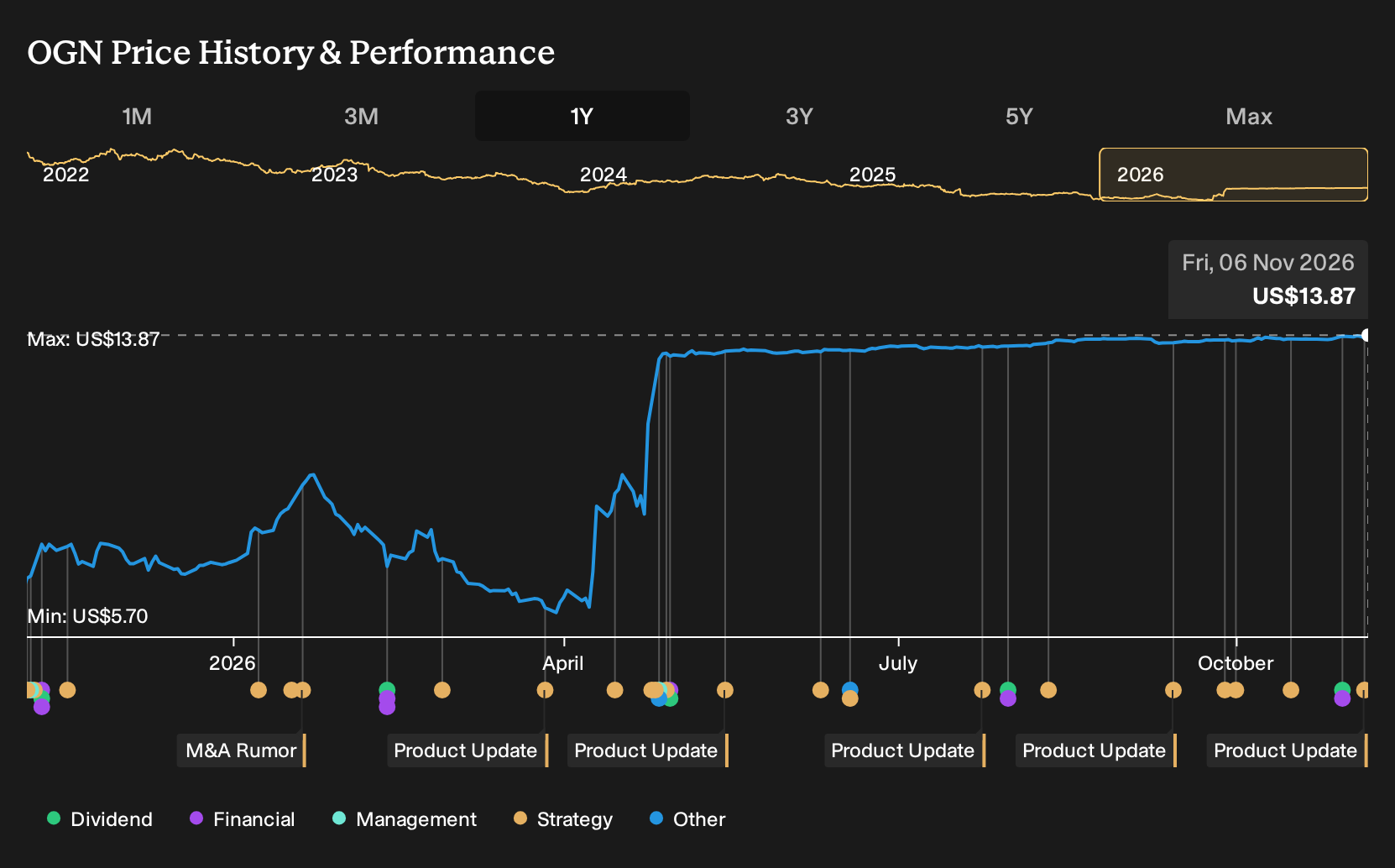
- Organon reported third quarter 2026 sales of US$1,574 million and net income of US$164 million, and declared a US$0.02 quarterly dividend payable in December 2026.
- Fresh real world data on HADLIMA’s switch from HUMIRA within the US Veterans Affairs system highlights how Organon’s biosimilar portfolio can influence payer costs and long term contract potential.
- The focus now shifts to how Organon’s investment narrative could change as investors weigh HADLIMA’s VA performance against existing expectations.
Organon Investment Narrative Recap
For Organon, the core belief as a shareholder is that women’s health, dermatology and biosimilars together can offset pressure from older off patent brands while cost controls keep earnings supported. The latest real world data on HADLIMA and the upcoming VTAMA Phase 3 subgroup analysis both feed into that effort but do not change the overall dependence on successful execution in these growth areas.
In the near term, the key swing factor is how efficiently Organon converts assets like VTAMA and HADLIMA into durable, reimbursed volume while keeping operating expenses in check. The biggest risk remains a drag from mature therapies, combined with interest costs that limit flexibility if newer products underperform expectations.
The VTAMA Phase 3 analysis being presented at the 2026 American College of Allergy, Asthma & Immunology meeting matters most here. It speaks directly to whether Organon can deepen VTAMA’s clinical story across different atopic dermatitis patient profiles, which can influence prescriber confidence and payer discussions for a franchise that still requires investment to scale.
For anyone watching catalysts, VTAMA sits alongside women’s health launches and the biosimilar portfolio as a key test of Organon’s ability to reshape its product mix. If the data support consistent efficacy across subgroups and safety remains aligned with the published adverse reaction profile, that supports the operational case for VTAMA as a more meaningful contributor over time.
Organon's narrative projects US$6.4b revenue and US$1.1b earnings by 2029, based on analyst assumptions of 1.7% yearly revenue growth and an increase in earnings of about US$891m from US$209.0m today.
Uncover why Organon's fair value indicates a 25% potential downside to its current price, leaving little room for error.
Exploring Other Perspectives
The lowest analysts lean hard into VTAMA execution risk. They were already modeling slower revenue progress, with only 1.1% annual top line growth and about US$6.3b in sales by 2029, plus around US$1.0b in earnings. You can treat this new subgroup data as a live test of whether that cautious Organon storyline still holds.
Explore 4 other Organon fair value estimates, including one that suggests as much as 42% downside from the current price.
Decide For Yourself
Disagree with existing narratives? Extraordinary investment returns rarely come from following the herd, so consider your own analysis carefully.
- A great starting point for your Organon research is our analysis highlighting 2 key rewards and 3 important warning signs that could impact your investment decision.
- See our latest analysis for Organon. The report includes a comprehensive fundamental analysis summarized in a single visual, the Snowflake, making it easier to evaluate Organon's overall financial health at a glance.
Looking for more Organon investment ideas?
If the Organon story has sharpened your view on risk, income and quality, it can help to test that thinking against a wider watchlist using the Simply Wall St Screener.
- For income focused investors who want yield with resilience, scan a curated set of 8 dividend fortresses that may help balance Organon in a portfolio.
- If capital preservation is front of mind, stress test your risk tolerance against a group of 29 resilient stocks with low risk scores that score well on stability factors.
- When you want something less crowded than Organon, cast a wider net across 19 high quality undiscovered gems that pair fundamentals with lower market attention.
Have feedback on this article? Concerned about the content? Get in touch with us directly. Alternatively, email editorial-team@simplywallst.com