


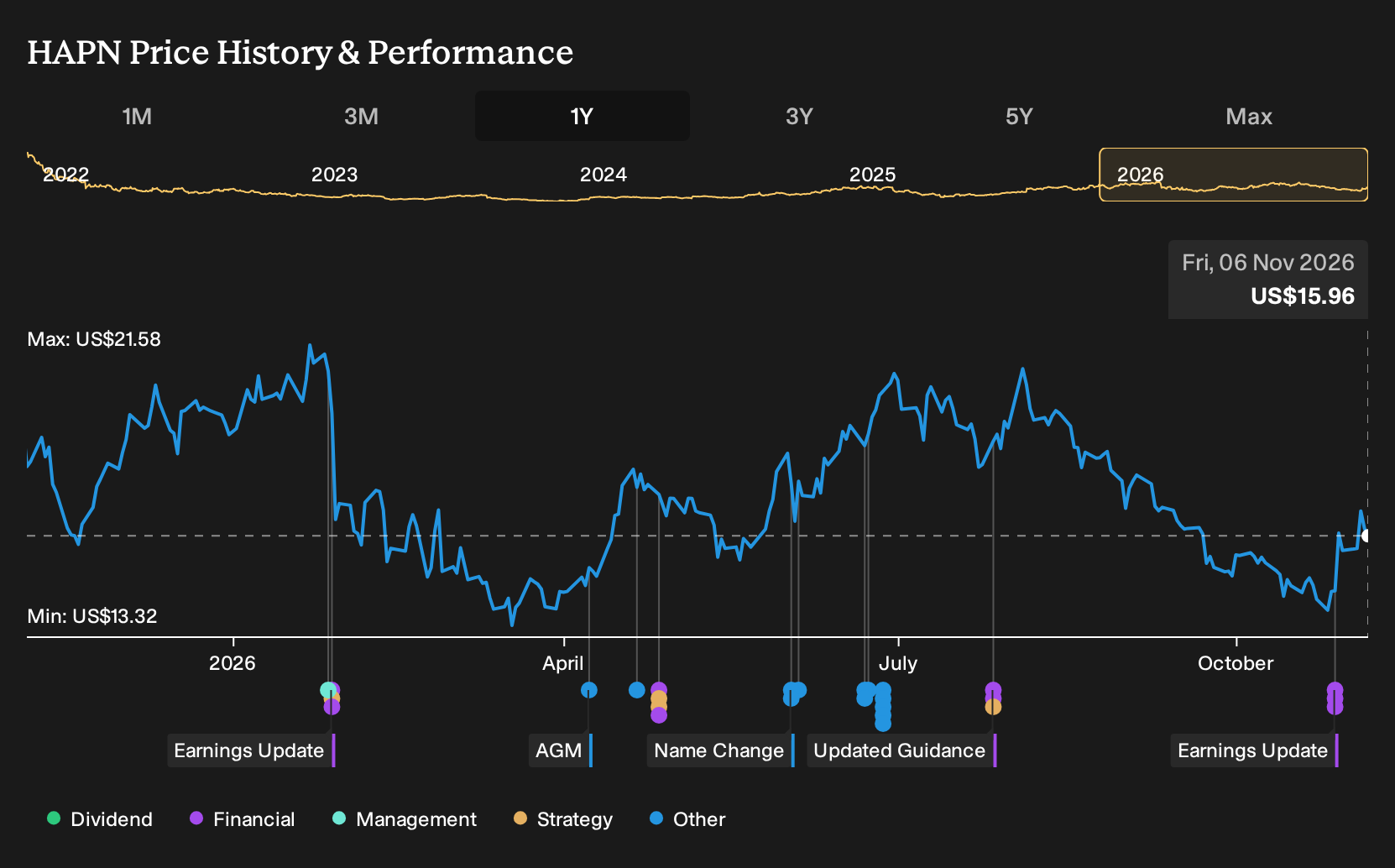
- Happen, Inc. reported third quarter 2026 net income of US$59.28 million and diluted EPS from continuing operations of US$0.50, and also issued fourth quarter guidance for diluted EPS of US$0.43 to US$0.48.
- The business raised full year 2026 diluted EPS guidance to US$1.87 to US$1.92 and completed a US$59.4 million buyback covering 3,537,635 shares, signaling a focus on unit margins and capital returns.
- Investors may now focus on how Happen's stronger EPS guidance and completed buyback program affect the investment narrative they rely on.
Scan how Happen's latest EPS guidance and buyback activity compare with other companies focused on earnings quality inside the 39 high quality undervalued stocks.
Happen Investment Narrative Recap
Owning Happen means believing the digital marketplace bank model can keep turning member growth, deposit funding and credit discipline into resilient earnings, even as personal loan demand and funding costs move around. The raised full year 2026 diluted EPS guidance relies on that mix holding together, with credit performance and unit margins doing the heavy lifting.
The near term swing factor is still whether management can balance originations, unit margins and funding so that earnings quality looks durable, not just accounting driven. The biggest risk remains cash generation and capital flexibility. If free cash flow stays weak while on balance sheet lending grows, that concern is not really addressed by this quarter.
The most relevant update here is Happen lifting full year 2026 diluted EPS guidance to US$1.87 to US$1.92. Management also framed that outlook around prioritising unit margins in an elevated rate backdrop, while still targeting 26% to 27% annual originations growth. That combination puts clear pressure on execution in the lending engine.
For you as a shareholder, that guidance ties directly into the key catalyst and the key risk. The upside case leans on the marketplace and deposit funded loan book converting into stronger earnings per share. The risk is that slower revenue progress, high non cash earnings and previously negative operating cash flow leave that EPS target exposed if conditions turn less favourable.
Happen's current earnings of US$195.6 million are matched against analyst projections for US$429.5 million of earnings on US$1.4b of revenue by 2029. This implies earnings a little over 2x higher than today, while revenue is expected to stay broadly flat over that period.
Uncover why Happen's fair value indicates a 55% potential upside to its current price, which could narrow quickly.
Exploring Other Perspectives
One alternate view on Happen puts the spotlight on cost pressure instead of earnings upgrades. The most bearish analysts were already assuming only 3.7% annual revenue growth to about US$1.6b and a lower 6.6x P/E on roughly US$440.0 million of 2029 earnings. That is a much harsher read on risk. These forecasts all pre date the latest EPS guidance, so you can treat them as a baseline set of expectations that may shift as fresh information feeds into different models and viewpoints.
Explore 2 other Happen fair value estimates, including one that suggests it could be worth just $24.75!
Form Your Own Verdict
Don't just follow the ticker. Dig into the data and build a conviction that's truly your own.
- A great starting point for your Happen research is our analysis highlighting 4 key rewards and 1 important warning sign that could impact your investment decision.
- See our latest analysis for Happen. The report includes a comprehensive fundamental analysis summarized in a single visual, the Snowflake, making it easy to evaluate Happen's overall financial health at a glance.
Looking For More Ideas Beyond Happen?
If you want to pressure test your Happen thesis against what else is out there, use the Simply Wall St Screener to line it up against other businesses with different risk and return profiles.
- For investors who want potential upside without ignoring balance sheet strength, scan a 19 high quality undiscovered gems that combines quality and less crowded stories.
- If capital preservation comes first for you, filter for steadier profiles using our 29 resilient stocks with low risk scores that screens for resilient companies with lower risk scores.
- When you care most about financial robustness and clean fundamentals, focus on companies filtered through the list of solid balance sheet and fundamentals (24 results) to narrow your watchlist to sturdier options.
Have feedback on this article? Concerned about the content? Get in touch with us directly. Alternatively, email editorial-team@simplywallst.com