


Regular readers will know that we love our dividends at Simply Wall St, which is why it's exciting to see Insecticides (India) Limited (NSE:INSECTICID) is about to trade ex-dividend in the next 3 days. The ex-dividend date generally occurs two days before the record date, which is the day on which shareholders need to be on the company's books in order to receive a dividend. The ex-dividend date is of consequence because whenever a stock is bought or sold, the trade can take two business days or more to settle. This means that investors who purchase Insecticides (India)'s shares on or after the 12th of November will not receive the dividend, which will be paid on the 5th of December.
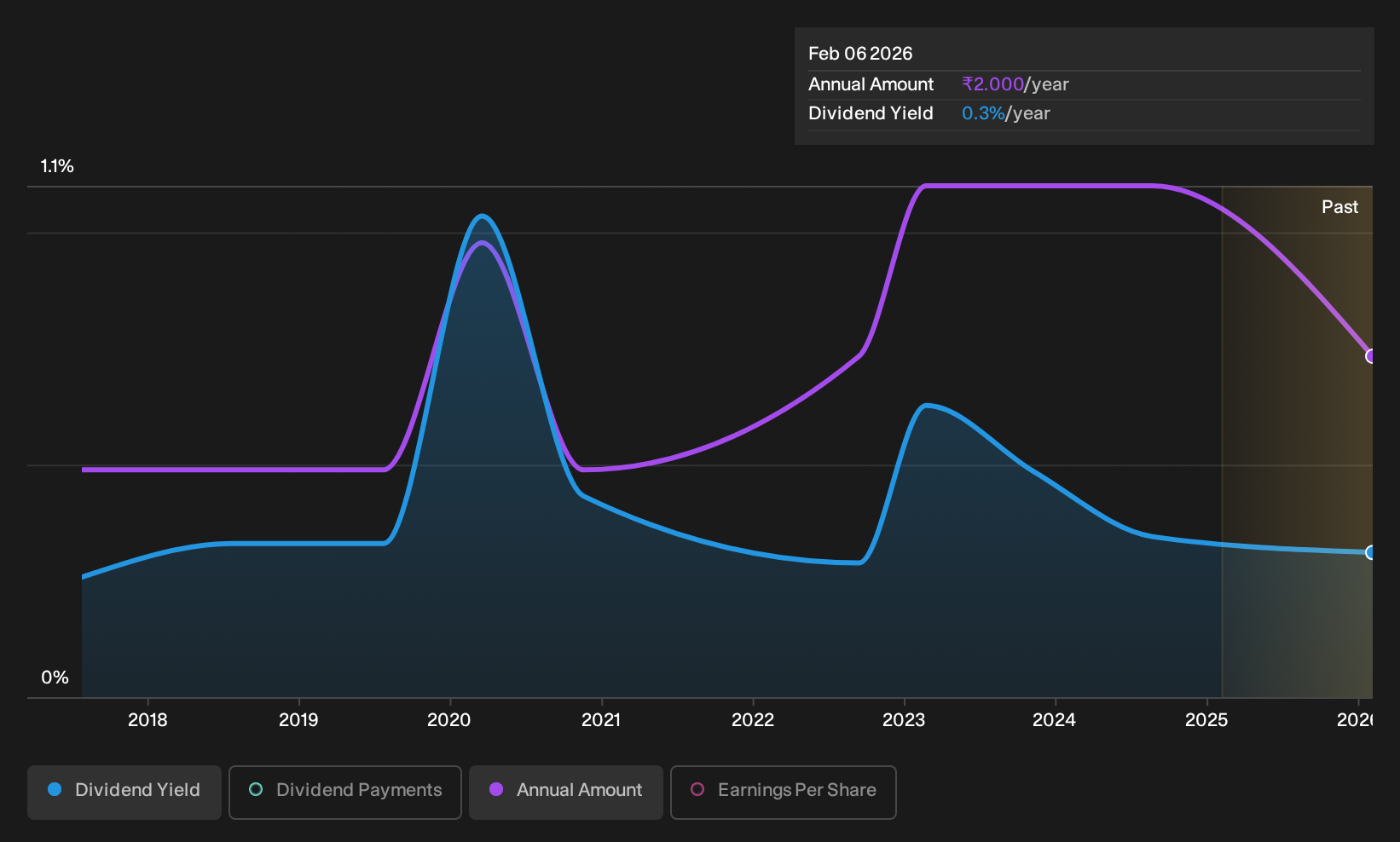
The company's upcoming dividend is ₹5.00 a share, following on from the last 12 months, when the company distributed a total of ₹2.00 per share to shareholders. Based on the last year's worth of payments, Insecticides (India) stock has a trailing yield of around 0.4% on the current share price of ₹545.00. If you buy this business for its dividend, you should have an idea of whether Insecticides (India)'s dividend is reliable and sustainable. That's why we should always check whether the dividend payments appear sustainable, and if the company is growing.
If a company pays out more in dividends than it earned, then the dividend might become unsustainable - hardly an ideal situation. Insecticides (India) is paying out just 4.2% of its profit after tax, which is comfortably low and leaves plenty of breathing room in the case of adverse events. Yet cash flows are even more important than profits for assessing a dividend, so we need to see if the company generated enough cash to pay its distribution. The good news is it paid out just 15% of its free cash flow in the last year.
It's positive to see that Insecticides (India)'s dividend is covered by both profits and cash flow, since this is generally a sign that the dividend is sustainable, and a lower payout ratio usually suggests a greater margin of safety before the dividend gets cut.
View our latest analysis for Insecticides (India)
Click here to see how much of its profit Insecticides (India) paid out over the last 12 months.
Have Earnings And Dividends Been Growing?
Businesses with strong growth prospects usually make the best dividend payers, because it's easier to grow dividends when earnings per share are improving. If earnings decline and the company is forced to cut its dividend, investors could watch the value of their investment go up in smoke. With that in mind, we're encouraged by the steady growth at Insecticides (India), with earnings per share up 6.8% on average over the last five years. Earnings per share have been growing at a decent rate, and the company is retaining more than three-quarters of its earnings in the business. This is an attractive combination, because when profits are reinvested effectively, growth can compound, with corresponding benefits for earnings and dividends in the future.
Another key way to measure a company's dividend prospects is by measuring its historical rate of dividend growth. Since the start of our data, 10 years ago, Insecticides (India) has lifted its dividend by approximately 4.1% a year on average. We're glad to see dividends rising alongside earnings over a number of years, which may be a sign the company intends to share the growth with shareholders.
To Sum It Up
From a dividend perspective, should investors buy or avoid Insecticides (India)? Earnings per share have been growing moderately, and Insecticides (India) is paying out less than half its earnings and cash flow as dividends, which is an attractive combination as it suggests the company is investing in growth. It might be nice to see earnings growing faster, but Insecticides (India) is being conservative with its dividend payouts and could still perform reasonably over the long run. There's a lot to like about Insecticides (India), and we would prioritise taking a closer look at it.
In light of that, while Insecticides (India) has an appealing dividend, it's worth knowing the risks involved with this stock. For example - Insecticides (India) has 1 warning sign we think you should be aware of.
A common investing mistake is buying the first interesting stock you see. Here you can find a full list of high-yield dividend stocks.
Have feedback on this article? Concerned about the content? Get in touch with us directly. Alternatively, email editorial-team (at) simplywallst.com.