


- Mastercard reported third quarter 2026 sales of US$9,807 million and net income of US$4,628 million, while continuing to buy back shares and extend its digital payments reach through efforts such as Samsung Pay in Morocco and a new embedded B2B payments partnership with Tech Mahindra.
- The combination of higher recent earnings, expanding tokenization driven services, and ongoing capital returns highlights how Mastercard is trying to deepen its role across both consumer and enterprise payment flows.
- We will now look at how Mastercard's strong recent earnings and Samsung Pay expansion may influence the broader investment narrative.
Scan how Mastercard’s push into tokenized mobile payments and embedded B2B flows compares with peers using our hand picked 53 AI infrastructure stocks shaping the rails behind digital commerce.
Mastercard Investment Narrative Recap
To own Mastercard, you need to believe its role in digital payments, security and data services stays central even as real time rails and local schemes grow. The current story leans on high margin value added services, tokenized payments and new flows like B2B, with Q3 2026 results showing that earnings and net margins remain an operational focus.
In the near term, the key catalyst is execution on tokenization and embedded payments, including Samsung Pay in Morocco, while keeping cross border volumes healthy. The biggest risk remains regulatory and competitive pressure on fees and card rails. The recent news does not materially change that risk balance and instead reinforces Mastercard’s digital push.
The October 2026 earnings release is the most relevant backdrop for the Samsung Pay launch. Net revenue of US$9,807 million and net income of US$4,628 million in Q3 set the financial context for Mastercard’s push into tokenized wallets and B2B flows. These figures provide the basis for ongoing investment into security, AI driven services and tokenization infrastructure.
For catalysts, that October update ties directly to value added services already representing a large share of Mastercard net revenue. The Samsung Pay rollout in Morocco sits on those same tokenization rails. Execution on this kind of project is what could underpin higher margin services tied to the network, while competitive and regulatory threats to card economics stay in the foreground.
Mastercard's narrative projects US$51.9b revenue and US$24.2b earnings by 2029. This is based on analysts assuming 12.6% yearly revenue growth and an earnings increase of about US$7.2b from US$17.0b today.
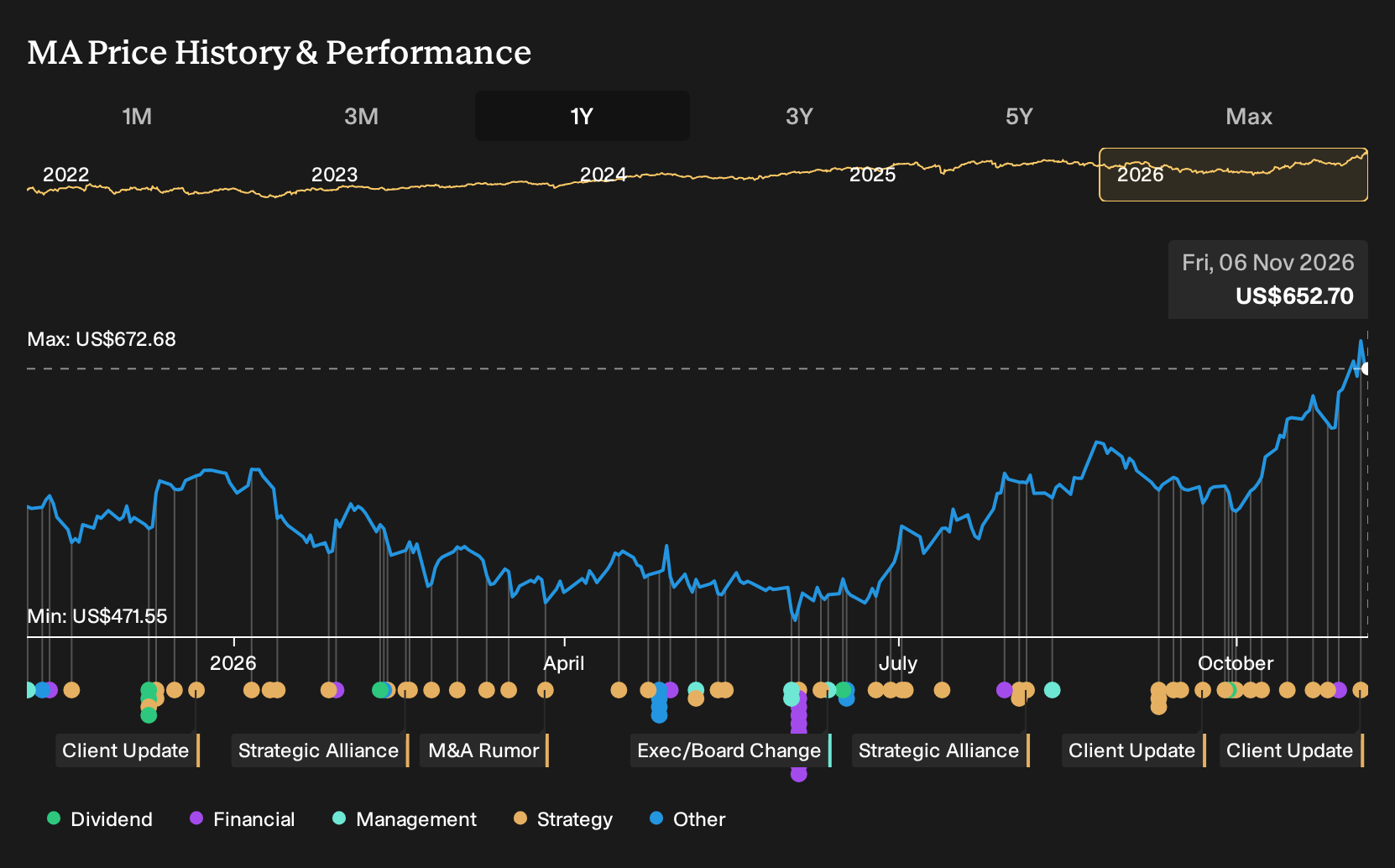
Uncover how Mastercard's fair value indicates a 5% potential upside to its current price, before the gap closes and the discount fades.
Exploring Other Perspectives
The 21 fair value estimates from the Simply Wall St Community span roughly US$520 to about US$834 per share, so some retail investors see Mastercard as heavily discounted while others lean toward a rich appraisal. When this is set against regulatory threats like alternative payment rails and card fee scrutiny, it results in a wide dispersion of expectations. Investor opinions can differ sharply, so it makes sense to review several of these community viewpoints before deciding how Mastercard fits your portfolio story.
Explore 20 other Mastercard fair value estimates, including one that suggests as much as 20% downside from the current price!
Reach Your Own Conclusion
Don't just follow the ticker; dig into the data and build a conviction that's truly your own.
- A great starting point for your Mastercard research is our analysis highlighting 3 key rewards and 2 important warning signs that could impact your investment decision.
- See our latest analysis for Mastercard. The report includes a comprehensive fundamental analysis summarized in a single visual, the Snowflake, making it easy to evaluate Mastercard's overall financial health at a glance.
Looking for more investment ideas beyond Mastercard?
Once you have a view on Mastercard, it can help to widen the lens and compare it with other businesses that share similar qualities, whether you care more about value, resilience, or income.
- If you are hunting for companies that look attractively priced relative to their fundamentals, scan our hand picked 36 high quality undervalued stocks that might merit a place on your watchlist.
- For a focus on durability and balance sheet strength, sort through a list of solid balance sheet and fundamentals (25 results) and see which businesses line up with your risk comfort.
- Income focused investors can cast a wider net across reliable payers by reviewing our curated 7 dividend fortresses that prioritize yield alongside underlying business quality.
Have feedback on this article? Concerned about the content? Get in touch with us directly. Alternatively, email editorial-team@simplywallst.com