


The “blue tsunami” washed over Washington, and Wall Street is weighing what comes next. This phrase describes a sweeping Democratic election victory, with blue representing the party’s traditional political color. As of November 4, Democrats had secured 54 Senate seats and 238 House seats, exceeding the 218 needed to control the House, with several races still undecided.
Those gains put Democrats in control of Congress for the final two years of President Donald Trump’s term, setting the stage for a divided government. The implications extend to technology, where UBS strategists say the political shift could bring greater scrutiny of AI and data center development. State and local officials also retain considerable influence over the permits, utilities, and electricity prices that shape these projects.
That combination of political change and potential industry scrutiny brings Amphenol (APH) into focus through investment banking firm Evercore's “blue tsunami” stock-picking thesis. What makes the company stand out in this political moment, and could its shares offer an opportunity worth considering? Let’s take a closer look.
Why APH Fits Evercore’s Blue Tsunami Thesis
Amphenol designs, manufactures, and sells electrical, electronic, and fiber optic connectors, interconnect systems, antennas, sensors, and specialty cables. These products transmit power, signals, and data, giving the company a role in the infrastructure supporting modern electronics.
Evercore’s case for Amphenol centers on diversification, rather than immunity from political risk. The firm warns that Democratic control of Congress could bring more restrictive rules around data center development, potentially weighing on sentiment toward AI infrastructure stocks. Its analysts distinguish that initial market reaction from the more consequential question of whether policy changes actually weaken business fundamentals.
Amphenol offers a way to retain AI exposure without relying entirely on that market. Evercore points to increasing signal, power, and optical content alongside strong defense, commercial aviation, and industrial businesses. That combination reduces dependence on any single AI architecture or customer base, making APH a broader bet than a company whose prospects hinge on one technology platform or spending cycle.
Evercore argues that Amphenol has navigated historical fluctuations better than most peers, making it a preferred holding if conditions deteriorate. Its defensive appeal therefore rests on business breadth and execution through changing conditions.
The implication for APH is that its investment case could remain intact even if enthusiasm for AI infrastructure cools. Evercore sees a way to retain exposure to AI growth while reducing reliance on that theme alone. However, the recommendation does not establish that political changes will increase Amphenol’s sales, prevent share price declines, or make the stock attractive at every valuation.
Where Amphenol’s Business Stands Today
Amphenol’s earnings, released October 28, showed third-quarter revenue rising 65.1% annually to $10.23 billion, beating the $9.53 billion consensus by 7.4%. Its adjusted earnings of $0.80 per share exceeded the $0.73 forecast by 9.5%. The operating margin expanded to 29.5% from 27.5%, reflecting improved profitability alongside the sales growth.
That performance was supported by AI data center demand, record bookings, and acquisition integration, particularly CommScope. Amphenol also recorded organic growth above 20% in five of seven end markets, demonstrating the breadth of demand across its businesses.
The results provide context for the stock’s recent performance. Its shares traded at $79.01 on November 4, up 16.93% year to date and 15.60% over 52 weeks.
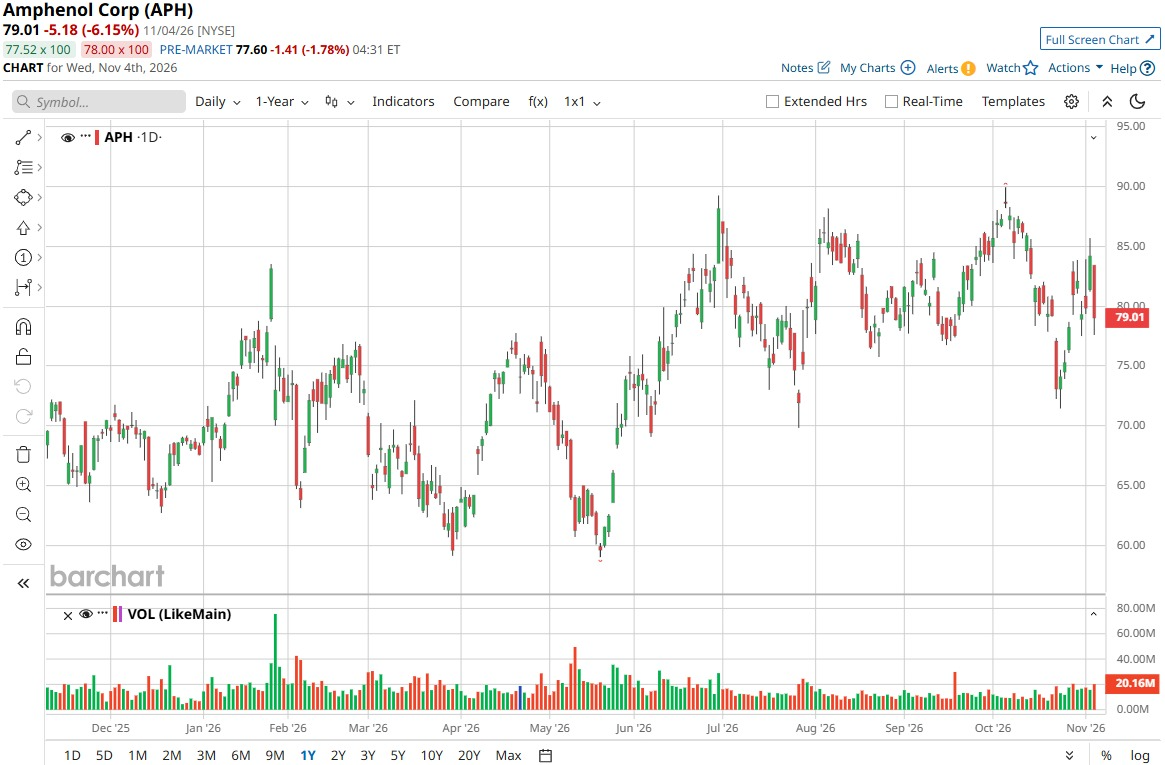
APH’s market value stood at approximately $207.89 billion, while its $0.50 annual dividend yielded 0.63%.
Amphenol is expanding its business base further through an agreement announced Oct. 28 to acquire AdvancedPCB. The company supplies circuit boards for defense, aerospace, and industrial applications from six U.S. facilities, with completion subject to regulatory approvals and customary conditions.
The broader growth outlook calls for fourth-quarter revenue of $10.4 billion at the midpoint, 6.1% above the $9.80 billion consensus. Its full-year adjusted earnings midpoint of $2.83 exceeded expectations by 5.2%.
Amphenol expects continued organic growth, margin improvement, and acquisition contributions, supported by technology investment and diversified demand. Craig Lampo, Chief Financial Officer, highlighted operating leverage and disciplined capital allocation as support for margins despite automation and technology spending, while management expressed confidence in lasting demand for electronics content.
What Wall Street Expects From APH Next
Amphenol’s next earnings report, scheduled for January 27, 2027, will give Wall Street a chance to see whether its strong growth has continued. Analysts expect earnings of $0.82 per share for the quarter ending December 2026, up 67.35% from $0.49 a year earlier.
That optimism follows a strong second quarter, when record sales and better-than-expected earnings prompted UBS analyst Joseph Spak to raise his price target to $197 from $185 on July 30. He kept his “Buy” rating, citing demand across AI, data centers, and defense.
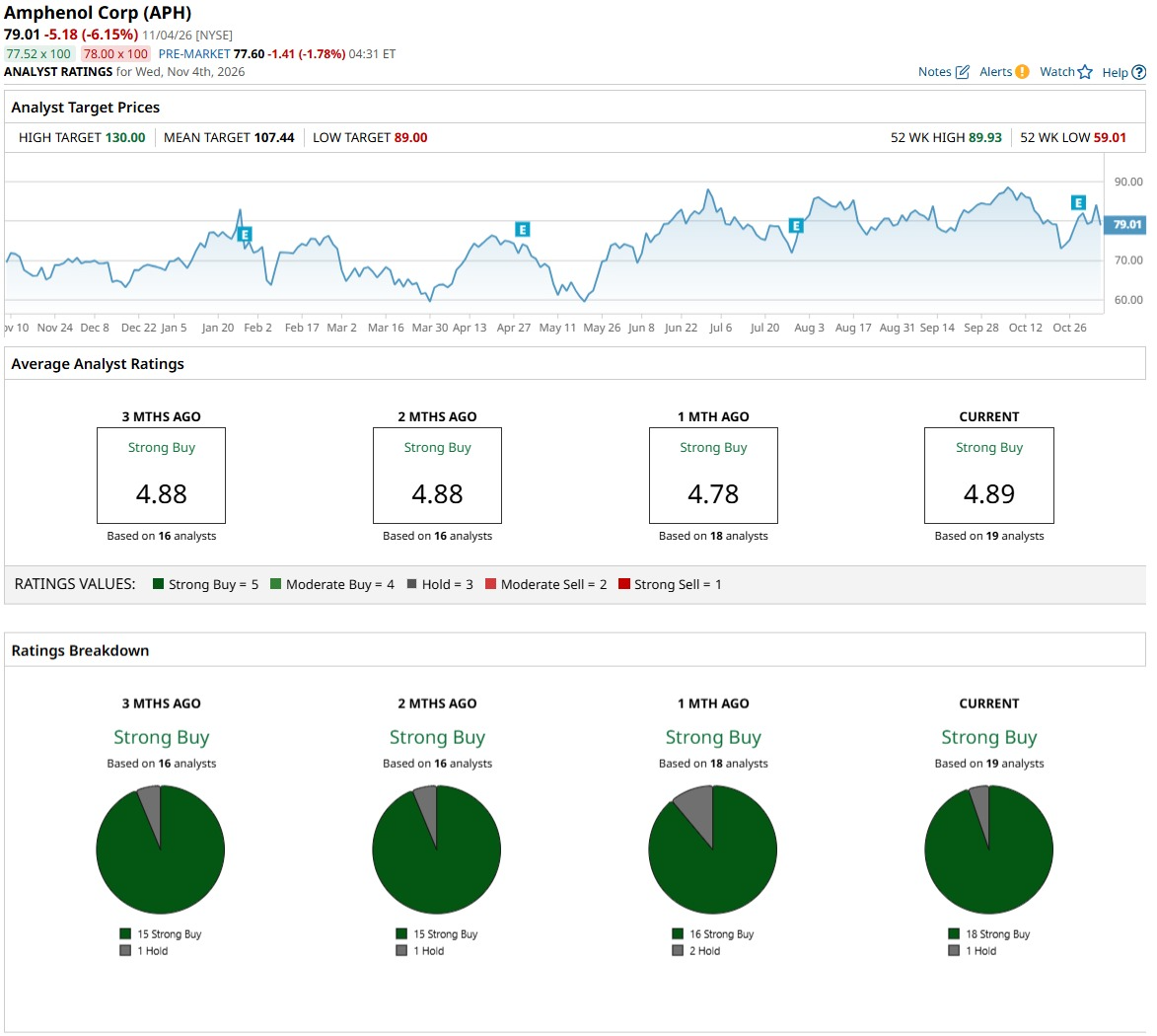
The broader analyst outlook is positive too. APH carries a consensus “Strong Buy” rating from 19 analysts. Their average target of $107.44 points to a potential gain of 35.56% from $79.01.
Conclusion
Evercore’s case makes sense because Amphenol offers AI growth backed by demand from other industries. That gives APH a credible place among its preferred stocks as Washington changes course. Continued earnings growth looks more likely than a lasting slowdown, provided demand holds and acquisitions deliver. The shares could move higher as results support that outlook, although political uncertainty may make the ride uneven. APH looks worth considering, with business performance rather than election headlines ultimately deciding where it goes next.
On the date of publication, Ebube Jones did not directly have a position in any of the securities mentioned in this article. All information and data in this article is solely for informational purposes. For more information please view the Barchart Disclosure Policy here.