


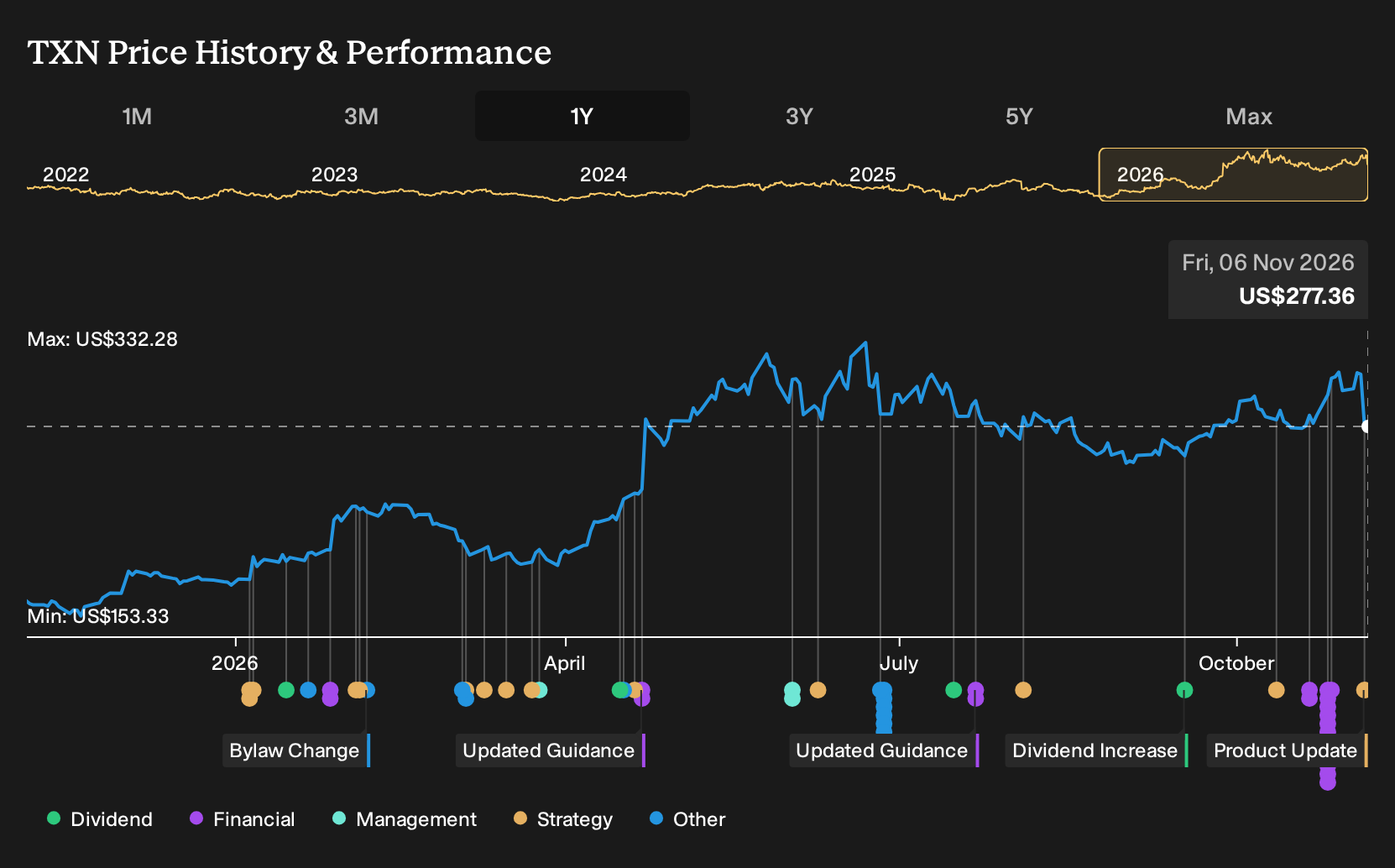
If Texas Instruments looked balanced on a knife edge in late 2025, the last twelve months made that call feel far weightier than it seemed at the time. Holding Texas Instruments over the past year would have returned 76.5%, including dividends. If you had been weighing domestically built 300mm fabs, rising AI power demand and fresh worries over US China friction on 6 November 2025, which of those threads would have mattered most to your decision?
The useful thing about a Narrative is that the reasoning is checkable: the assumptions sit beside the argument, and together they imply an estimated Fair Value you can disagree with.
This theme extends beyond Texas Instruments. See which of 41 power grid technology and infrastructure stocks may still merit a closer look.
The Two Texas Instruments Stories Investors Were Arguing About
The shares cost US$161 at the start of the period, which put Texas Instruments between two sharply different stories about what might come next.
On the optimistic side, the October 2025 Narrative pinned Fair Value at US$206, or 27% above the start price. That view leaned on industrial automation and automotive chip demand, as well as U.S. 300mm fabs and tax incentives that analysts thought could support higher gross margins and cash generation.
The May 2025 bear case set Fair Value at US$125, or 23% below the start price. It focused on maturing analog and embedded markets, rising regulatory costs, and the risk that heavier U.S. China trade frictions could restrict access to important overseas customers.
What The Texas Instruments Evidence Put To The Test
Texas Instruments delivered Q3 2026 revenue of US$6.1b versus US$4.7b a year earlier, while net income moved from US$1.4b to US$2.4b and net margin rose from 28.6% to 39.8%. Strong AI driven data center and industrial demand plus 300mm fab capacity clearly leaned toward the optimistic industrial and automotive story, although insider selling left the cautious case alive on governance and valuation risk. The evidence mainly supported the optimistic case.
The key question was whether higher capital spending and domestic 300mm fabs would result in cash rich, higher margin quarters. When you look at another chipmaker with a similar story, start by checking revenue, absolute profit and net margin one year on from the capex ramp.
What Texas Instruments' Rally Already Assumes
Texas Instruments now trades at US$277, with this Narrative’s Fair Value set below that level. The cautious angle is less about recent results and more about how much future strength is already baked into that price.
The Narrative turns on whether heavy 300mm fab spending and strong recent demand truly convert into long term cost advantages and cash generation. A buyer today is effectively assuming that high utilization and resilient end markets offset depreciation pressure and any softer industrial or automotive orders.
"Although Texas Instruments highlights long term cost and supply benefits from its more than US$20b 300mm U.S. fab buildout and higher internal production, the July 2026 concerns about rising depreciation and the potential for weaker industrial and automotive demand suggest the expanded footprint could compress gross margins and limit the uplift to net earnings if utilization falls short of expectations."
That disagreement has a full argument behind it. → Uncover the lower Fair Value this Narrative argues for
Looking One Step Beyond Texas Instruments
Texas Instruments points you to chips and factories, but that is only part of the picture.
AI servers, cloud tools and industrial systems do not work in isolation. They need data moved, stored, secured and kept talking reliably across complex networks.
Another business concentrates on that digital plumbing. It supplies hardware and software that help large customers connect, route and protect information.
That shift from pure semiconductors to broader infrastructure changes the story. You are not just asking who makes the chips anymore.
You are asking who keeps the whole stack running when everything depends on constant communication.
The argument comes with a number attached. → Uncover the AI infrastructure company trading 55% below one Narrative's Fair Value
Have feedback on this article? Concerned about the content? Get in touch with us directly. Alternatively, email editorial-team@simplywallst.com