


AI data centers are quietly turning into some of the hungriest carbon and emissions engines on the planet, and that tug of war between digital growth and physical pollution is creating fresh pressure on companies tied to carbon capture, methane tracking and emissions reporting. If you care where AI-linked energy money flows next, this is your moment. Ahead, you will see 3 stocks that illustrate how this story is starting to play out in markets.
The three example stocks you are about to see are only a starter set, and the full screen on Simply Wall St surfaced 3 more AI linked carbon and emissions management providers with equally interesting stories that are not covered below. To identify potential leaders in this theme and analyze which ones best fit your own thesis, head straight into the AI-Linked Carbon & Emissions Management Providers screener.
Mistras Group (MG)
Overview: Mistras Group provides inspection, monitoring, maintenance, and testing services that help heavy industry, power assets, and data centers keep critical equipment safe, efficient, and compliant.
Operations: Mistras Group generates about $605 million in North America, $150 million internationally, and $15 million from products and systems, with corporate eliminations reducing the total.
Market Cap: US$642 million
Mistras Group sits at the intersection of aging energy infrastructure, rising AI-driven power demand, and growing pressure on operators to measure what they emit as carefully as what they produce.
"Mistras Group is positioned to capitalize on accelerating customer demand for integrated digital asset monitoring and predictive analytics, with recent double digit growth in PCMS asset integrity software and continued new customer wins and site expansions supporting higher margin software revenue and improved earnings quality."
What happens to those higher margin ambitions if a single unseen pressure on emissions-focused inspection budgets intensifies faster than customers expect?
If that pressure is building faster than budgets, read the full narrative for Mistras Group to see how those forces could reshape returns, risk, and pricing power.

Gevo (GEVO)
Overview: Gevo is a carbon abatement business that produces low carbon fuels, renewable natural gas, and tracking software that large emitters can use to cut and verify emissions.
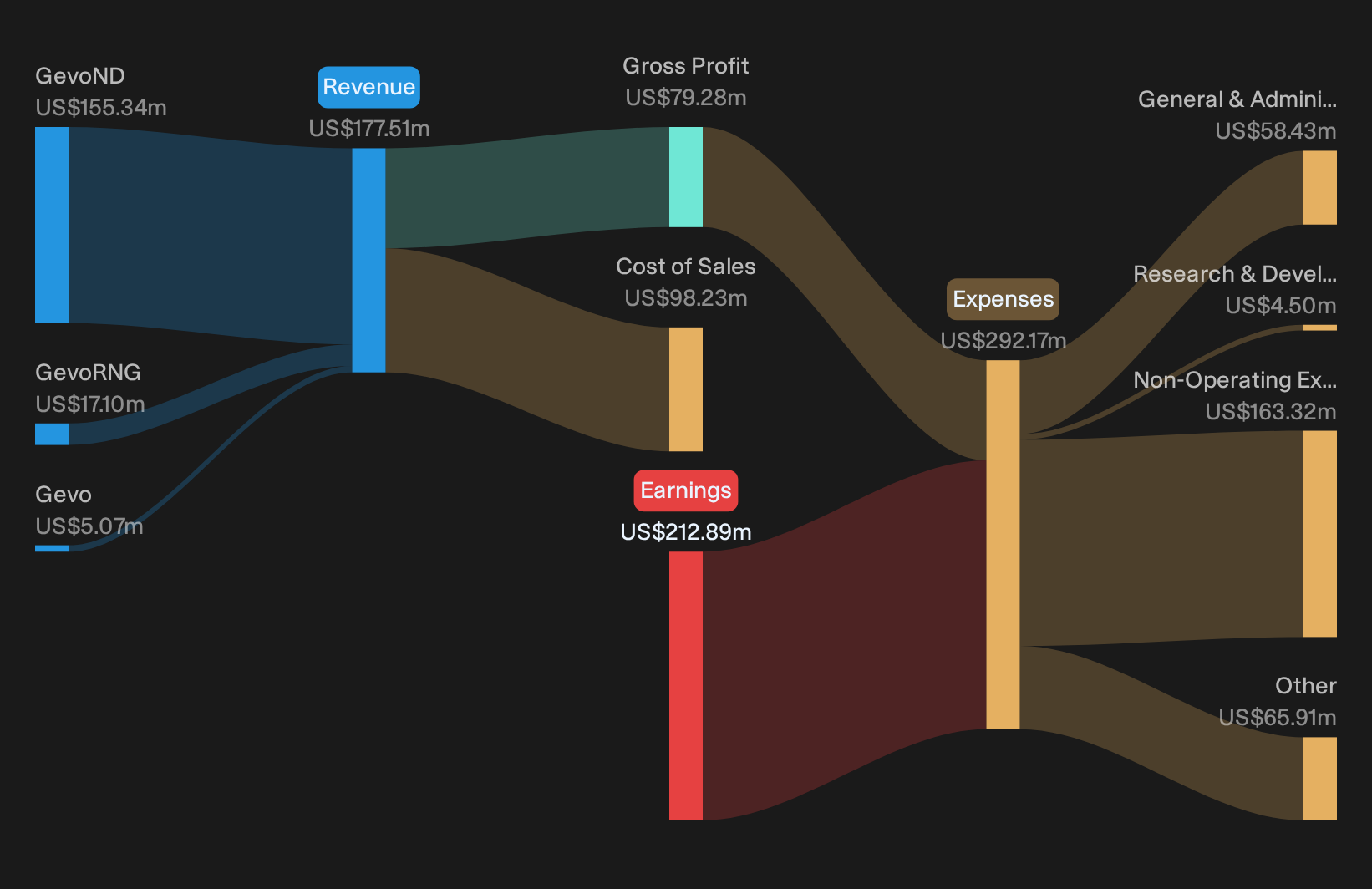
Operations: Gevo generates about $155 million from GevoND, $17 million from GevoRNG, and $5 million from the Gevo segment.
Market Cap: US$333 million
Gevo sits squarely in this theme because it sells concrete emissions reduction tools, from sustainable fuels to MRV software. Heavy energy users may need these tools as AI data center emissions climb.
"Monetization and growth of high-integrity carbon dioxide removal (CDR) credits and clean fuel production tax credits (CFPCs), enabled by Gevo's uniquely certified carbon sequestration site, provide new stable, high-margin revenue streams and cost offsets that are expected to meaningfully lift recurring net income and reduce volatility."
The real question is what happens if one policy or market shift changes how much value buyers place on those low carbon attributes.
If that value suddenly compresses or accelerates, the full narrative for Gevo shows how Gevo's credits, fuel mix, and policy risk could reshape the whole opportunity set.
KBR (KBR)
Overview: KBR delivers engineering, technology and digital solutions for governments and energy clients, with a growing focus on decarbonization and emissions-cutting infrastructure.
Operations: KBR generates about US$5.4b from Mission Technology Solutions and US$2.4b from Sustainable Technology Solutions, with sizeable exposure to the United States, Europe and the Middle East.
Market Cap: US$4.69b
KBR is relevant to this AI-linked carbon theme because its engineering work increasingly targets cleaner fuels, lower emission facilities and digitally monitored infrastructure for energy-intensive customers.
"Accelerated investment in energy transition and infrastructure, especially in regions such as the Middle East and emerging markets, continues to feed into KBR’s record Sustainable Technology Solutions backlog of about US$5.5b in Q2 2026 and a book to bill above 1x, which supports future revenue and earnings as this work converts."
What happens to KBR’s earnings quality if one key assumption about how efficiently that backlog turns into higher margin work starts to shift?
If that efficiency starts to decouple from expectations, the full narrative for KBR outlines how KBR’s backlog, margins and risk profile could change as energy transition spending accelerates.

Seeking Alternatives Before They Fly
Fresh themes are breaking out while attention stays locked on yesterday’s winners. Momentum shifts quickly and is under the radar for now. Scan the next wave of ideas and look for opportunities early.
- Spot potential breakout charts with real balance sheet strength by running the 38 high quality undervalued stocks before those opportunities get fully priced in.
- Look for structural demand in electrification by tracking the 41 power grid technology and infrastructure stocks while these grid upgrade plays are still dropping in under many radars.
- Follow the next leg of AI momentum by scanning the 53 AI infrastructure stocks while the market is still catching up to the buildout story.
Have feedback on this article? Concerned about the content? Get in touch with us directly. Alternatively, email editorial-team@simplywallst.com