


The Zhitong Finance App learned that the US treasury bond market can be described as simultaneously receiving bullish support from strong safe-haven demand for capital under the collapse of global AI computing power themes, semiconductors, and a wide range of technology stocks, and a swarm of global capital under the cooling of fiscal expansion expectations and easing pressure on energy inflation. The strong non-farm payrolls data released last Friday has not even completely reversed the inflow trend brought about by these factors. According to the US Treasury's end-of-day yield, as of last Friday, November 6, the 10-year US Treasury yield was 4.86%. Although it rebounded 2 basis points on the same day after the non-agricultural announcement, it still fell 8 basis points throughout the week; 2-year and 30-year US bond yields were reported at 4.51% and 5.26%, respectively, down an average of 5 basis points throughout the week.
The entry of global capital finance into the US bond market is driving down US bond yields, to a large extent, meaning that capital is no longer fully dependent on fixed income asset investment demand brought about by continued weakening economic data — in the current financial market context, the US midterm election results changed the market's judgment on future fiscal stimulus, AI investment intensity, and the risk of inflation, and the long-term yield close to 5% has also made long-term returns of 10 years or more attractive.
Despite strong non-farm payrolls driving up yields on the same day, it still fell 8 basis points throughout the week, showing a reassessment of interest rate hikes due to the strong resilience of the US economy — market expectations for interest rate hikes in December and early next year continued to heat up after the announcement, which has yet to offset the increasingly strong support of safe-haven demand and adjustments in long-term inflation expectations for the bond market.
Capital allocation has also changed ahead of schedule: According to LSEG global market capital flow data, for the week ending November 4, the net inflow of global bond funds was US$9.10 billion, and the net inflow of US longer-term government bonds and treasury bond funds was US$2.66 billion, which shows that investors have begun to lock in higher long-term returns while increasing defensive allocations.
Ed Yardeni, a senior financial market strategist with the title of “Wall Street Prophet,” is optimistic about the strong buying power brought by US bond yields close to 5%. The core bullish basis is that productivity improvements driven by the world's most advanced AI technology such as AI agents may drive long-term inflation to continue to cool down, thereby increasing the consistent expectation of actual returns in the bond asset market.
As far as the global equity asset pricing system is concerned, if this 10-year US bond yield curve, which has the title of “the anchor of global asset pricing”, continues to move downward, it is expected to significantly reduce the risk-free interest/risk-free yield pressure on the valuation side of the stock market (that is, the “risk-free interest rate portion” on the denominator side of the DCF valuation model). In particular, the valuation pressure on AI computing power and semiconductors, which are expected to drastically reduce the recent sharp decline in AI computing power and the valuation pressure on semiconductors is even expected to drive AI financing costs into a continuous downward trajectory; if corporate profits also continue to grow resilient, the attractiveness of bond allocations The recovery opportunities for AI computing power, semiconductors, and global technology stocks in a broad sense may simultaneously increase. The next CPI and treasury bond auctions will test expectations of cooling inflation and whether bond market purchases can continue to support this revaluation.
The midterm elections impacted AI transactions and eased the heavy pressure on fiscal deficits, and the US bond market was strongly supported by the bullish army
Wall Street's senior strategists focusing on fixed income portfolios almost agree that the US Treasury bond market is becoming the beneficiary of the Democratic Party's big victory in the US midterm elections, which gives traders another reason to re-examine the sharp decline in the bond market this year.
The Democratic Party swept both houses of Congress and was viewed as an advantage by bond bulls. Previously, technology stocks plummeted due to market speculation that changes in the political landscape would put the brakes on the AI investment boom. This boom has been driving economic growth, increasing inflation, and boosting interest rates as companies issue large amounts of debt to finance investments.
A government pattern where the two parties separate executive and legislative powers will also prevent President Donald Trump from pushing for any major tax cuts or spending laws to be passed, thereby easing some of the market's concerns about the annual budget deficit. Currently, this deficit has reached 2 trillion US dollars, which is equivalent to about 6% of the size of the US economy.
Meanwhile, oil prices fell sharply because of market speculation that losing the Republican Party would speed up the process of ending the war in Iran. The energy shock caused by this war began a sell-off in the bond market eight months ago.
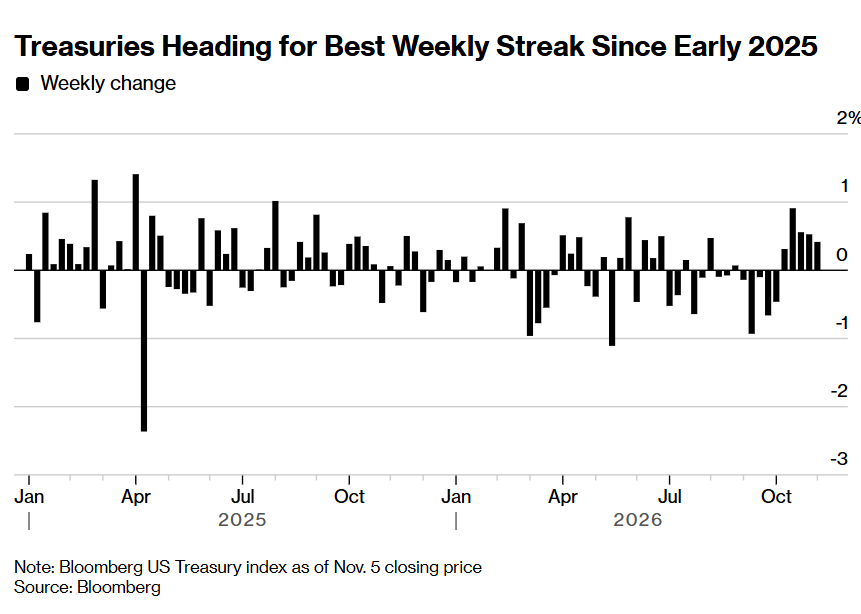
As shown in the chart above, the US Treasury bond market is expected to have the best continuous weekly upward performance since the beginning of 2025. Note: The Bloomberg US Treasury Index closed on November 5.
The market's reaction to the election results continued the rise in US Treasury bonds that continued for nearly a month, lowering the 10-year yield to close to 4.8%, down more than 0.5 percentage points from the high in early October. Even though the US Department of Labor report on Friday showed a significant acceleration in employment growth last month, the bond market generally maintained its weekly gains.
“AI has always been the biggest contributor to nominal GDP growth, so any kind of setback could benefit the bond market,” said Scott DiMaggio, head of fixed income at Lianbo. “Bonds provide a form of insurance: if the situation falters, interest rates still have a lot of room to decline.”
The rapid reversal of the bond market is reminiscent of the round at the end of 2023. At that time, the Federal Reserve ended a cycle of interest rate hikes, and bond yields fell sharply.
“The macro narrative has changed since the Democratic Party swept the election. Investors understood this result as a policy impasse and a likely trend of continued reduction in additional US fiscal deficit spending.” Alice Andres, a senior strategist on the Markets Live channel from Bloomberg's Strategists, said in a research report.
However, the magnitude of this round of increase has raised doubts among some analysts, because inflation is still far above the Fed's 2% target, and the market currently expects the Fed to resume raising interest rates next month.
Furthermore, over the years, the stock market has been plagued by concerns about the AI bubble from time to time, but as companies continued to invest heavily in this technology and investors entered the market to buy on dips, the stock market then rebounded again.
“Unless the stock market continues to fall sharply, I think this round of bond market growth has gone too far and too fast,” said John Briggs, head of US interest rate strategy in North America at the French Foreign Trade Bank.
The next test for the bond market will come on Tuesday, when the US will announce the consumer price index for October. Economists expect the data to show a slowdown in inflation from the previous month. However, since last year's government shutdown hindered data collection, the year-on-year data will not be released.
The US Treasury will also hold a quarterly refinancing treasury bond auction this week. The auction will begin with the issuance of 3-year treasury bonds on Monday, followed by the issuance of 10-year and 30-year treasury bonds on Tuesday and Thursday, respectively. The US bond spot market will be closed on Wednesday due to the Veterans Day holiday.
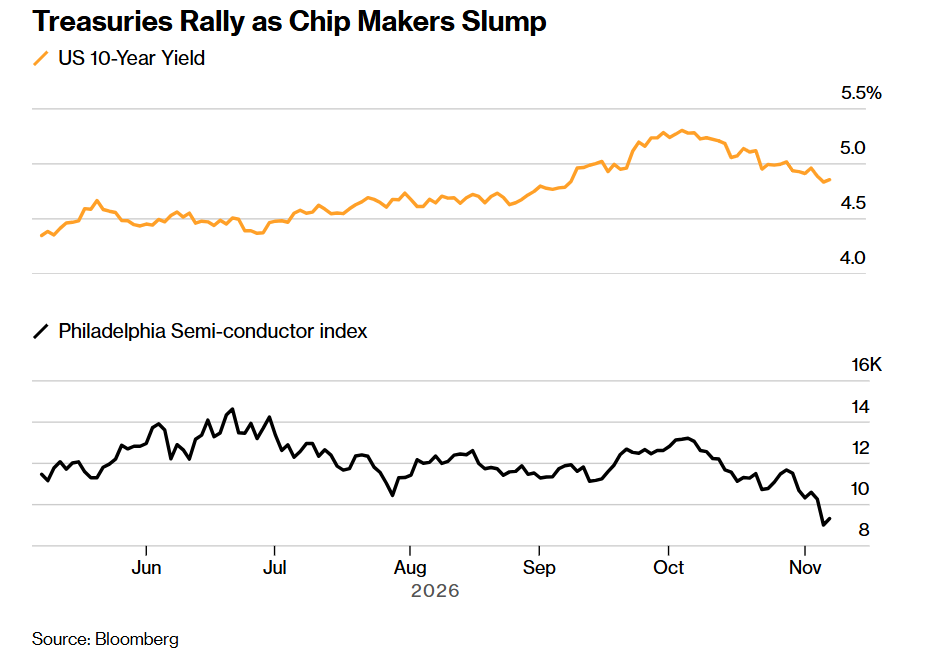
As shown in the chart above, the price of US Treasury bonds has accelerated as the stock prices of global chip makers and leaders in the AI computing power industry chain continue to fall.
The continued increase in the supply of new debt to cover the federal budget deficit may continue to put pressure on the market. Continued uncertainty about the Iran war, how much the Federal Reserve will raise interest rates, and what policies the new Democrat-led Congress will adopt will also affect the market.
However, considering that yields have previously risen to a high level and that Trump's power is now under new political checks and balances, investors still see the present as a good opportunity to lock in higher bond yields.
“At the current level, fixed income assets are a pretty attractive option,” said Neil Sutherland, portfolio manager at Schroder Investment Management.
“Many of the problems plaguing the market today will be a thing of the past within the next 6 to 12 months,” he said. In his opinion, “Overall, this will support the bond market.”
Capital buys bonds at the same time and cash liquidity bonuses: from seeking to avoid sharp stock market fluctuations to locking in long-term gains
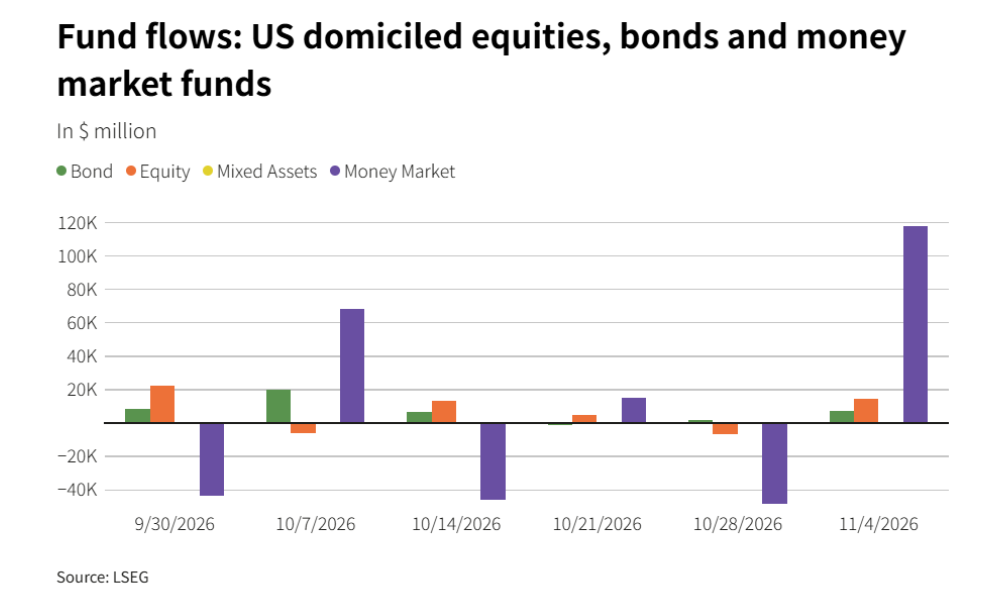
According to LSEG capital flows, the net inflow of global bond funds for the week ending November 4 was US$9.91 billion, the highest level since October 7. Among them, government bond funds had net inflows of US$3.07 billion, the highest in four weeks; high-yield bonds, Euro-denominated bonds, and short-term bond funds had net inflows of US$2.02 billion, US$2 billion and US$1.52 billion, respectively. Emerging market bond funds had a net outflow of US$299.7 million.
These dynamic trends in LSEG capital flows described above largely indicate that in the week ending November 4, capital was increasing fixed income allocation while watching out for a potential sharp decline in the stock market. At the same time, it continued to distinguish between credit qualifications, currencies, and maturities, and did not buy all bonds indiscriminately.
According to LSEG's capital flow, the net inflow of US bond funds during the same period was 7.31 billion US dollars, which also hit a four-week high; generally, US domestic taxable fixed income funds, longer-term government bonds, and US Treasury bond funds received net inflows of 2.72 billion US dollars and 2.66 billion US dollars respectively. As short as medium-term government bonds and US Treasury bond funds, there was a net inflow of 794.32 billion US dollars. Longer-term funds receive financial support, which means that some investors are willing to bear interest rates for a long period of time to lock in higher returns and participate in price increases brought about by declining yields.
At the same time, LSEG capital flow data also showed that the net inflow of global money market funds was US$172.71 billion, the largest weekly scale since April 2020. The net inflow of US money market funds was US$117.97 billion, a six-month high; global equity funds still received a net inflow of US$38.63 billion. As a result, capital showed a combination of “retaining growth exposure, increasing bond allocation, and increasing liquidity reserves.” As of November 4, the above statistics reflect a defensive trend already formed before the global stock market faced a sharp sell-off on Thursday, especially before the major sell-off in technology stocks; however, it is important to note that the US data is included on a global scale, and the inflow of funds is not directly equivalent to buying long-term US debt.
Next, what determines whether the bond market can turn a safe-haven rebound into a more lasting market is whether the cooling of inflation can be realized, and whether the supply of new treasury bonds can be fully accepted. The overall and core CPI increases for October announced on November 10 are expected to be 0.3% and 0.2% respectively; due to the lack of data for October last year, the relevant year-on-year readings will not be announced. This week, the US Treasury will also issue 58 billion US dollars of 3-year, 42 billion US dollars of 10-year treasury bonds, and 25 billion US dollars of 30-year treasury bonds, totaling 125 billion US dollars, of which net additional financing is about 28 billion US dollars. If inflation slows down and demand for auctions is steady, the appeal of high-yield allocations will be further verified; if inflation exceeds expectations and long-term treasury bonds are insufficient, the recent rapid rise may encounter resistance.
If the “anchor of global asset pricing” continues to decline, can AI financing costs be expected to decline significantly?
As described above, after the Democratic Party gains control of both houses of Congress, the core of bond market trading is that several forces that previously boosted yields may weaken at the same time.
First, the divided government raised the political threshold for further large-scale tax cuts and spending expansion, easing concerns that the deficit and treasury bond supply will continue to expand at an accelerated pace; this does not mean that the annual deficit of about 2 trillion US dollars will disappear immediately, but rather that expectations of additional fiscal stimulus have been restrained. Second, if data center projects are delayed due to approvals, electricity prices, and community requirements, it may slow the pace of short-term equipment procurement, construction, and expansion of electricity demand, and may also slow the pace of intensive financing of capital expenses by enterprises.
Finally, the market is betting that the election results will help cool down the war in Iran, and falling oil prices will further weaken expectations of energy inflation. Together, these factors support investors in reducing future interest rates and risk compensation requirements for holding long-term treasury bonds.
Recent trends in the US bond market have also highlighted that the logic of employment resilience and rising bond allocation values can be established at the same time. In October, 165,000 non-agricultural workers were added, significantly higher than the expectations of 65,000 people. The total number of people raised in the first two months was 84,000, and the unemployment rate fell to 4.1%, driving the probability of interest rate hikes in December from about 70% to 78% after the data was released. However, while the S&P 500 index rose about 0.3% and the Nasdaq Composite Index rose about 1.1% on Friday, US bonds maintained their weekly gains.
Ed Yardeni's opinion provides another basis for this round of bond market revaluation: if productivity increases driven by cutting-edge AI technology can drive inflation back to about 2% to 2.5% in the next ten years, then buying 10-year US bonds at a yield level close to 5% will have impressive expected actual returns. His bullish logic for the bond market is to participate in cooling inflation with higher starting yields, rather than having to wait for a recession to be optimistic about bonds.
His judgment also coexists with the long-term development of AI technology — concentrated demand for equipment, electricity, and financing during the construction phase may drive up costs, while the all-round penetration phase of AI applications is expected to greatly increase the capacity of unit input and output, which may gradually reduce unit production costs.
If the 10-year US Treasury yield, which has the title of “the anchor of global asset pricing,” continues to decline, it is expected to reduce the risk-free interest rate in the stock discount rate; under conditions where profit expectations remain stable and equity risk premiums have not increased significantly, this will raise the present value of future cash flow and create room for valuation repair for the AI computing power and semiconductor sector, which has recently been under pressure.
If the benchmark interest rate corresponding to the financing period falls simultaneously, and the credit spread stabilizes or narrows, the interest rate dividend may also be further transformed into a reduction in the new financing and refinancing costs of AI companies, increasing the net present value of data center projects, and supporting computing power investment and chip demand. However, at present, this potential transmission mechanism still requires the cooperation of the credit market — for example, CoreWeave's five-year CDS, which is at the core of the “AI computing power sell-off storm” and the “AI bubble bursting argument,” more than 1,000 basis points can be described as showing that the decline in US bond yields and the rise in credit pressure on AI companies can occur at the same time, and it is not yet possible to determine that actual financing costs have generally declined based on this.
Last Thursday, the Philadelphia Semiconductor Index fell sharply by 12.25%, and Micron fell 17.46%; the Korea Composite Index fell by a cumulative total of 11.7% last week. Samsung Electronics and SK Hynix fell by about 6.4% and 10.4% respectively on Friday, reflecting that the market is re-evaluating the speed of AI expansion and industry chain profit expectations. The underlying market linkage and transmission mechanism is mainly that the sell-off of technology assets pushes safe-haven funds to buy US bonds, and expectations that data center construction may slow down also cause the market to re-evaluate the intensity of future equipment, electricity, and financing needs; compounded by fiscal expansion being checked and oil prices falling, and long-term treasury bond yields are supported downward.
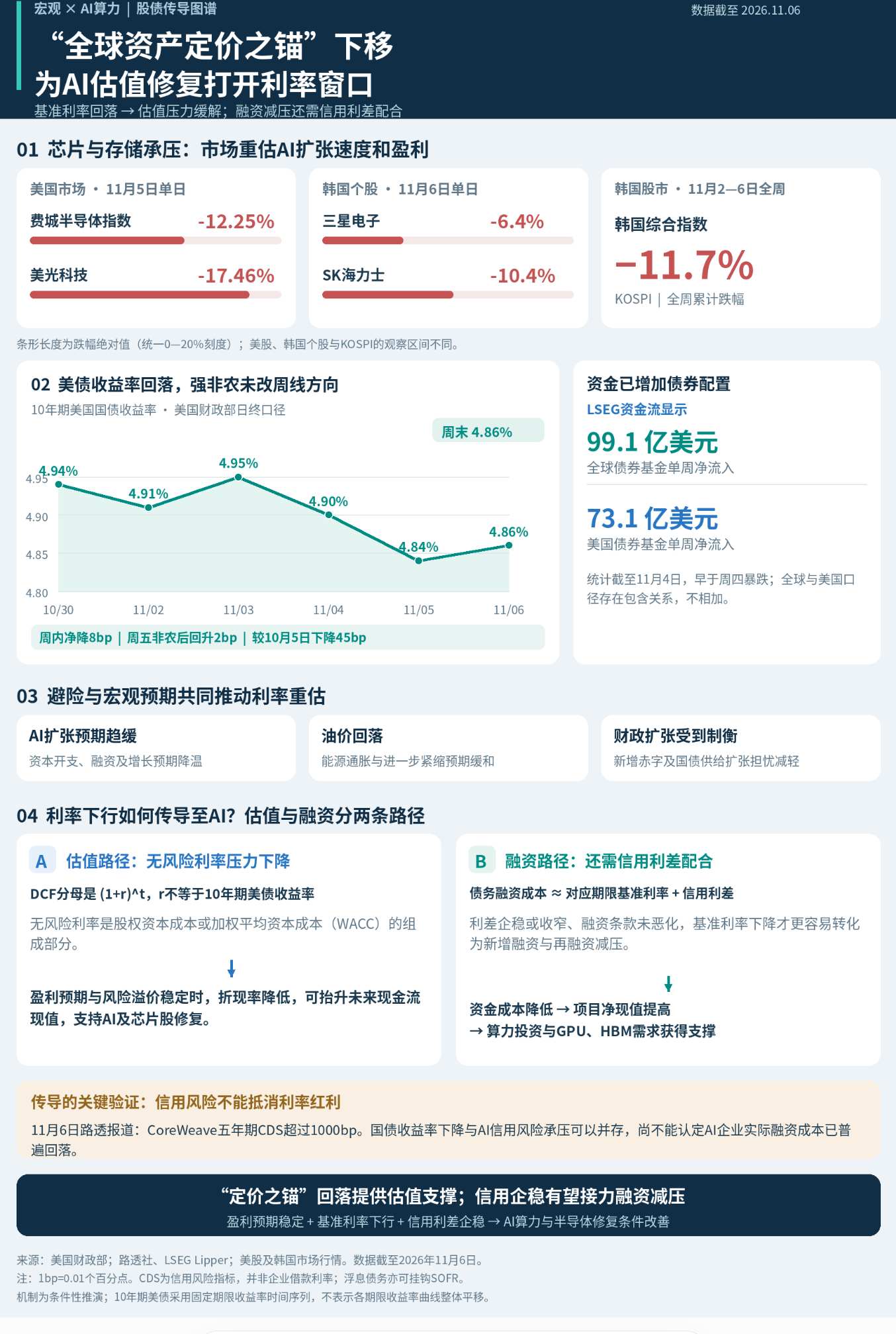
The 10-year US Treasury yield, which is the “anchor of global asset pricing,” fell back to 4.86% last weekend. The first improvement was the benchmark interest rate and valuation discount environment for AI investments. However, like the recent CoreWeave trend, which has been hit hard by equity bonds, whether it can be further transformed into a reduction in financing burdens depends on whether the credit market cooperates. The cost of debt financing for AI companies also includes credit spreads and other financing conditions above the benchmark interest rate for the corresponding term.
A more investment-inspiring AI computing power and semiconductor repair path is that falling benchmark interest rates and stabilizing credit spreads will jointly drive down AI financing costs: this will reduce the burden of new financing and refinancing, increase the net present value and construction feasibility of data center projects, and support the expected restoration of AI infrastructure requirements such as GPUs, HBM, servers, and data center power equipment while order demand remains resilient. As a result, the decline in financing costs is expected to be a catalyst for a further strong rebound in AI computing power and semiconductors. Among them, companies with strong credit qualifications, long-term customer agreements, and more clear cash recovery are in a better position to take the lead in benefiting.