


Realty Income (O) just delivered third quarter 2026 results that showed higher revenue and net income, slightly raised adjusted FFO guidance, and another dividend increase, while management reaffirmed acquisition plans and its funding approach.
Recent trading reflects that mix of income appeal and interest rate sensitivity. Realty Income’s share price has returned 8.97% over the past month and 3.02% year to date, while the 1 year total shareholder return of 10.49% points to building momentum supported by dividends over time.
Spot income opportunities like Realty Income’s peers by scanning hand picked real estate and dividend payers in the 7 dividend fortresses.After a near 9% climb in a month, Realty Income now trades at a price that still sits below both analyst targets and intrinsic value estimates. How wide is that gap in practical terms for income focused investors?
Most Popular Narrative: 4.9% Undervalued
At a last close of $59.04, the most followed fair value narrative on Realty Income pegs worth closer to $62.11, according to andre_santos, a Simply Wall St Community investor who built a detailed dividend based valuation using a 7.11% discount rate.
Given the fact that Realty Income is a dividend focused company, I will value it using only valuation methods related with dividends. A fundamentally driven one and then a historical/relative one to sanity check.
See why 118 investors see Realty Income as 5% undervalued.
That framework arrives at a fair value of $62.11, which is about 4.9% above the recent share price. In plain terms, the narrative suggests the stock is roughly in line with intrinsic worth, with a slight lean toward being inexpensive rather than stretched.
The approach rests heavily on Realty Income’s income stream. The narrative leans on dividend focused models, including a stable growth dividend discount model and a cross check against historical dividend yields, instead of earnings multiples. That suits a real estate trust where total return is often driven more by cash distributions and balance sheet funding than by headline profit metrics.
The discount rate assumption is central. Using a 7.11% cost of capital in the narrative, and an 8% cost of equity in the underlying worksheets, pushes the fair value toward the low $60s rather than dramatically higher levels. Readers should be aware that small tweaks to those inputs, or to long run dividend growth assumptions, can pull the estimate meaningfully up or down. This is why the author frames the result as a range rather than a precise answer.
The narrative also cross checks this dividend based result against the stock’s historical yield. With Realty Income currently paying an annual dividend of $3.25 per share, the analysis compares today’s yield to roughly 15 years of history. On that view, the stock screens as fairly valued to slightly inexpensive, consistent with the modest 4.9% narrative discount to fair value.
Result: Fair Value of $62.11 (UNDERVALUED)
Still, the Realty Income narrative could be challenged if funding costs stay elevated relative to its 7.11% capital estimate, or if share issuance keeps diluting holders.
Find out about the key risks to this Realty Income narrative.
Another View: Realty Income Through Earnings Multiples
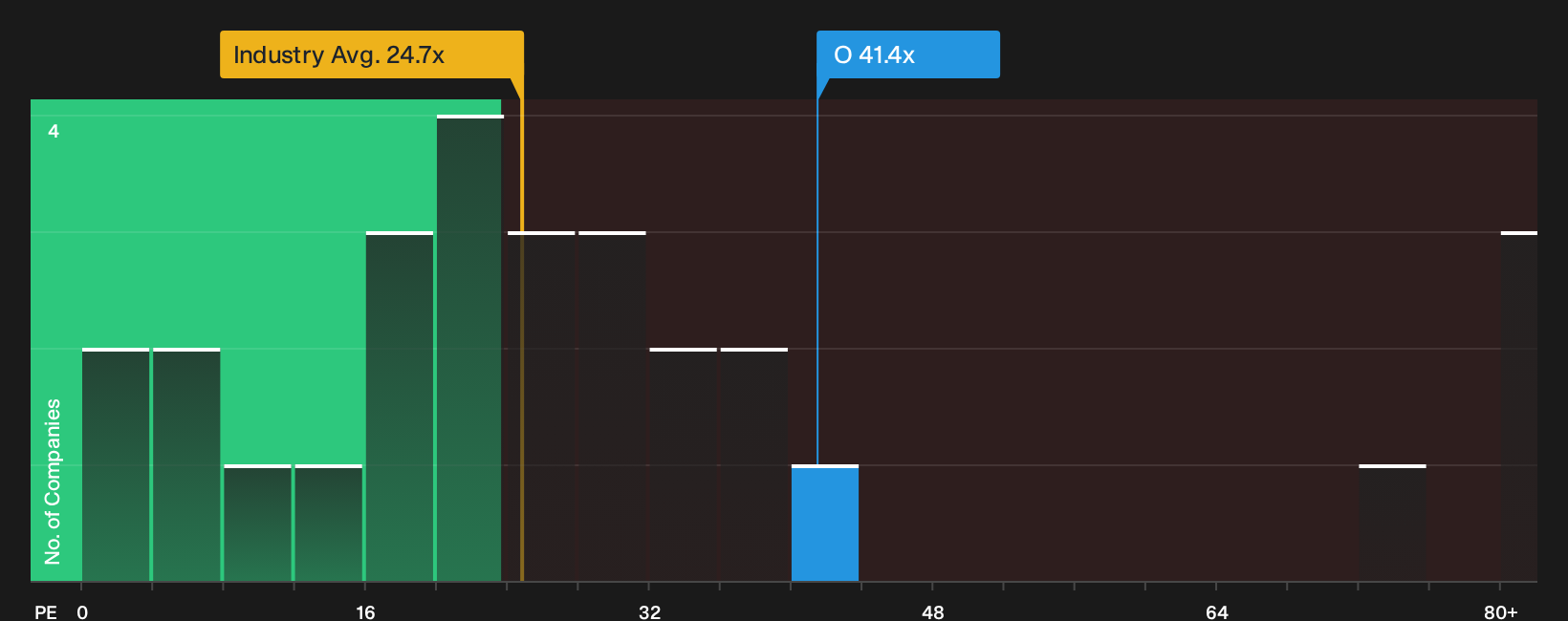
That dividend focused fair value of about $62.11 puts Realty Income only modestly below the current $59.04 share price. The earnings based picture looks less forgiving. On a P/E of 41.4x, the stock trades well above both the US Retail REITs industry average of 24.7x and a peer average of 26.4x, and even above a fair ratio of 35.7x that the market could move toward over time. That kind of premium can limit room for error if earnings growth or interest costs shift.
Put simply, income models point to mild undervaluation while the earnings multiple flags rich pricing, which raises the question investors need to answer for themselves: Is Realty Income primarily a bond like income vehicle, or should the high P/E make you more cautious about how much you pay for that reliability?
See what the numbers say about this price — find out in our valuation breakdown.
Next Steps
Mixed messages on Realty Income so far. If you want to move fast and ground your own view in the balance of concerns and positives, start with the 4 key rewards and 1 important warning sign.
Looking for more investment ideas beyond Realty Income?
Do not stop at one income stock. Broader ideas give you more ways to balance risk, reward, and timing across different business models and financial profiles.
- Target dependable cash generation and steadier balance sheets by scanning a list of solid balance sheet and fundamentals (25 results) that can help you avoid fragile businesses.
- Hunt for potential mispricings by checking a 38 high quality undervalued stocks that focuses on quality fundamentals rather than hype.
- Build your income shortlist by reviewing a 9 elite penny stocks with strong financials that can point you to higher yield possibilities with distinct risk profiles.
Have feedback on this article? Concerned about the content? Get in touch with us directly. Alternatively, email editorial-team@simplywallst.com