


The Zhitong Finance App learned that Omdia published an article stating that as AI vendors gradually switch to token-based pricing models, corporate AI spending continues to grow, making it more difficult to forecast their budgets. For PC original equipment manufacturers (OEMs), original design manufacturers (ODMs), chip vendors, channel partners, and managed service providers (MSPs), the key question is: Where should AI workloads run? What role should the PC play? Omdia predicts that AI PCs will account for 60% of total PC shipments in 2027. With the upgrading of devices, the infrastructure to support the operation of local AI is gradually being formed.
Most businesses expect AI spending to increase further next year. According to Omdia's 2026 AI Market Maturity Survey (AI Market Maturity Survey 2026), 86% of organizations with AI budgets expect AI spending to increase in 2027. As leading AI vendors gradually shift from charging per user seat or number of requests to token-based pricing models, it is becoming more and more difficult for companies to manage related expenses. Under this model, the enterprise can only clearly understand the actual cost of the task once the execution of the task has been completed. Intelligent AI further exacerbates this problem because a single task may trigger a series of pay-as-you-go model calls. Despite these risks, companies' spending and usage of AI has not slowed as a result.
To date, most enterprise AI workloads still run in the cloud. As costs continue to rise, businesses are reevaluating which workloads should continue to be deployed in the cloud. A hybrid infrastructure that encompasses the cloud, on-premise servers, and end-side AI is gradually becoming a solution. However, large-scale local deployment of AI is not easy, and many companies lack the corresponding technical capabilities. This capability gap presents opportunities for the entire PC ecosystem. From OEMs and ODMs to channel partners and MSPs, all parties can help companies determine which AI workloads are suitable to run on the device side and how to implement end-side deployment.
Cloud AI is increasing enterprise costs, risks, and management gaps
In addition to cost issues, as more enterprise data leaves local devices, cloud AI also brings concerns about compliance, security, and data sovereignty. As intelligent AI solutions are gradually introduced into production environments, these risks may increase further, and related management expenses are difficult to accurately track.
There is also a lack of visibility on the user side. According to Omdia's PC Horizons Consumer Survey, 78% of respondents who use PCs to work use AI at least a few times a week, yet only 12% of AI users in this group use tools provided by their workplace or school. This means that a large portion of AI use may be carried out through personal accounts and is outside the scope of IT department monitoring, thereby increasing the risk faced by enterprise data.
End-side AI has not been fully recognized by corporate buyers
The public cloud dominates the early stages of enterprise AI applications because it is easy to adopt, requires no hardware purchases, and can use the most powerful cutting-edge models.
Since then, multiple developments have made it more feasible to run AI outside the public cloud. The performance gap between open weighting models that enterprises can deploy on their own and cutting-edge models is narrowing, while quantitative technology has further reduced the size of the model so that it can run in PC memory. As a result, more and more conventional AI workloads can run locally while reaping the many advantages of private infrastructure in terms of compliance and data sovereignty at a lower incremental cost. Additionally, neural network processing units (NPUs) are now standard on many new PCs.
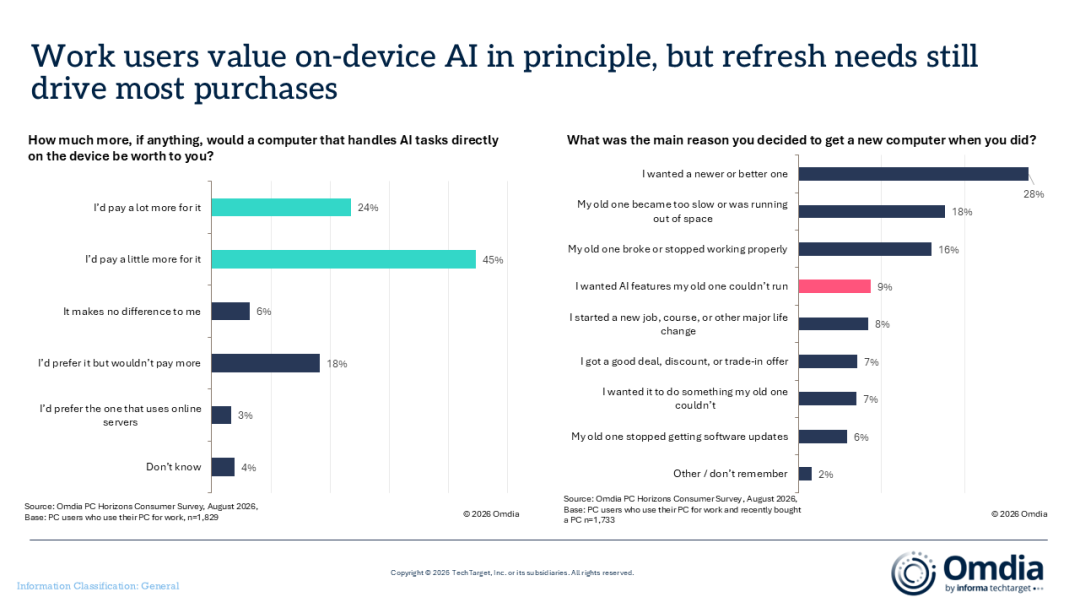
Figure 1: Top Reasons to Buy a Previous PC—Users Using a PC for Work
Source: Omdia, PC Horizons Consumer Survey, August 2026
Despite this, the value proposition of AI PCs has yet to be fully recognized in the market. According to Omdia's survey, 69% of respondents using a PC to work said they would pay a higher price for a computer that can handle AI tasks directly on the device. However, 62% of respondents replaced their previous PC because the device was running slowly, failed, or wanted to switch to a newer, better device, while only 9% of respondents listed AI functionality as the main reason for replacing the PC (Figure 1).
The positioning of AI PCs in hybrid infrastructure
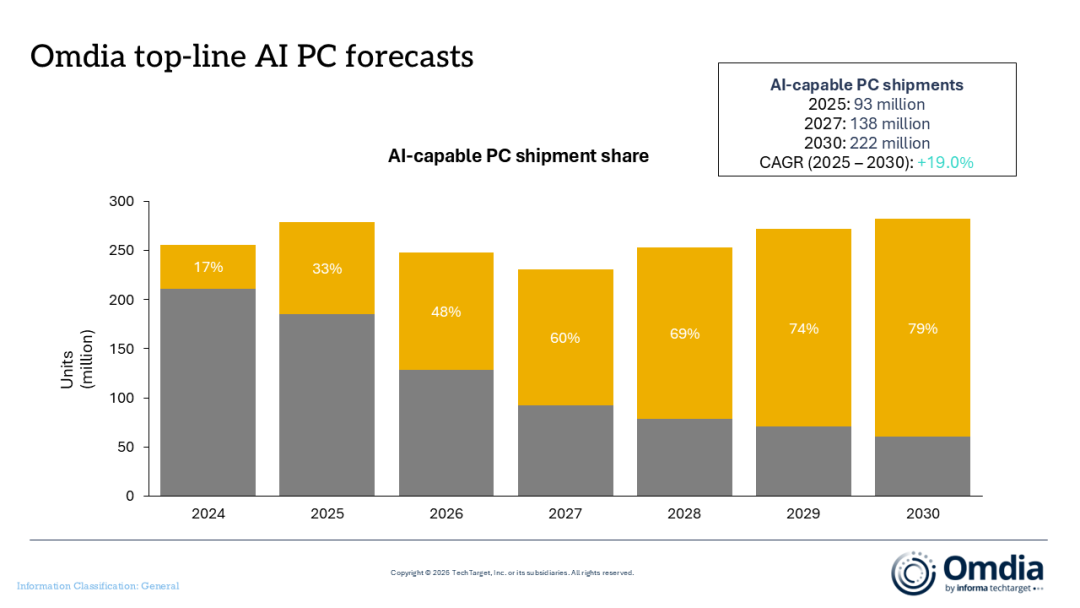
Omdia expects the share of AI PC shipments to rise from 33% in 2025 to 60% in 2027, and reach 79% in 2030 (Figure 2). This means that regardless of whether buyers actively request it or not, as the PC upgrade cycle progresses, the equipment foundation that supports local AI operation will gradually be formed.
Figure 2: Share of AI PC shipments in 2024-2030
Source: Omdia AI PC shipment forecast, August 2026
Commercial value is first reflected in cost. The cost of AI in the cloud is an ongoing expense and will increase as usage increases, while PCs are usually a one-time investment. A reasonable way to compare is to compare the added cost of a higher-configuration PC with the ongoing cloud expenses it replaced, rather than comparing the cost of an entire computer to a cloud bill. Using higher-configured AI PCs, employees can obtain local AI capabilities by only paying the increased cost of upgrading the configuration.
Traditional architectures are distributed according to workload size: the most complex tasks are handled by the cloud, the largest workloads and models are handled by locally deployed servers, and PCs are responsible for routine inference tasks. Quantification technology is changing this division of labor, making it possible to transfer more and more tasks to PC processing, particularly on devices with higher memory configurations.
Intelligent AI is one of the early scenarios of local inference applications. Local agents require far more memory capacity and bandwidth than mainstream PCs can currently provide. However, major OEMs have now begun to launch the first batch of PCs specially designed for smart AI, which are also relatively expensive, so at this stage they are mainly aimed at developers and advanced users. As open weighting models and quantitative technology continue to develop, such application scenarios are expected to expand further.
Memory is a major risk factor limiting the further spread of end-side AI. Since 2025, memory costs have risen from around 15% to nearly 40% of typical PC bill of materials (BOM) costs. This may prompt buyers to switch to lower memory configurations at a time when the demand for memory from local AI continues to increase. This cost pressure is likely to affect the server market as well. Furthermore, the value of laptops to employees is not limited to running AI, so compared to server investments, the additional cost of AI PCs is expected to remain relatively limited, while also helping to avoid the opacity of usage faced by AI in the cloud.
The PC ecosystem needs to turn end-side AI capabilities into commercial value
Although related hardware is gradually becoming the mainstream configuration, enterprises are still in the early stages of adopting end-side AI, as companies are still evaluating which scenarios can achieve cost efficiency through local reasoning. Closing this gap requires the participation of the entire ecosystem. OEMs need to demonstrate their economic benefits through typical workload cases to explain how the increased costs of higher-configured PCs can be rewarded by saving ongoing cloud expenses; at the same time, ODM manufacturers and chip suppliers decide whether the cost of these configurations can be accepted by the market, with memory costs being particularly critical.
Channel partners and MSPs need to translate this value proposition into actions that businesses can actually take. Assessing an enterprise's AI maturity, deciding where to deploy workloads, deploying models, and formulating relevant strategies all require professional competencies that many companies do not currently have. Additionally, as models, cloud pricing, and hardware continue to change, businesses need to re-evaluate and adjust relevant decisions before the next PC refresh. This provides channel partners and MSPs with ongoing service opportunities that go beyond laptop sales themselves.
Enterprise AI spending is expected to continue to grow, and enterprises will also face increasing pressure to determine the costs and suitable operating locations for each workload. AI PCs won't replace servers deployed in the cloud or locally, but if the entire ecosystem can fully collaborate, they can help optimize enterprise AI spending.