The Zhitong Finance App notes that utility companies, developers, and companies vying to supply power to AI data centers are searching around the world for used gas turbines, restarting sealed machines, and reusing decommissioned jet engines, because the delivery cycle for expensive new equipment has already been scheduled for the next ten years.
Despite growing concerns about the risks of artificial intelligence technology and the recent sell-off of related stocks, demand for energy-intensive data centers is still soaring, causing serious bottlenecks to critical power infrastructure and equipment such as gas turbines.
Speaking about the US gas turbine market, Aurora Tenorio, a senior analyst at energy consulting firm Wood Mackens, said, “Delivery negotiations are already firmly focused on the 2030-2031 window.”
According to more than a dozen brokers, service companies, and suppliers, this has prompted some companies to instead look for used and refurbished equipment and gas turbines based on jet engines rather than wait for the backlog of orders to be digested.
Anna Amicarella, CEO of equipment service provider EthosEnergy, said, “This second-hand market is very, very hot right now.” “We have also seen that buyers' bids are being upgraded.”
Can this market solve the tight electricity supply?
Nur Qureshi, an assistant at Enverus Intelligence Research, said he is afraid it will only be partially mitigated. “The market is already limited and surplus supply is limited, so it's unlikely to offset a significant portion of delivery delays.” she said. Gas turbines are only one obstacle; factors such as air permits and grid access also caused delays.
There are currently no reliable estimates showing how much the second-hand market contributes to the global gas turbine supply of around $25 billion a year. But its emergence itself confirms the profound impact of the data center boom on all walks of life.
For example, in April of this year, AI infrastructure company Crusoe ordered 13 so-called aeronautical modified gas turbines from US ProEnergy. The equipment is based on jet engines manufactured by General Electric Aerospace (GE.US). Crusoe says this is a strategic move for rapid expansion.
The gas turbines have a combined capacity of 650 megawatts (MW) and will be deployed at Crusoe's AI data center project in the US.
Data centers and their operators have become big customers of gas turbines, and a few years ago this market almost only served traditional utility companies.
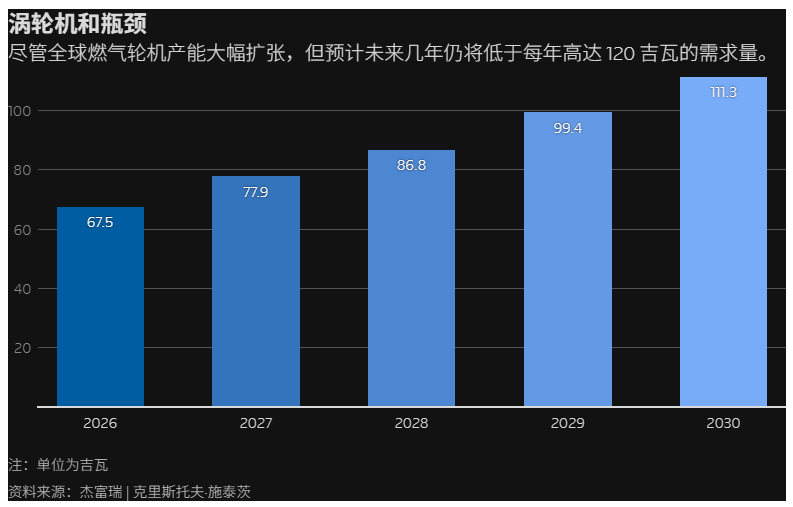
According to Wood Mackenzie data, the total number of global orders has now exceeded 100 gigawatts (GW), far higher than the estimated global production capacity of about 60 to 70 gigawatts.
Analysts at investment bank Jefferies estimate that US data centers alone contributed nearly 17 gigawatts of demand this year, and this figure could more than double by 2028.
They said that although global gas turbine manufacturing capacity is growing and is expected to rise to about 87 gigawatts in 2028, it will still be far below the expected demand for gas turbine electricity of 129 gigawatts.
Siemens Energy, GE Vernova (GEV.US), and Mitsubishi Heavy Industries, which dominate the market, all said that orders driven by the AI boom have exceeded their production capacity.
Tenorio said that in the US, the current average delivery time for a gas turbine is as long as six years.
Used, refurbished, or repurposed equipment also presents challenges. Tenorio said that maintenance records for overhauled gas turbines may be unclear, remaining life is limited, and long-term service guarantees are weak; modified jet engines raise questions about whether they are suitable for continuous operation as generators.
Despite this, years of waiting time have ensured the appeal of the market.
Darayus Padiwala, head of Sulzer's US after-sales business, said, “Every few weeks we get requests: 'Can you find a used gas turbine to install in the data center? '”
The cost is just as important.
According to Origin Partners managing partner Zack Machuca, which purchases power equipment for data center developers, well-maintained used machines cost around $1.5 million to $1.7 million per megawatt, and refurbished units cost around $1.3 million.
According to Aurora Energy Research estimates, this is significantly lower than the price of a new unit of about 2 million to 2.5 million US dollars per megawatt.
For smaller, cheaper units, the discount may be even greater.
ReflowX general manager Dan Poole, who has brokered the buyer and seller, said that two 14.5 MW gas turbines manufactured by Solar Turbines under Caterpillar (CAT.US) recently sold for 12.5 million US dollars, or about 430,000 US dollars per megawatt. He said the price of the new machine was about 35 million US dollars, and delivery took five years, but the buyer's identity was not disclosed.
When time is tight, if large units are difficult to obtain, developers will switch to small units. Scott Schrieger, sales director for US equipment supplier SVI Bremco, said they sometimes deploy more than 100 units at a single site and mix different models and brands.
The impact of the AI boom extends far beyond data centers.
The Tennessee Valley Authority, the US federal utility company, said that the price of all equipment (new, used, or refurbished) has “risen sharply” in the past two years.
Jim Matheson, CEO of the National Association of Rural Electric Cooperatives representing client-owned non-profit utility companies, said its members are facing unprecedented delivery cycles and soaring prices. “Cooperative organizations that require additional production capacity are turning to every viable option,” including purchasing refurbished gas turbines.
The race for gigawatts has also opened up new markets for alternatives to scarce gas turbines.
Anders Lindberg, president of the energy business of Finland's Wärtsilä Group, said that since last spring, the company has received orders for about 3 gigawatts from US data centers. The products are generator sets driven by gas internal combustion engines rather than gas turbines.
“What's driving this market? “Delivery cycle, delivery cycle, delivery cycle,” he said.