


With a 10% increase in 12 trading days, glass futures, which have been growing all the way, are now linked or out of an “inflection point”, while Hong Kong glass stocks are also quietly strengthening. Has the glass industry's adversity reversed?
The Zhitong Finance App learned that glass prices bottomed out on October 23 and continued to rise for 12 trading days up to November 6. The main contract price rose from 828 yuan/ton to 915 yuan/ton, an increase of 10.5% during the period. Affected by this, the Hong Kong stock glass sector also experienced an overall rise after a long absence. In the past five trading days, Follett Glass (06865) rose 9.9%, Xinyi Solar (00968) rose 14.5%, and Fuyao Glass rose 7.4%.
The core logic of this wave of rebound is “price-driven,” which guides fundamentals to improve expectations. The sustainability of price increases is the key to determining how long this wave of market increases can last. So, is this wave of market a confirmation of an inflection point in valuation or just a passing moment?
Supply shrinks and prices rebound, and the glass sector ushered in wave opportunities
Price increases and falls may be hype in the short term, but sustainability still depends on supply and demand. Demand in core markets such as downstream real estate continues to shrink, demand growth is limited, and supply contraction is the biggest variable in price rebound.
In terms of float glass, since 2026, 37 float production lines across the country have been cold repaired and discontinued, involving a daily melting volume of 25,220 tons; a net withdrawal of about 12,190 tons/day, the production line operating rate fell to 65.87% from 71.38% in the same period last year, the capacity utilization rate fell from 75.52% to 69.97%, and the daily output fell from 151,100 tons to 140,300 tons, a year-on-year decrease of 13.1%. From the end of October to the beginning of November, various production lines, such as Wuhan Changli, Jinjing Zibo, and Shahe Safety, released water or stopped one after another, and cold repairs moved closer from “sporadic” to “centralized.”
Maintenance, production stoppage, and reduced operating rate are all aimed at reducing supply and relieving inventory pressure, but the country's nominal production capacity is still at an all-time high of 200,000 tons/day, and inventory is not low. As of November 5, 2026, the national float glass factory stocks 689.62 million heavy boxes, of which traders in the Shahe region stock 4.24 million heavy boxes, all of which are at a high position. On the demand side, real estate is the core demand market. Demand accounts for more than 70%, and is still weak. In January-September, the completed housing area fell 25.1% year on year, and the construction area fell 13.2% year on year. The completion chain is still reflecting the decline in new construction in the early stages.
As can be seen, glass supply and demand are showing a weak pattern, which suppresses the room for prices to rebound and rise. However, prices are at historically low levels. At the same time, the industrial chain is also in a state of deep loss as costs move up and prices fall. The bottom is quite solid, and there is limited room for further development. Demand determines the upper price limit, and the bottom of the price+contraction in supply+demand for stock replenishment brought about phased recovery, which enabled the Hong Kong stock glass sector to usher in a wave of opportunities.
Market segment leader resilience, Xinyi Glass's “two legs”
Judging from industry performance, the differentiation is obvious, mainly due to differences in market segment demand performance. Corresponding to industry leaders, including racetrack standards such as architectural glass, float glass, photovoltaic glass, and automotive glass, also showed differentiation.
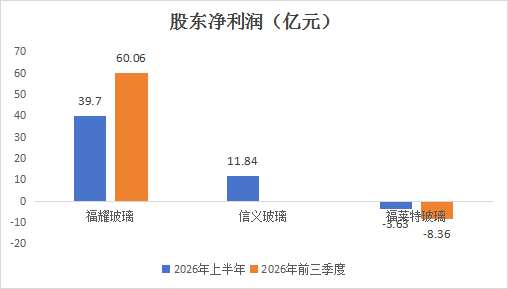
Data source: Company financial report
Fuyao Glass is the leading automotive glass leader. More than 90% of its revenue comes from automotive glass, benefiting from the development of new energy vehicles, and demand continued to grow. In the first three quarters, the company's revenue was 34.123 billion yuan, up 2.46% year on year, and shareholders' net profit was 6.06 billion yuan. Although down 14.97% year on year, the net shareholder interest rate was 17.6%. In addition, the company has abundant cash flow. As of September 2026, it had cash and equivalents as of $21.52 billion, which is far higher than that of its peers.
Follett Glass's main revenue comes from photovoltaic glass, accounting for nearly 90%. Supply in the PV industry chain exceeds demand, dragged down by prices, and demand continues to be weak, making the company's performance poor. In the first three quarters, the company's revenue was 9.582 billion yuan, down 23.12% year on year, and shareholders' net loss was 836 million yuan, changing from profit to loss year over year. Xinyi Glass has “float glass+automotive glass” as its two core businesses. Among them, automotive glass accounts for more than 30%. The company did not disclose its third quarter results. Looking at the results for the previous half year, revenue was 9.521 billion yuan, a year-on-year decrease of only 3.06%. The net profit for shareholders was 1,184 billion yuan, and the net interest rate for shareholders was 12.43%.
When the three financial reports are put together, the three standard businesses all have a global layout, and the share of overseas markets has basically reached 40%. This effectively absorbs the risk of domestic overcapacity to a certain extent.
From the product side, all three companies are taking effective measures to combat overcapacity and improve performance resilience. For example, Fuyao Glass continues to improve and promote the share of high-value-added products such as intelligent panoramic roof glass, dimmable glass, head-up display glass, ultra-insulating glass, lightweight ultra-thin glass, and coated heatable glass to optimize the product structure; Xinyi Glass is splitting the automotive glass business while optimizing the differentiated supply of float glass while simultaneously reducing costs and increasing efficiency.
However, also being dragged down by falling prices, Fuyao Glass's performance is clearly superior, but in terms of elasticity, Xinyi Glass, which has a higher share of float glass revenue, is expected to be higher. Mainly, on the one hand, automotive glass accounts for relatively low, and growth expectations are weak; on the other hand, demand for float glass stems from real estate, and real estate is at the bottom of the market, and there are policy expectations. “Volume and price increase” is highly sensitive to performance.
Under band opportunities, which one is more worthy of attention?
As mentioned above, the price rebound drives the glass sector to have volatile opportunities, so the above three targets will also usher in valuation repair opportunities. In terms of valuation, up to now, Fuyao Glass, Xinyi Glass, and Follett Glass Hong Kong stocks are worth HK$142.2 billion, HK$37.2 billion and HK$12.8 billion respectively. The corresponding PB values are 3.3 times, 0.9 times and 0.5 times, respectively, but this cannot be used as a standard for judging high or low valuations. Follett lost money in 2026. Fuyao and Xinyi are profitable, and PE (TTM) is 15 times and 11 times, respectively.
Compared to the two, the market gave Fuyao a high valuation and is the only bull stock that is ready for an upward trend. The market value rose for three consecutive years from 2023-2025, and the market value fell 15% in 2026, but the overall market value still doubled, and even emerged from a ten-year bull market since 2015. This is mainly because the company's leading position in the automotive glass industry is difficult to shake, and its performance continues to lead the industry, and its profitability is stronger than that of its peers.
However, it is worth noting that Xinyi Glass's valuation is the most flexible. It began to rebound in 2025 and closed up 5% against the trend in 2026. The recovery of float glass is the key to its inflection point in valuation. In 2026, the company's share of automotive glass increased, and profitability increased significantly, and the current valuation is very low. Refer to Fuyao Glass's valuation, and the premium space is over 50%. More importantly, the company's performance is highly flexible on glass prices, and there is plenty of room for valuation repair.
From the point of view of major investment banks, they are both optimistic and pessimistic about the industry, but the majority are optimistic about Fuyao Glass and Xinyi Glass. Among them, Southwest Securities published a research report on Fuyao Glass, believing that the company has strong operational resilience, and that its market share is expected to continue to rise and give it a buying rating; Haitong Securities published a research report on Xinyi Glass, believing that the company's float glass leads the industry in terms of profitability and resilience at the bottom of the industry. At the same time, automotive glass maintains a stable and high gross profit margin, and the spin-off of automotive glass is expected to go through the cycle and revalue.
Taken together, this round of the glass sector is not a reversal in demand. It is essentially a valuation repair of “loss bottom+cold repair expectations+supply contraction”, but this has also brought opportunities for market fluctuations in the glass sector. However, differences in market segment demand have divided the target's performance. Fuyao Glass's performance is the most resilient, but the valuation is too high. Xinyi Glass's “float+automobile” glass two-wheel drive maintains profitability, and there is plenty of room for valuation premiums after the separation of automotive glass.