


The Zhitong Finance App learned that the results of the US midterm elections and the subsequent market collapse have revealed the vulnerability of the market due to excessive concentration of artificial intelligence (AI) bets, and investors may need to readjust their expectations for return on investment.
Last Friday's rebound was far from enough to make up for the biggest evaporation in market capitalization experienced by technology stocks since the COVID-19 pandemic. Although investors have stopped selling stocks indiscriminately, it now takes considerable courage to re-increase risk exposure, given the overall political environment and wider uncertainty, and the impact these factors may have on economic growth and corporate profits.
Wolf von Rotberg, stock strategist at Safra Sahin Bank of Switzerland, said, “Compared with the victory of the Democratic Party and its impact on data center construction, the potential macroeconomic situation has begun to change, and this has dragged down the stock market. The market is unlikely to see a sharp rebound quickly.”
Short-term macro risk
Currently, the surge in volatile futures shows that short-term risk is still the main concern in the market. After the sharp fall in US stocks last week, investors had little room to breathe, as the next major risk event is almost imminent, forcing the market to quickly turn its attention back to the fundamentals of economic and monetary policy.
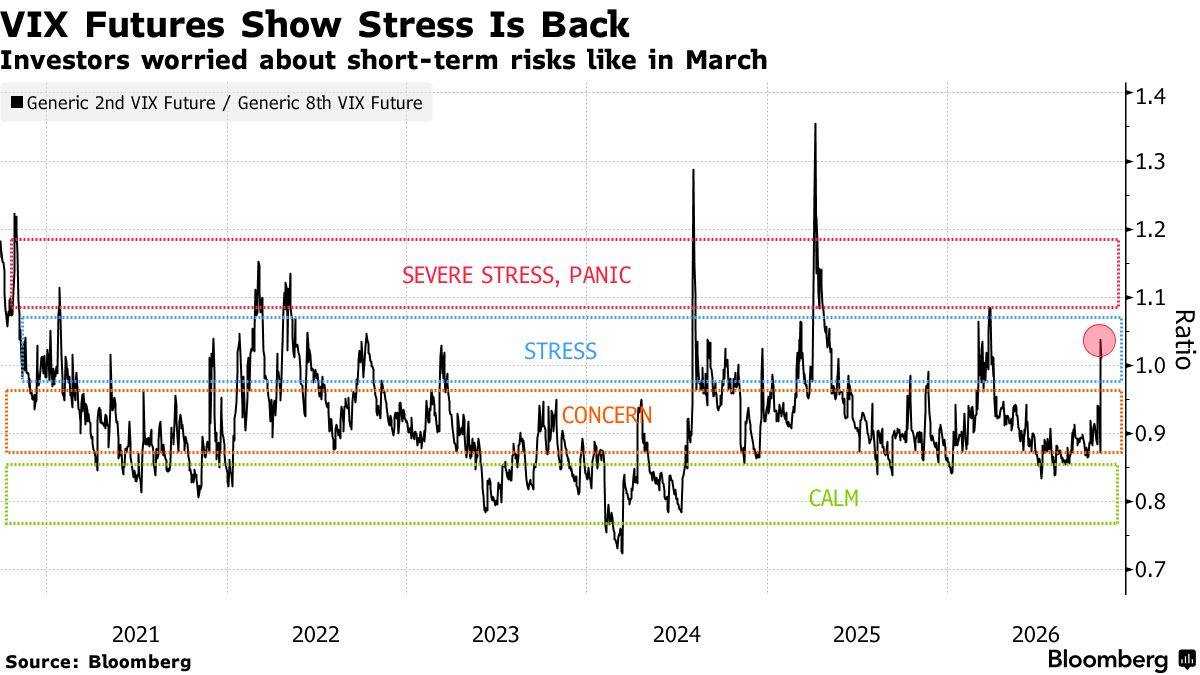
The US October CPI data released on Tuesday will be the most important macroeconomic data for this week. The previous core inflation data for August and September were higher than expected, so this latest inflation data will test whether potential price pressure is still high and help the market to re-evaluate interest rate trends.
Meanwhile, the current obvious liquidity pressure means that the financial environment appears to have tightened to a level comparable to the beginning of the war with Iran in March this year. Perhaps what the market needs most right now is an easing of the financial environment.
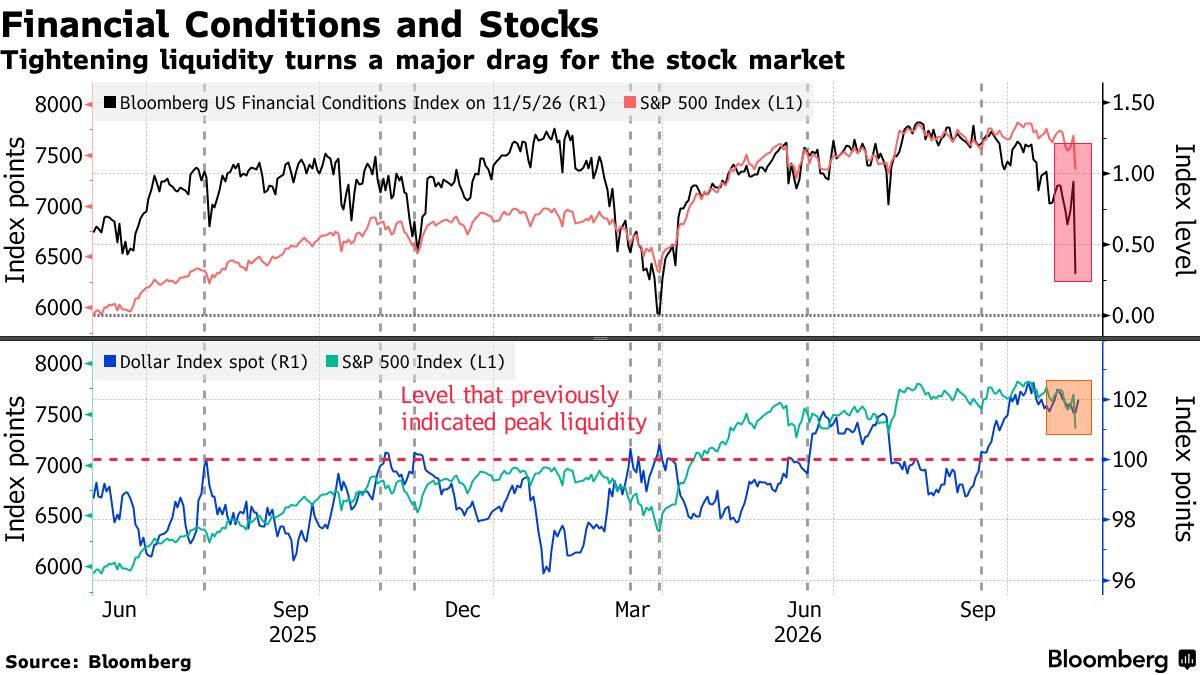
Seen from this perspective, this election may have mitigated two factors that cause the economy to overheat — fiscal stimulus and unrestrained AI spending, but it did not send a signal of economic recession. Traders have lowered their bets on the Federal Reserve's December rate hike. The decline in US bond yields and the Federal Reserve's moderate stance will help ease the pressure on stock valuations and may push the market's leading forces to spread from large technology stocks to a wider range of sectors.
AI infrastructure investment faces torture
Compared to short-term macroeconomic and monetary policy changes, the uncertainty of the AI investment cycle itself may be a deeper concern for the market. After the Democratic Party's “blue wave” swept through Washington, one of the biggest problems investors faced was to determine where AI infrastructure construction will go next. AI trading is currently facing huge capital expenses, overcrowded positions, and increasingly difficult to answer questions about future return on investment.
Barclays estimates that about 80% of the high-probability data center project reserves reported by utility companies in 2027 will be located in states governed by Democratic governors, and this year this year this year this year this year this year this year is less than 30%. US President Trump has veto power, making it difficult to implement far-reaching restrictions at the federal level. However, the results of the midterm elections at the state level have drawn market attention to physical infrastructure restrictions, and these restrictions are increasingly determining the actual speed of AI infrastructure construction.
This means that even if policy restrictions at the federal level are difficult to fully implement, issues such as state-level approval, power supply, and grid access may become important factors limiting data center construction. Joachim Klement, strategist at British investment bank Panmure Liberum, believes that if hyperscale cloud service providers slow down capital expenditure growth as a result, then the entire data center supply chain will face lower revenue and profit forecasts. “The message the market is sending us is that investors are exhausted and not many new buyers are entering AI trading,” he said.
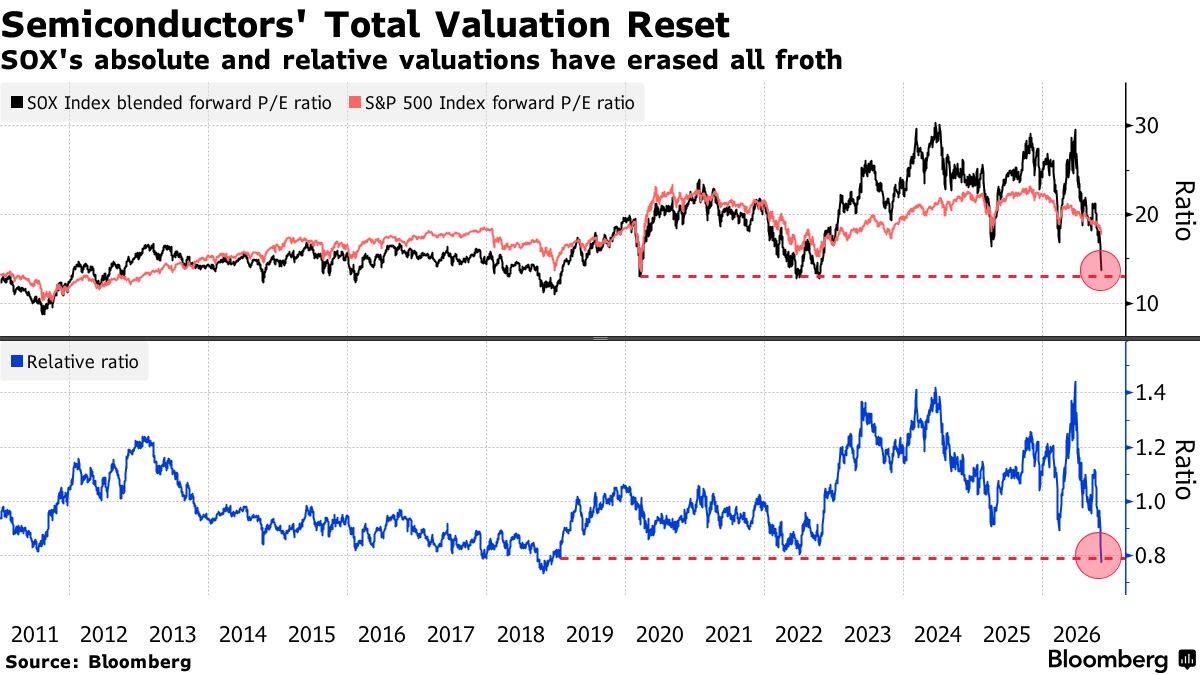
Last week, chipmakers became central targets for investors to readjust their expectations. Investor concerns, stricter approval processes, and higher grid access costs may delay orders until the next few years. For the Philadelphia Stock Exchange semiconductor index, this means that the valuation has been drastically adjusted. It is now close to the low end of the valuation range for the past 10 years, and its full valuation premium over the S&P 500 index has disappeared.
Corporate profit expectations or revisions
The uncertainty of AI infrastructure investment prospects may eventually be further transmitted to corporate profit expectations. In the future, the market may need to re-examine previously overly optimistic profit forecasts. The previous bull market was built on the expectation that AI capital expenditure and strong economic growth will continue to translate into corporate profits for years to come. In recent weeks, as the market's doubts about the AI deployment process have gradually surfaced, investors have made adjustments by depressing valuations. Next, analysts are likely to react, as they currently expect corporate profits to grow 29% this year, followed by 19% and 16% in 2027 and 2028, respectively.
Dario Perkins, managing director of TS Lombard Global Macro, said, “The reason for the sharp increase in profits of companies related to the technology industry is simply because US hyperscale cloud service providers continue to invest a record amount of capital into the AI ecosystem. “In the long run, we are also skeptical about whether the enterprise sector can actually reap the benefits of AI — both the companies leading the infrastructure for this new technology and the end users have this problem.”
According to Dario Perkins, there are three reasons for the slowdown in corporate profit growth in 2027: the positive driving effect of rising energy prices will gradually subside; capital expenditure related to AI will slow down; and the composition of the US economic growth will shift from productivity increases to employment growth.
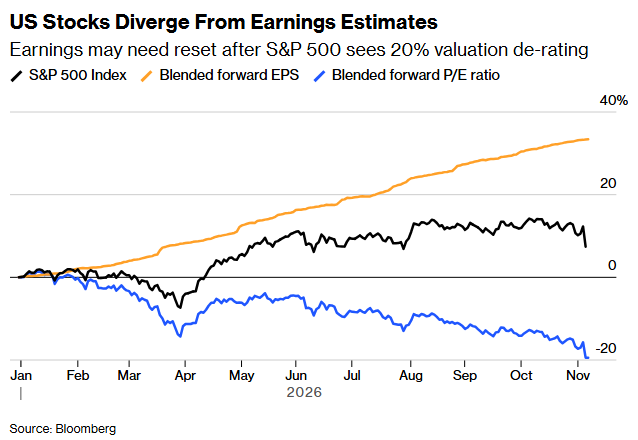
After the valuation of the S&P 500 index experienced a 20% reduction, corporate profit expectations may need to be readjusted
In a context where profit expectations may face adjustments, investors also need to weigh two very different risks after the election. On the one hand, a slowdown in AI investment is likely to dampen economic growth and inflation, and drive returns down. On the other hand, a further escalation of the tariff policy or the intensification of the conflict between the US and Iran could weaken economic growth while boosting inflation, oil prices, and yields.
Midterm elections usually make investors stop worrying about political factors and refocus on fundamentals. But this time, political factors directly collided with the investment cycle. The election did not create the current vulnerabilities facing the market, but it has largely exposed these vulnerabilities.
Kristofer Barrett, head of global equities and fund manager at French asset management company Carmignac, said: “Once panic spreads, everyone will rush to the same exit.” He pointed out that the scale of this sell-off was largely due to leveraged participants in the market.
However, market concerns about AI investment prospects do not mean that related companies have begun to cut capital expenses across the board. Hyperscale cloud service providers are still investing heavily, and Kristofer Barrett hasn't seen any signs of slowing down in data center builders or chip makers. He said, “At the same time, valuations have dropped drastically. If there is no significant decline in demand for AI terminals, then the current valuation looks quite attractive.”