


The Zhitong Finance App learned that Yardeni Research pointed out in a November 9 report that the S&P 500's profit forecast was overly optimistic: the market consensus did not reflect the agency's expectations of the three types of constraints — financial, political, and physical — that are dragging down the AI investment boom.
The gap is concentrated in 2028: the market's consensus on operating earnings per share (EPS) for the year was $495; Yardeni's own forecast was $450, with a difference of $45; there was little disagreement between the two sides in 2027, with a consensus of $426 and the agency's $425. In other words, Wall Street and Yardeni's profit judgments for the next two years are basically the same, and all differences lie in 2028 — the point of disagreement is not “whether AI is good now,” but “in which year will AI capital spending decelerate.”
“We suspect there is some irrational boom in profit forecasts because they don't even reflect the deceleration zone.” The report reads. At the same time, the agency said that analysts did not expect AI infrastructure construction to completely shut down — the consensus profit forecast continues to improve, which just shows that the market assumes a “smooth journey.”
Two other numbers are worth keeping in mind: semiconductors account for about 20% of S&P 500's forward-looking earnings; Yardeni believes EPS will not reach $500 until 2030, two years behind consensus.
Triple Restraint: Money, Votes, and Electricity; AI Investment or Slowdown
The report divides the constraints facing the AI investment boom into three categories, each of which is being tightened.
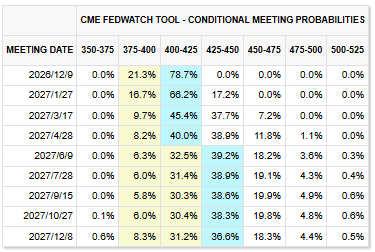
Financial constraints — As investors demand a more clear return on investment from hyperscale cloud vendors, financing will become more expensive. This is particularly glaring in the current interest rate environment: the October non-farm payrolls announced on November 6 increased by 165,000, more than double the market's forecast of 62,000, the unemployment rate fell to 4.1%, traders' bets on the Federal Reserve's December rate hike rose to about 79%, and the 10-year US Treasury yield rose to 4.86%. The rise in financing costs is the most direct stone in measuring data center returns.
Political restraints — Data center developers may be required to fund grid upgrades, protect local water resources, and provide more community compensation. This isn't an abstract risk: Texas Governor-elect Gina Hinojosa (Gina Hinojosa) made it clear during an election week interview that the state needs to “stop what it's doing now” before measures are put in place to protect Texans — that is, data centers. Texas is one of the most concentrated locations in this round of AI infrastructure, and approval is in the hands of the state and power grid operators.
Physical constraints — power shortages, grid access queues, and equipment supply bottlenecks can all delay projects and prolong the waiting time for free cash flow to be positive. This type of restriction is the most difficult to hedge against with policy: it's easy to get connected to the grid for several years, and delivery times for transformers, gas turbines, and energy storage equipment are also measured in years.
The market has already set the price, but it's only half
Notably, stock investors seem to be already pricing these constraints. The S&P 500's forward-looking price-earnings ratio has dropped to 17.6 times, down from 18.1 times during “Liberation Day” (April 2025 tariff shock) — Yardeni used this frame of reference to explain that the correction on the valuation side was not small.
Last week's market situation gave a footnote to this judgment: in the week ending November 6, the S&P 500 fell 2.7%, the information technology sector fell 6.9%, the Philadelphia Semiconductor Index fell sharply by 12% in a single day on Thursday, and the NASDAQ Composite Index fell 3.4% in a week and closed at nearly 12% below the October record high, officially entering a technical correction; the S&P 500 also recorded its biggest one-day decline since April 2025. Yardeni attributed Thursday's sharp drop directly to market concerns about political resistance in data centers after the midterm elections — this is the first time the “political restraint” it lists has been priced on the market.
On Friday, there was a rebound: the S&P 500 closed 7,376.86 points, up 0.32%; Nasdaq rose 1.1%; the Philadelphia Semiconductor Index rebounded 4.2%; Nvidia rose 2.8%; and AMD rose 11%. However, after a week, the main indices closed down across the board.
So this week's question for the market to answer was put on the table: is this a “correction” or the beginning of a “crash”? Three variables determine the answer — the political prospects for data center construction, whether investor anxiety is beginning to ebb, and whether inflation data leaves room for the Federal Reserve not to raise interest rates.
Why are you still bullish: no evidence of a slowdown on the demand side
Juxtaposed with the three types of constraints, the report's conclusion is not bearish, but rather “slow down rather than end.” Support comes from the hardest set of data on the demand side: Anthropic revealed in its prospectus that as of September 30, 2026, there were more than 11,900 customers with annual expenses of more than $100,000, compared to about 950 a year ago; of these, there were more than 1,900 companies with annual expenses of over $1 million and about 250 companies with an annual expenditure of over $10 million, with a net revenue retention rate of about 900%. The twelve-fold expansion of paying customers in a year is the clearest evidence that “demand for computing power is still accelerating.”
The report also anticipates that increasingly autonomous AI agents will take on complex tasks, release the next wave of computing power requirements, and bring productivity improvements. This contrasts with the constraints on the supply side of computing power: the demand curve is rising steeply, and the supply curve is being dragged down by power grids and approvals — the result is not that demand disappears, but that prices, site selection, and construction pace are being repriced.
True asymmetry: valuation falls first, profit hasn't
In QuickTakes notes on the same day, Ed Yardeni added another set of comparisons: semiconductor equipment stocks fell 14.5% in a week, while analysts' profit growth forecasts for the sector in 2026 and 2027 were 35.4% and 51.5%, respectively.
This set of numbers makes the problem clear—investors have downgraded AI infrastructure vendor valuations, but profit forecasts haven't. “The slight reduction in the profit forecast is probably taken into account in the price, while the sharp reduction did not.” Yardeni wrote.
This also explains the nature of the $45 gap: it's not a warning for 2027, but a “conditional judgment” for 2028. If the three types of constraints only delayed the project by two quarters, the gap between 450 and 495 was irrelevant; if they caused a real step-down in capital expenditure in 2028, then now the consensus is on the wrong side.
The seller on the other side: the disagreement is not “whether you want AI”, “which year to settle accounts”
Yardeni isn't the only agency that adjusts posture, but the direction isn't the same. On November 9, Citibank downgraded US stocks and global technology stocks from overallocation to neutral, and raised European stock markets other than the UK to overallocation. The reason is that the latter has lower exposure to AI turmoil and can benefit more from falling oil prices; its strategy director Beata Manthey (Beata Manthey) warned that positions in key indices such as NASDAQ “may be further reset and enter the net short zone.” Goldman Sachs added a set of comparisons on the same day: AI infrastructure accounts for about 15% of the Stoxx 600 index, yet contributes more than two-thirds of S&P 500's profit growth next year — concentration itself is a source of risk.
There is also a sound on the side that is watching more. Keith Lerner, chief investment officer at Truist Advisory Services, said after S&P's rebound on Friday, “We still think AI is the dominant theme of this bull market”; Adam Turnquist, chief cross-asset strategist at LPL Financial, said that “AI has been tried many times during this cycle and has been acquitted each time,” and he called last week's sell-off a “little knee-jerk reaction.”
Putting these together, the nature of the $45 gap is even more clear: it's not a “bearish/long” question; it's a “what year to settle accounts” — the consensus is that $495 can be reached in 2028, Yardeni said it will only see $500 in 2030, and Citi's approach is simply to switch to a market where this account is not calculated first.
Three maps: politics, volatility, and yield. Keep an eye on each of the three clues
Three maps depicting VIX, US Treasury yields, and data center stocks can give a clue as to whether last week's sell-off is losing momentum.
The first picture is “Politics is picking winners within AI deals.” The chart tracks the month-to-date rise and fall of Semiconductors (SMH), Vertiv (VRT), Constellation Energy (CEG), Clean Energy (TAN), and S&P 500 (as of last Friday). The conclusion is that after the Democratic Party took the National Assembly, construction of companies related to electricity supply was under pressure, and clean energy instead received funding — because investors expected the Democrat-led Congress to support more renewable energy development. One logic that is easily overlooked is that the expansion of AI not only relies on chips and computing power, but also requires electricity, land, and approval, so whether the sell-off will worsen depends largely on whether local and political resistance makes it more difficult to implement the project.
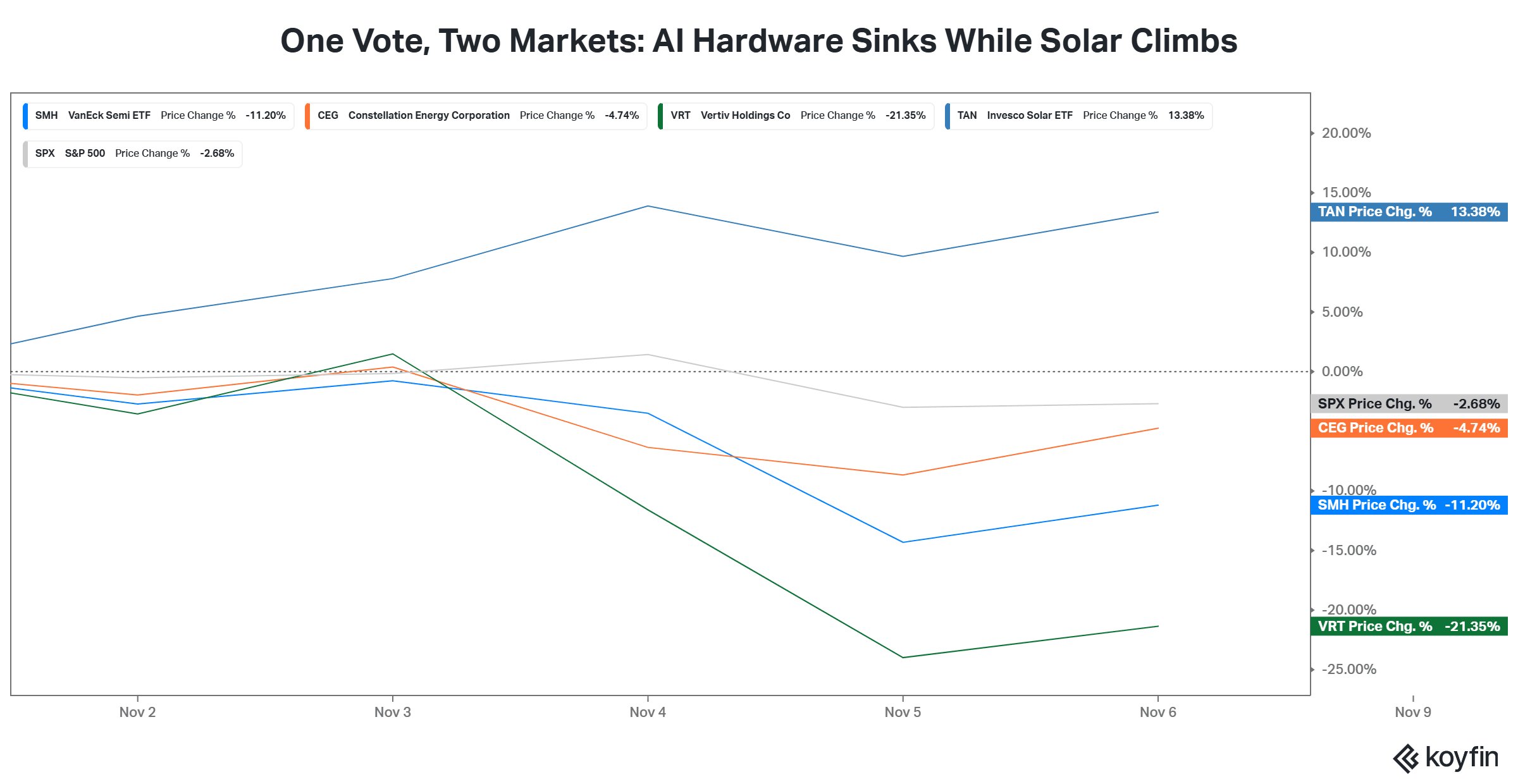
Vertiv (VRT.US) is the test paper for this sell-off. The data center equipment provider just handed over strong results and raised guidelines last month, but declined last week without any company-level news. Its peers Eaton (ETN.US) and nVent (NVT.US) declined simultaneously. This is the key sample that distinguishes “business concerns” from “mood swings” — if the fundamentals don't change and the stock price falls, then it is the valuation that falls, not the business.
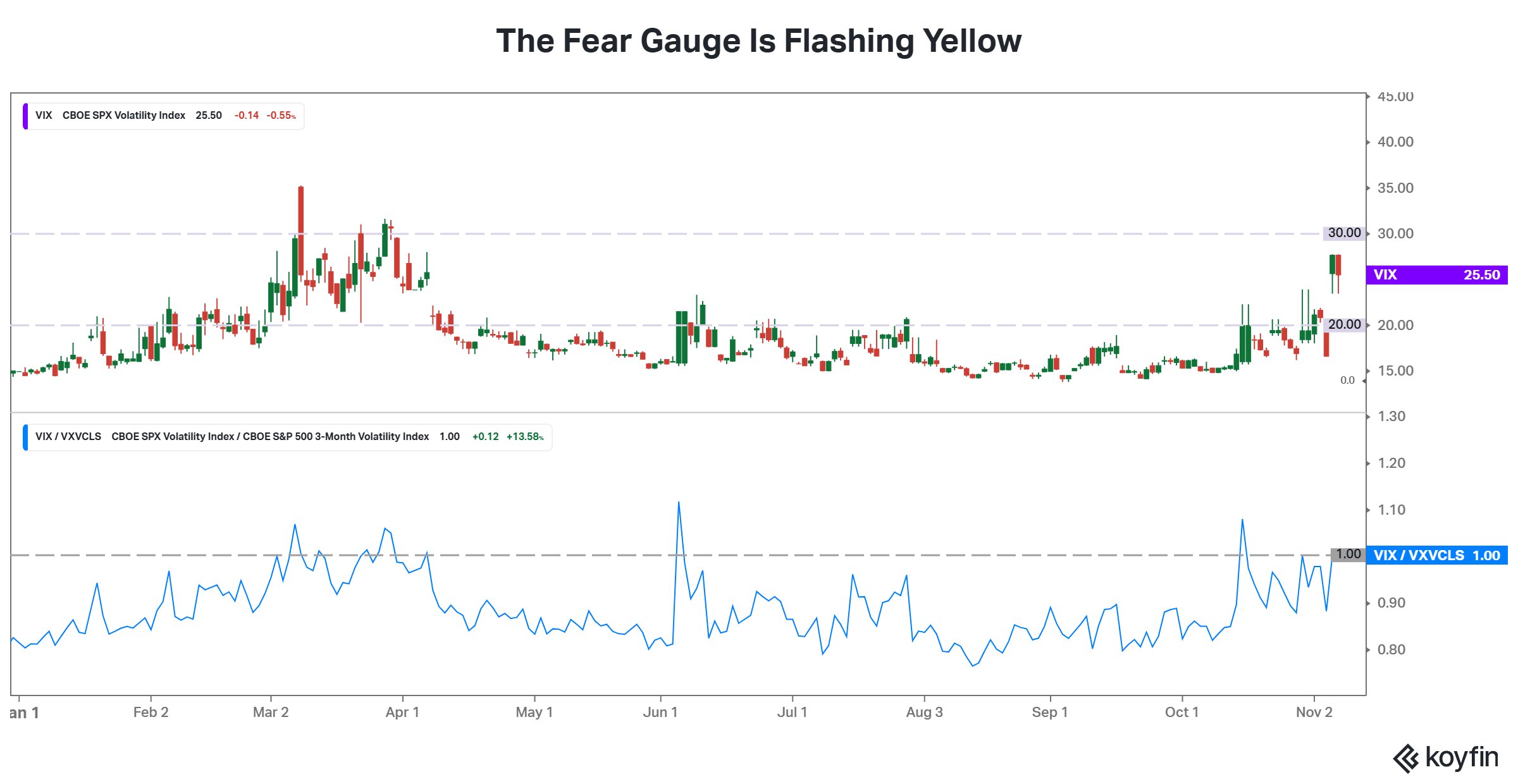
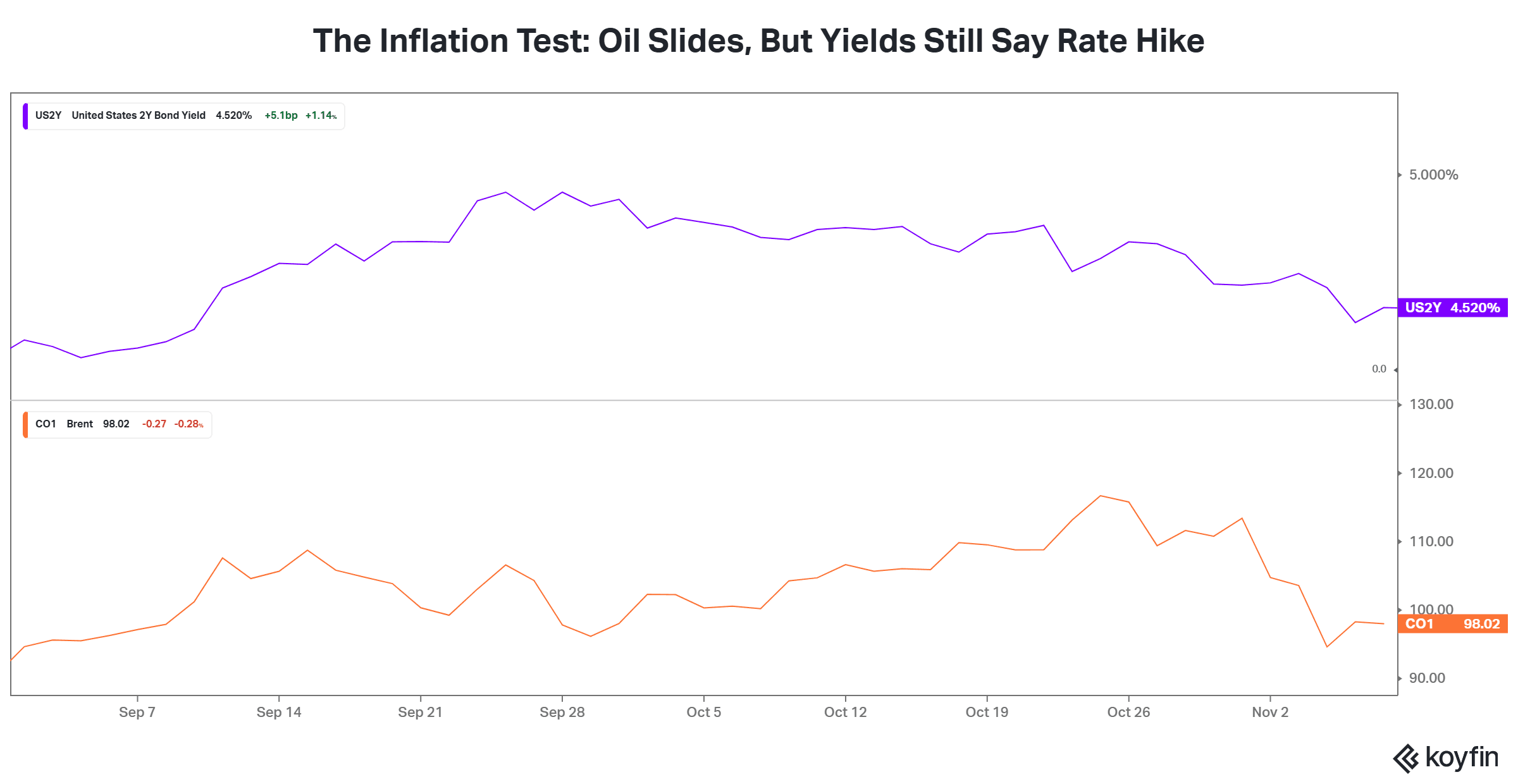
The other two charts focus on volatility and interest rates. According to the framework given in the media subtitle, VIX determines whether the panic will peak, and the US bond yield determines the financing cost and valuation denominator. VIX retreated 9% to 25.63 on Friday, but remained up 32% throughout the week, the biggest weekly gain since mid-October; the 10-year US Treasury yield rose to 4.86%. These two figures coincide with Yardeni's “financial constraints”: if the yield doesn't go down, the data center's financing costs won't go down; if VIX doesn't go down, the crowded positions will have to continue to be cleared.
Waiting for verification of CPI and AI financial reports this week
US stock futures rose on Monday, and investors are evaluating whether tech stocks can recover from last week's sharp decline while awaiting key CPI inflation data and AI-related company earnings reports. Dow futures rose about 400 points or 0.76%, S&P 500 futures rose 0.36%, and Nasdaq 100 futures rose about 0.5%. The pre-market ETF performance is more evident in the structure: SPY rose 0.31%, QQQ rose 1.4%, while DIA fell by about 0.40% — technology led the way and blue chips weakened, which is in line with the pattern of “AI being thrown and defensive stocks resisting the decline” last week.
In the Stocktwits community, retail investors' sentiment towards SPY has improved from “bearish” to “neutral,” with “bearish” on QQQ and “bullish” on DIA — a combination of “broad-market defense and prudent technology”, which indicates that the intention to go undercover is returning, but no consensus has yet been reached.
For this report, the real test point is close: whether the assumption that CPI determines the financing costs holds true, and the AI-related companies' financial reports and guidelines determine whether the 2028 profit curve can still hold up. Colder inflation readings can give tech stocks a breath, but data center construction and political resistance won't go away because of a single CPI figure. Yardeni's judgment is a “speed bump” rather than a “wall,” and the market wants to answer — how long is this speed bump actually.