


In Q3 2026, China Free Trade (01880) handed over an “anti-common sense” quarterly report — revenue is still shrinking, but profits are clearly accelerating.
According to financial reports, in the third quarter of 2026, the company's revenue was 11.166 billion yuan, down 4.66% year on year, and still not corrected; however, net profit to mother was 564 million yuan, up 24.64% year on year, net profit after deducting net profit of 565 million yuan, up 28.19% year on year. The growth rate after deducting non-return growth was still nearly 4 percentage points higher than the growth rate of return to mother.
However, capital markets have yet to respond simultaneously to this “profit first” quarterly report. Since 2026, China's free Hong Kong stock market has shown an overall trend of fluctuating downward trend and intermittent restoration. The three-quarter report fell close to a low level — as of November 9, the year-to-date decline was about 42%, and the stock price was reported at HK$45.26. What is behind this is that the market is still absorbing revenue pressure and waiting for profit improvements and the second growth curve to be realized.
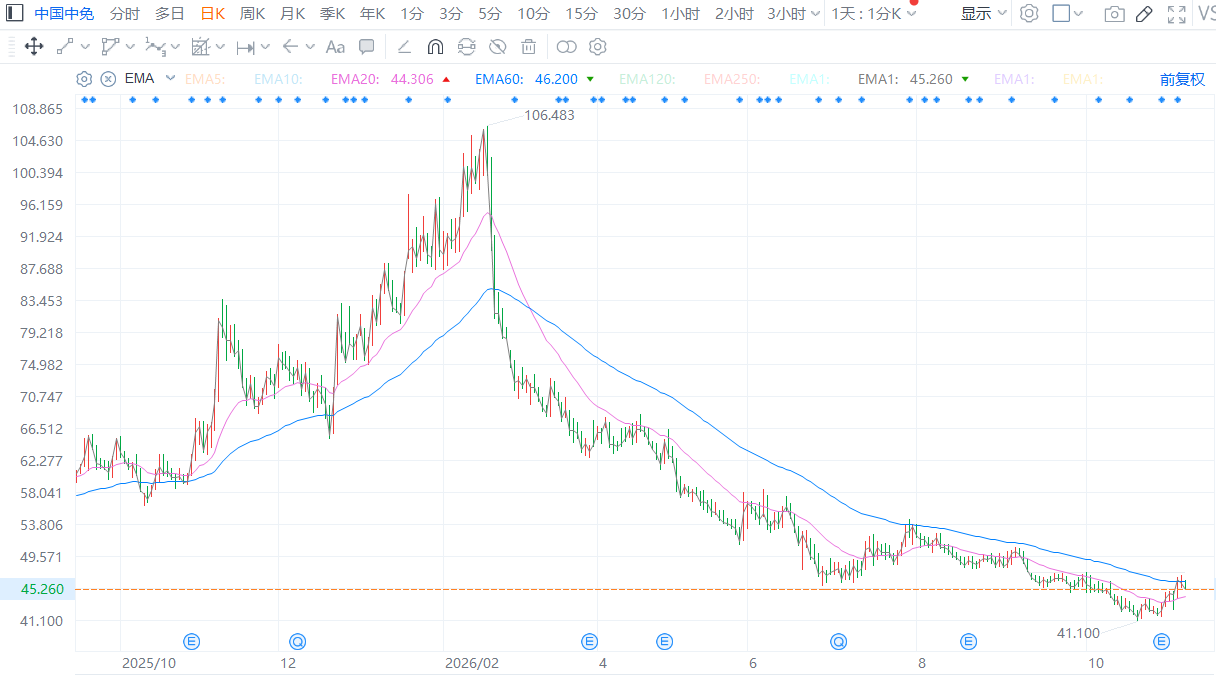
(Market source: Futu)
So, as far as China's exemption is concerned, will this Q3 profit-leading performance be a sign of a valuation repair?
Profit surpasses first, revenue comes later: the inflection point will begin in 2025Q4
Lengthen the timeline. The starting point of the story is in Q4 of 2025, not Q3 of 2026.
For the whole of 2025, free revenue was 53.694 billion yuan and net profit to mother was 3,586 billion yuan. The outlook seemed lackluster, and the revenue side was still declining year-on-year. However, when split into a single quarter, net profit for Q4 in 2025 was 534 million yuan, up 53.59% year on year. After deducting growth, the growth rate was as high as 87.17%; Q4 gross profit margin was 33.34%, up nearly 5 percentage points year on year, the highest level in Q4 since 2021.
Entering 2026, the profit growth rate of exempted profits is still being realized at an accelerated pace. Q1 revenue was 16.906 billion yuan, up 0.96% year on year, net profit to mother was 2,348 billion yuan, up 21.18% year on year, gross profit margin was 33.63%, up 0.65 pct year on year, and increased month-on-month for two consecutive quarters. Q2 The profit side continued to maintain positive growth while revenue was still under pressure. By Q3, the net growth rate had risen further to 28.19%, and the profit growth rate for the three quarters had stepped out of a quarterly acceleration ladder.
As a result, a comparison that is easily overlooked emerged — net profit from mother for the first three quarters of 2026 was 3.67 billion yuan, which has already exceeded 3,586 billion yuan for the whole of 2025. Revenue has yet to return to the level of the previous cycle, and profits have taken the lead in surpassing the previous cycle.
Of course, profits have been ahead of revenue for three consecutive quarters, and if you just boil it down to “narrowing discounts” or “exchange rate friendliness,” you're underestimating the problem. Taken apart, the sources of profit are distributed at three different levels, at least two of which have structural implications.
First level, Hainan: The share is rising, which is more important than the industry growing.
After a year of customs closure, the duty-free market on the outlying islands of Hainan is indeed being restored. According to Haikou Customs statistics, from November 2025 to October 2026, the amount of duty-free shopping on the outlying islands was 33.45 billion yuan, +13.8% year-on-year, and the number of shoppers +8.6% year-on-year. However, China's share of the Hainan outlying islands duty-free market increased by more than 2 percentage points over the same period. This means that a significant portion of the Q3 profit increase was not distributed by the industry beta “following the trend,” but was taken from competitors by relying on share α. In a market where total volume is expanding moderately, the profit elasticity of share leaders is naturally higher than the industry's growth rate itself — because of fixed advantages such as procurement negotiations, brand launches, and port resources, it will be amplified rather than diluted when the share is expanded.
Second level, internationalization: DFS is more than just contributing; it's changing the texture of profits.
The international business increased 71% year-on-year in the first three quarters of 2026. On the surface, the volume was consolidated after the DFS Greater China acquisition was completed. However, what is more worth keeping an eye on is the growth rate figures, but the structure of this deal: no more than US$395 million was used to acquire DFS Hong Kong Macau and intangible assets in Greater China. The LVMH Group and the Miller family simultaneously subscribed to free H shares. The three parties were bound by a long-term relationship between the brand, IP, and channel, rather than a one-time asset transfer. The Hong Kong and Macau stores brought high-net-worth traffic and high-end consumption scenarios, while LVMH's shareholding brought supply-side voice. The 71% growth rate will decline as the base figure rises, but the upward effect of internationalization on the gross margin center is the one that lasts longer in the profit table.
Third level, categories and scenarios: The drivers of gross margin are changing anchors.
The Q3 gross profit margin was 33.99%, +1.98 pcts year over year. Many brokerage firms attributed this to the optimization of the category structure, the increase in the share of high-end luxury, and the positive exchange rate. However, looking at a deeper level, Pudong Airport's Duty-free Guochao Zone, the largest single airport in the country, and Sanya Duty Free City introduced traffic IP and a “duty-free plus tax” complementary business format, pointing in the same direction: China Free is migrating from a “channel provider for branded duty-free goods” to a “consumer scenario operator.” Once the ability to operate the scenario is settled, the driving force of gross margin is no longer completely bound to cyclical variables such as discount strength and exchange rate fluctuations, but is partially switched to structural variables such as category combinations and experience premiums.
It is easy to see that profit inflection point occurred in the fourth quarter of 2025, and growth accelerated quarter by quarter by 2026, and China Insurance has broken out of the beta market, which simply depends on the recovery of the industry. Consolidating Hainan's market share internally, opening up a high-end international supply chain to the outside world, and increasing gross profit margin by superimposing business transformation. Multiple structural variables will continue to boost corporate profit ceilings.
Customs clearance bonuses on the first hand, Hengqiang on the other hand: ushered in a “double click” moment
It is certainly important for companies to practice internal skills, but if they can take advantage of the industry's development, they can often do more with less. Meanwhile, China's immunity stands at the intersection of two historic opportunities.
On the one hand, there are policy dividends. From “switching” to “capacity expansion,” the customs closure effect is being unleashed at an accelerated pace.
Zhitong Finance has observed that the Hainan Free Trade Port has been closed for ten months, and its impact is moving from “system breakthroughs” to “consumption expansion.” The core of customs clearance is “institutional openness,” which aims to create a more open, free, and convenient consumption environment through policies such as zero tariffs, low tax rates, and simplified taxation.
For duty-free shopping, this is certainly a huge benefit. After customs closure, the duty-free shopping experience will be more convenient (such as “buy and refund” offsite with departure tax refunds), and product categories will continue to expand, which will effectively attract the return of overseas consumption. As the absolute leader in the Hainan duty-free market and the holder of a full license, China Free China is undoubtedly the most direct and biggest beneficiary of this consumer return feast. Its first-mover advantage, scale effect, and channel control will be further amplified under the catalyst of policy dividends. According to the “2025-2026 Free Consumption White Paper” published by China Exemption, the amount of duty-free spending on the outlying islands increased by 46.8% year-on-year in the first month of customs clearance, and 27.1% year-on-year in the first month of implementation of the New Deal.
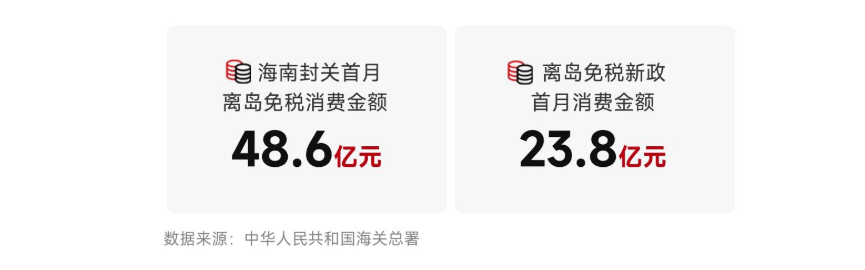
(Photo source: “2025-2026 Free Consumption White Paper”)
On the other hand, as the concentration of the industry increases, China Free has become a veritable duty-free leader in the country, and market resources continue to be concentrated on the leaders, forming a pattern of strong players.
China's duty-free retail market is undergoing a profound consolidation and concentration. According to the Zheshang Securities Research Report, China's duty-free retail market is expected to reach 450 billion yuan by 2026. Among these, China has built irreplaceable license barriers, supply chain barriers, and scale barriers with the most comprehensive domestic duty-free business license, covering all outlying islands, ports, cities, and overseas racetracks. In the context of standardized development of the industry and increased competition, it is difficult for small to medium players to compete with the supply advantages, cost advantages and operational advantages of leading companies. Industry concentration continues to increase, and the company's leading position continues to be consolidated.
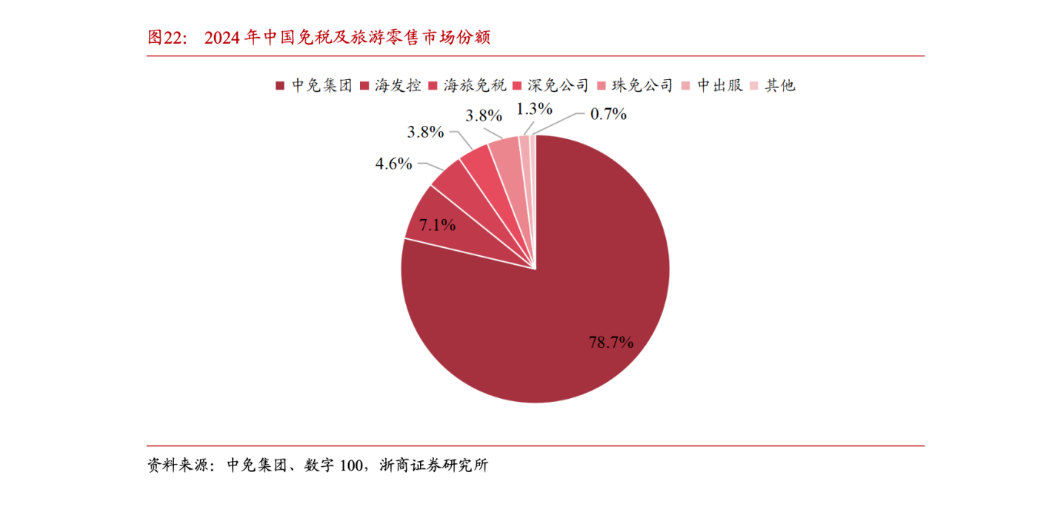
(Image source: Zheshang Securities)
As can be seen, as the dual trend of policy dividends and industry concentration has already blown, China is the biggest recipient of this joint effort, holding scarce licenses and omni-channel layout. It is foreseeable that with the continuous release of customs clearance effects and the accelerated convergence of market resources, the value of the leader will continue to be revalued.
Summarize
Although the capital market has concerns about the pace of consumption recovery, China's solid three-quarter report strongly responds to market concerns with real profit growth and clear strategic progress. Many mainstream brokerage firms maintained a “buy” rating after the financial report and made positive valuation judgments based on the company's clear path of profit growth. Among them, Shenwan Hongyuan Securities stated that profits continued to grow, and the increase in Hainan's market share went hand in hand with international expansion, maintaining a “buy” rating.
The market may price short-term fluctuations, but it will eventually pay a premium for determined growth and continued returns. China's free stock price is awaiting an opportunity to recalibrate its value anchor. This three-quarter report is just that opportunity — it uses data to prove the company's profit resilience and long-term value, and is expected to push the stock price back to its true value, and even usher in a “double hit by Davis.”