


The Zhitong Finance App learned that on November 9, Bernstein's US semiconductor team maintained Nvidia's target price at $400, rated it “outperforming the market.” The entire report has been rewritten as a risk warning in the investment conclusion: the opportunities for data centers are still huge, but recent allegations against the CEO have brought “additional key personnel risks and a ceiling that could last for quite some time.” The sentence weighs a lot more than “maintaining a buy.” It is tantamount to admitting that in Nvidia's valuation model, there is a variable that has never been separately priced before — Hwang In-hoon himself.
What happened
On October 29, the media reported that the US intelligence community determined that Alice Huang (Alice Huang), an executive of the Singaporean data center company Megaspeed, is a source of Chinese intelligence and has a close relationship with Huang Renxun. A day or two later, the media followed up, saying that Singaporean officials echoed some of the concerns of the US side.
On November 5 (Thursday), the chairmen of the three House committees sent a joint letter to Wong In-hoon — Chairman of the Foreign Affairs Committee Brian Mast (Brian Mast), Chairman of the US House Special Committee on US-China Strategic Competition John Moolenaar (John Moolenaar), and Chairman of the Special Committee on Intelligence Rick Crawford (Rick Crawford) — requesting that he volunteer to attend a closed-door briefing on November 18 to explain his dealings with Huang Le and Nvidia's security policy to prevent spying by foreign rivals. “Congress must determine the extent of risk to America's national security,” the letter reads.
On November 6, the media reported that the relationship was “in the nature of a relationship,” citing a US intelligence memorandum earlier this year. The next day, Democratic Senator Chris Coons (Chris Coons), who will be the chairman of the Senate Foreign Relations Committee in January next year, called this relationship “ridiculous” on X and promised that Congress would launch an investigation.
On November 8 (Sunday), Nvidia's board of directors announced the launch of an independent investigation: a committee composed of independent directors and hired external independent lawyers to review all available data; at the same time, it stated that there was no reason to believe that national security or Nvidia secrets had been leaked. Wong In-hoon sent an apology letter to all employees, admitting that he had been unfaithful to his wife — “My actions hurt her and our children, and there is no excuse for what I did”. According to reports, he admitted the affair. A company spokesperson added: “Today's news won't slow Nvidia down.”
Why does Bernstein say “spy” is currently untenable
What is most worth reading about this report is that it deconstructs the logic of the “Beauty Plan” narrative piece by piece, and it is unceremoniously dismantled.
The first flaw is the need for lobbying. The core concern of the accusation is that Huang Le may influence Huang Renxun's lobbying for the US to ease chip sales to China. Bernstein thought: He did this already, didn't need anyone to encourage it — and it didn't work. The proof is its revenue. Nvidia China (including Hong Kong)'s revenue share fell from 25% — 28% in FY2022 to 9% in the fourth quarter of FY2024; H20 pushed it back 15% in 2025, then bottomed out to 5% in the third quarter of FY2026, and was 8% in the most recent quarter (second quarter of FY2027). The two steepest declines in the curve correspond to two rounds of export controls in October 2022 and October 2023, respectively.
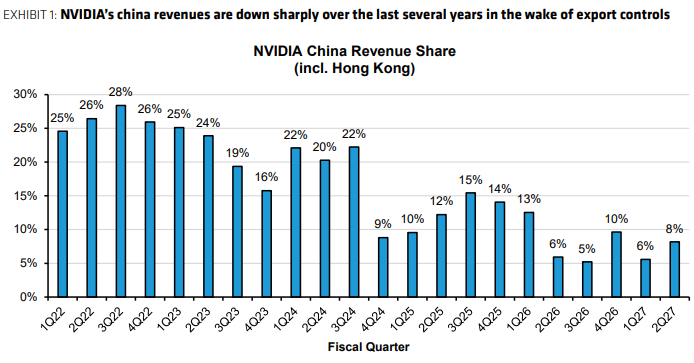
The second flaw is that what is being sold is worthless. The other half of the concern is “advanced AI chips coming to China.” However, the report indicates that what the US currently allows for export (H20, and H200, which is released in limited quantities) is already several generations behind current generations; moreover, these products are not being sold in the region, mainly because China itself is promoting domestically produced alternatives. Digital evidence: After obtaining the license in August 2025, H20's revenue for the full year of fiscal year 2026 was only about US$60 million; the H200 had zero revenue in the quarter ending January of this year, and shipments in the July quarter were less than 1% of the data center revenue. In October of this year, it was reported that the B300 could not be sold to Chinese buyers.
The third flaw is the path. If she really is a spy, why take the CEO path of being the most expensive and most easily exposed? The report's counterquestion is straightforward: there are always ways to obtain information without going through Hwang In-hoon himself, such as bypassing the company's equipment.
The conclusion is a juxtaposition of the two sentences: the spying accusation “currently looks more like a form than substance,” but this matter “has a very poor perception; this is the bottom line.”
The meaning of “extremely poor perception”
Bernstein didn't stop at this judgment; it gave two transmission paths.
The first one is politics. The report says that even if the accusation is lacking in substance, the title “Nvidia CEO has been taken down by a Chinese beauty plan” is, to put it mildly, a serious distraction; in other words, it is a congressional hawk who is already dissatisfied with the current policy towards China, and the incoming Democrats, who are dissatisfied with the close relationship between Huang Renxun and Trump, on the other.
This is not an assumption. The Democratic Party won the Senate and House of Representatives after the midterm elections; Mullenard's committee filed a bill on Nvidia's Asian chip sales as early as April 2025. Bernstein's judgment is that demand is unlikely to be affected, but as AI infrastructure becomes more of a political issue, it is “likely” that regulatory risks will rise. This news will keep Nvidia and its CEO at the center of this debate.
The second one is the key person. This section is the heaviest: “Nvidia is not an ordinary company, nor is Hwang In-hoon an ordinary CEO; he is Nvidia.” He sets long-term strategy and direction, and supposedly has 60 direct reporting subordinates. As a result, “if he is unwilling or unable to continue leading for any reason, it is currently unclear who can or is qualified to take over”.
The report also points out an irony: if Huang Renxun leaves office, the most obvious beneficiary will be China. So it wants a “calm mind to prevail.”
Megaspeed: The Half That Makes “Form Over Substance” Uncomfortable
Just looking at Bernstein's teardown, this incident is like an amplified gossip. But putting Megaspeed out, the accusation was half as credible.
The company's predecessor was the Singaporean subsidiary of the game company Seventh Avenue and was registered in 2015; it was renamed Megaspeed International in March 2023; Huang Le and Cang Yang appeared on the list of directors. The shares were transferred to the British Virgin Islands company controlled by Huang Le in the same month; it was also sold to Swiftdata, a shell company controlled by Singaporean businessman Tan Yong Pong in November — four days later, it became Nvidia's cloud partner.
There is a serious mismatch between the scale of procurement and its own size. According to reports, its Malaysian affiliate Speedmatrix purchased at least US$4.8 billion of AI devices containing Nvidia chips between June 2024 and February 2026. According to Malaysian and Indonesian customs records, Megaspeed imported about 136,000 Nvidia chips, more than half of which were the latest generation Blackwell, and most of them arrived more than half a year ago; while Nvidia sent someone to the computer room to take stock, there were only a few thousand Blackwells on site. During an inspection in September 2024, investigators discovered that some of the equipment was unsealed and lying in the box.
The company had only $5.7 million in cash at the end of 2023, and the order was placed with Inspur's affiliate Aivres in the US. Nvidia's response was: Megaspeed is a “small commercial cloud”, no different from cloud customers in other regions; the company has taken stock of the equipment and has not found that the chips have been transferred to China. Megaspeed denied involvement in the illegal shipment, while the Singapore police confirmed an ongoing investigation into the company.
Overlooked counterevidence: both Singapore and Beijing denied key circumstances
Bernstein specifically quoted the Singapore Ministry of Home Affairs's rebuttal: the ministry made it clear that “the Singapore government and its officials” had never expressed any opinions on Huang Le's relationship with Huang Renxun or her claim that she was a so-called Chinese intelligence source; and “no such investigation has been carried out on Alice Huang” — but confirmed that the investigation into Megaspeed is still ongoing.
In other words, the “Singaporean officials echoing US concerns” part of the report was denied by the Singapore government itself. The Chinese Ministry of Foreign Affairs responded by “catching the wind and catching the picture,” adding that the relevant reports “simply slander and discredit China.”
So far, no party has brought charges against Wong In-hoon or Wong Lok. The subject of the Board's investigation was “whether it became the target of foreign intelligence activities,” not “whether it was leaking secrets.”
The market dropped first, and it wasn't because of this
The timing is critical: this round of decline occurred before the news broke. The market value once reached about 5.77 trillion US dollars on October 6, then shrank more than 800 billion US dollars in the month; from October 28 to November 5, the stock price fell from 215.38 US dollars to 181.60 US dollars, down 15.7% in seven trading days; on November 6, it rebounded 2.78% to 186.64 US dollars, and the market value was about 4.51 trillion US dollars.
In other words, the market's pricing order is: first drop one round for the sustainability of AI capital spending, then drop the second round for the CEO scandal. The first round kills numerators (profit expectations), and the second round kills the denominator (risk premium).
Retailers and institutions split here: According to Stocktwits, Nvidia is the platform's most popular code, and retail sentiment is “extremely bullish”; sellers and buyers are almost all cautious.
The disagreement is not “is there anything wrong”, but “will Hwang In-hoon step down”
Think the risk is real: Yorkville Ives partner Dan Ives called it Wong In-hoon's “dark circle moment,” which is expected to trigger multiple congressional investigations and bluntly stated that “according to board findings, there is a real risk that Wong In-hoon will be removed”; Future Fund managing partner Gary Black is more direct — “I doubt that Wong In-hoon can continue to be CEO” and warned that many fund managers will reduce their holdings in the next few weeks; Citi's Atif Malik team takes corporate governance and long-term leadership Layer stability was listed as a major concern.
I don't think there will be a change: Pepperstone research director Chris Weston said that if the market really thought he was going to step down, “it would be a complete bloodwash,” and apparently not now; eToro's Josh Gilbert believes the investigation will damage sentiment and not change long-term fundamentals unless it evolves into a high-level change.
Jim Cramer, a well-known economic commentator: “If I didn't own Nvidia, I wouldn't buy it on Monday.” His logic was not a moral judgment, but a cost of time — complexity meant lengthy investigations, and lengthy investigations were “dead money” for shareholders. He also pointed out a detail: Hwang In-hoon initially denied the relationship before admitting it.
SemiAnalysis's Dylan Patel extended the timeline even longer: there will be no changes in the short term, but “the Democrats will summon him to Congress to thoroughly investigate GPU sales of related companies, and that is when the boots may fall.”
What you really need to look at are the two dates
After the market on November 17, Nvidia announced results for the third quarter of fiscal year 2027. The previous guidance was revenue of 108 billion US dollars, fluctuating 2% up and down, increasing by nearly 90% year over year, gross profit margin of 74%, and fluctuating 50 basis points up and down. The base for the full fiscal year 2026 was revenue of US$215.94 billion and net profit of US$120.8 billion.
On November 18, Wong In-hoon was asked to appear at the closed-door briefing. Bernstein pointed out that this is still an “invitation”; it is neither a subpoena nor a coercion.
The nature of the two matters is completely different: the financial report answered “is business good or not,” and the closed-door briefing answered “how expensive is politics.” For a stock with a forward-looking price-earnings ratio of more than 20 times, the former determines the short-term direction, while the latter determines the long-term discount.
The real contribution of this report
Bernstein didn't change anything; he just added one sentence. But this sentence translates a “thing that can't be modeled” into two variables that can be priced — regulatory risk premium, and key person discount.
The reason why its argument stands is because it does not defend Wong In-hoon: admitting that the perception is extremely poor, admitting that “he is Nvidia” is a risk in itself; it only points out that “he is being deceived by beauty” chain lacks evidence at every step, and sales of the so-called “lobbying results” to China have shrunk to single digits.
In turn, the report also highlights the failure of this logic: once the investigation finds an undisclosed conflict of interest or export compliance issue, the nature of which changes from “private morality” to “governance,” $400 will have to be recalculated — $400 calculated based on approximately 21 times FY28-29 non-GAAP earnings of $19.04 per share, assuming that $19.04 was established; and the premise of $19.04 is that Hwang In-hoon is still there.