


Nvidia (NVDA) plunged roughly 5% in Monday premarket trading to about $177, down from Friday's close of $186.64, after its board announced an independent investigation into whether CEO Jensen Huang was the target of a foreign intelligence effort, a move that would erase roughly $225 billion in market value.
The probe follows Huang's admission of an extramarital affair with a former Megaspeed executive whom U.S. authorities reportedly view as a Chinese intelligence asset, an unprecedented governance shock for the AI bellwether.
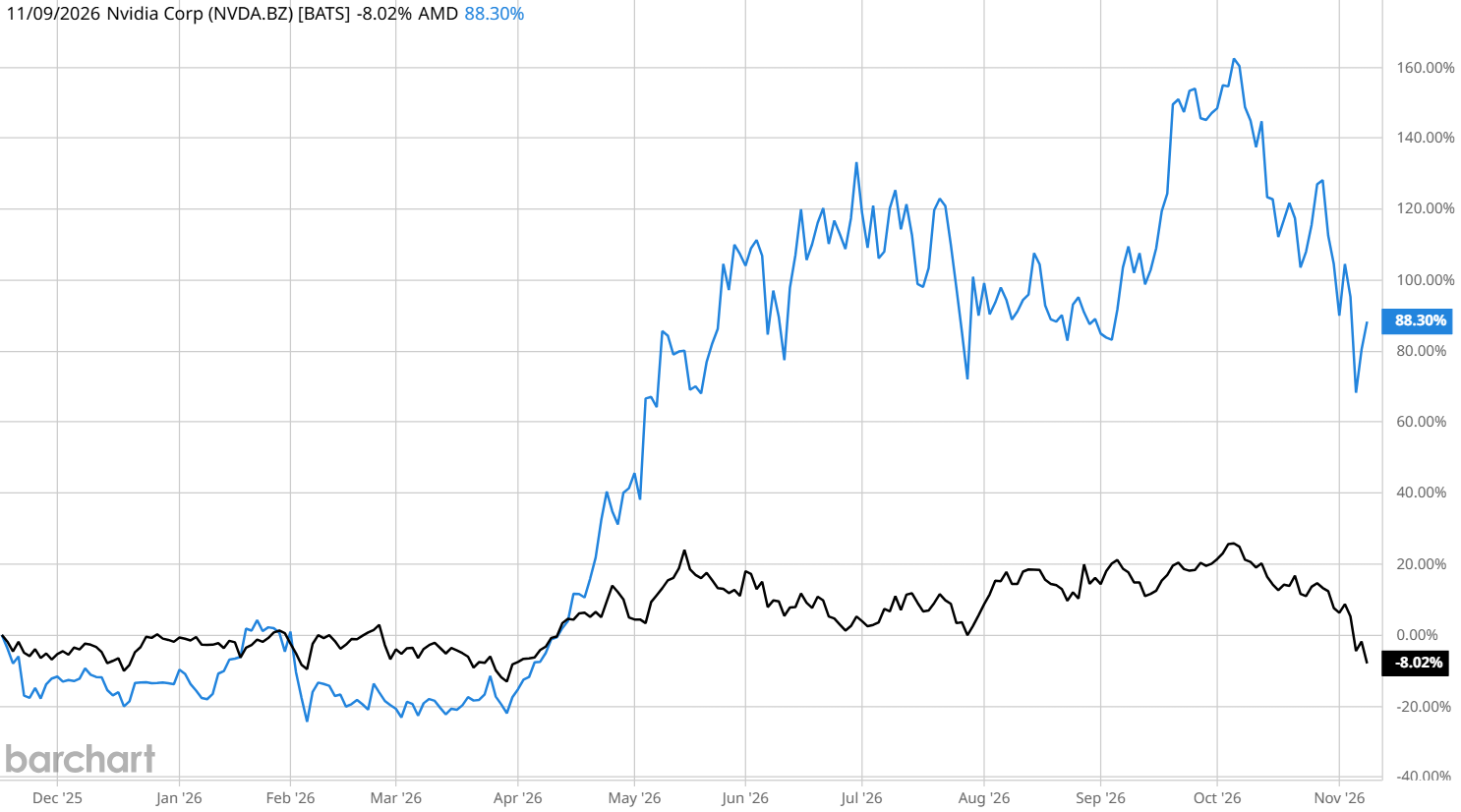
Yet the most telling move came elsewhere, as artificial intelligence (AI) peers like Advanced Micro Devices (AMD), Broadcom (AVGO), and Taiwan Semiconductor (TSM) all gained in early trading, confirming that the selling is Nvidia-specific rather than a sector-wide rejection of AI hardware.
Key-Person Risk Comes Due for NVDA
The core issue is key-person risk, which is more acute at Nvidia than at most mega-caps because Huang runs an unusually flat organization with dozens of direct reports and has no public succession plan.
Unlike some founder-led peers, Nvidia also has no dual-class structure to entrench Huang, so his standing rests more directly on how the board's findings land.
The board has expressed confidence in Huang and says it has no reason to believe secrets or national security were compromised, but it has set no completion date for the review.
That missing timeline means the uncertainty could linger well past Nvidia's next earnings release.
Monday's drop compounds a punishing run that has left the stock down about 27% from its October record, as post-midterm fears over data center regulation and AI capital spending hammered the sector.
Oppenheimer Bets on AMD
Elsewhere, AMD climbed about 4% toward $466 after Oppenheimer this morning upgraded it to “Outperform” with a $600 price target, implying roughly 33% upside, a call that rests on fundamentals rather than on Nvidia's troubles.
Oppenheimer projects 135% data center growth next year, following a third quarter in which AMD's revenue rose 45% to $13.38 billion and data center sales nearly doubled.
Those figures show that AMD's momentum predates, and stands apart from, Nvidia's governance turmoil.
Governance, Not Demand
The market appears to be pricing governance uncertainty rather than any deterioration in demand, with Nvidia having guided to $108 billion in quarterly revenue and its Vera Rubin platform now shipping.
With shares trading at a historically compressed earnings multiple, a clean investigative outcome and confident commentary alongside fiscal third-quarter results on November 17 could spark a sharp relief rally for NVDA stock.
The Risks Still Stacking Up
However, the open-ended board review, China-related export scrutiny ahead of the APEC summit, and one analyst downgrade to “Hold” all argue for caution in the near term.
House Republicans have also requested a closed-door briefing on November 18, just one day after the earnings report, which puts Washington's scrutiny directly on the heels of Nvidia's biggest scheduled catalyst.
The Next Catalyst to Watch
All eyes now turn to the November 17 earnings report, where management will need to deliver numbers convincing enough to shift the conversation from Huang's personal life back to Nvidia's order book.
Until then, AMD's fundamentals-driven rally suggests investors haven't abandoned AI hardware but have simply found a seat with less headline risk.
This article was created with the support of automated content tools from our partners at Sigma.AI. Together, our financial data and AI solutions help us to deliver more informed market headline analysis to readers faster than ever.
On the date of publication, Sarah Holzmann did not directly have a position in any of the securities mentioned in this article. All information and data in this article is solely for informational purposes. For more information please view the Barchart Disclosure Policy here.