


Corporate leadership rarely determines whether a company succeeds or fails overnight. But when a business becomes synonymous with the person running it, investors face risks that don't appear on an earnings statement.
Visionary founders can attract customers, inspire employees, and convince Wall Street to pay premium valuations for future growth. Losing that leadership can be costly, particularly when a company's stock price assumes years of continued success.
The artificial intelligence boom has produced few executives more closely identified with their companies than Nvidia's (NVDA) Jensen Huang. Now an unfolding controversy threatens to test whether the chipmaker's extraordinary success can survive without its most recognizable asset.
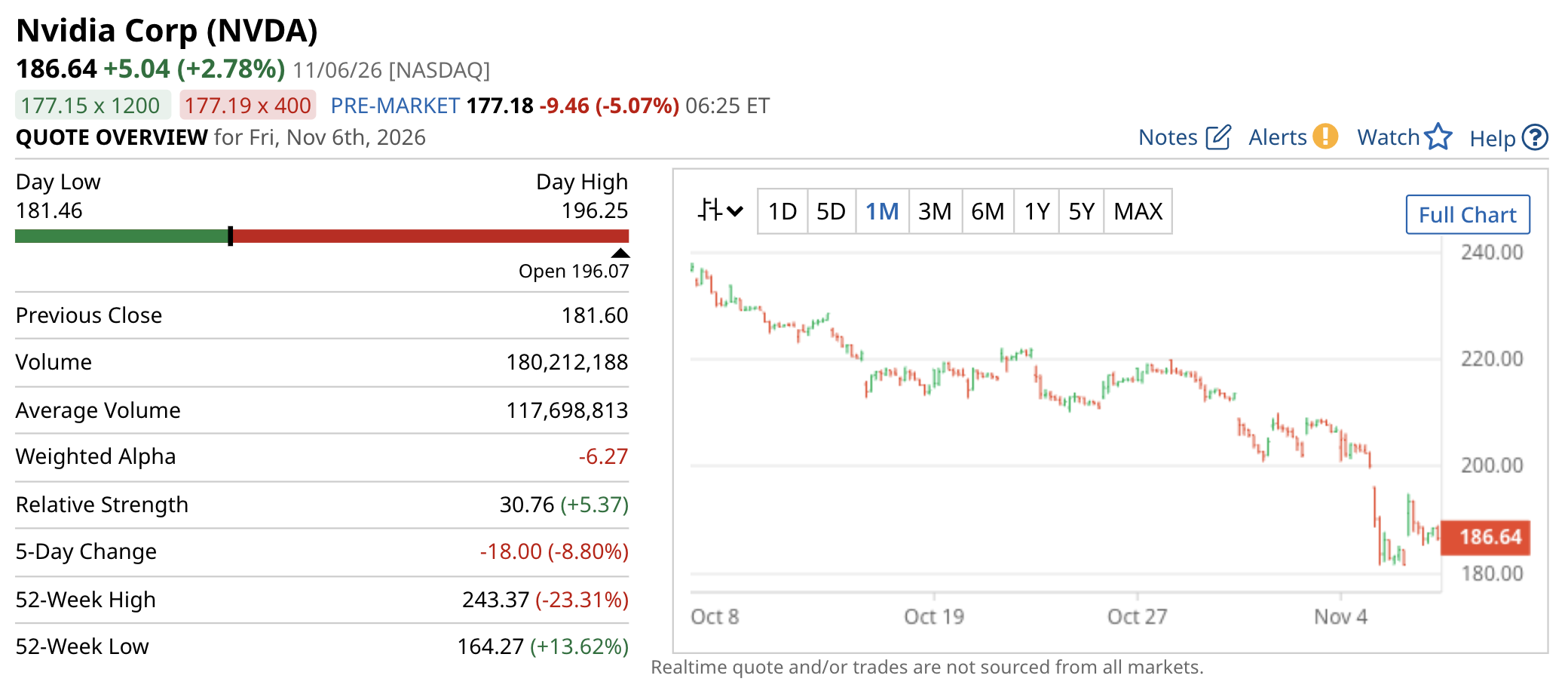
A Scandal Threatens Nvidia's Leadership
Nvidia CEO Jensen Huang has acknowledged having an extramarital affair amid allegations that the woman involved was working for Chinese intelligence.
According to Reuters, U.S. authorities identified Alice Huang, a former executive at Nvidia customer Megaspeed, as a suspected Chinese intelligence asset. Nvidia's board announced an independent investigation on Nov. 8, overseen by outside counsel.
Importantly, neither Huang nor Nvidia has been accused of criminal wrongdoing. The board says it has no reason to believe company secrets or national security were compromised. China denies the espionage allegations.
Nevertheless, the controversy is widening. Three Republican congressional committee chairs requested that Huang attend a closed-door briefing on Nov. 18 concerning the allegations and Nvidia's security procedures. That scrutiny could keep the company operating under a cloud even if the investigation finds no wrongdoing.
Corporate history offers plenty of examples of executives losing their positions over personal misconduct. Huang's position is complicated by the national security implications surrounding advanced artificial intelligence chips.
The board has expressed confidence in Huang, but shareholders cannot dismiss the possibility of an unexpected leadership change.
Can Nvidia Survive Without Jensen Huang?
Huang co-founded Nvidia in 1993 and transformed a graphics-chip manufacturer into the company at the center of the AI revolution. Its latest financial results illustrate what is at stake.
According to Nvidia's fiscal second-quarter earnings release:
- Revenue reached $96.2 billion, increasing 106% year-over-year (YoY).
- Data center revenue climbed 117% to $89 billion.
- Gross margins reached 75%.
- Free cash flow totaled $21.3 billion.
Those results reflect more than Huang's personal charisma. Nvidia has built an ecosystem of hardware, software, and customer relationships competitors cannot easily replicate.
Its Vera Rubin platform could generate $40 billion in revenue opportunity per gigawatt of AI computing capacity, according to company estimates. Yet Huang has been instrumental in creating that advantage. He isn't simply Nvidia's chief executive. He's its chief evangelist, strategic architect, and most recognizable salesman.
Losing him could be a greater challenge than losing an ordinary CEO.
A Multibillion-Dollar Divorce Complication
There's another potential risk investors shouldn't overlook: Huang's marriage. His wife, Lori, could seek a divorce following the affair, raising questions about how the couple's enormous Nvidia holdings would be divided.
Nvidia's 2026 proxy statement shows Huang beneficially owns 3.58% of the company, a stake worth approximately $161 billion at its recent valuation. A hypothetical division of half that value would amount to more than $80 billion.
But the situation isn't straightforward. Lori already shares voting and investment authority over hundreds of millions of Nvidia shares held through family trusts. A divorce could complicate those arrangements, potentially changing ownership or creating pressure to sell shares.
While there is no indication a divorce is planned at this time, and a settlement wouldn't necessarily require stock sales, for a company already facing uncertainty over its founder's future, this is another potential disruption that deserves investor attention.
History Offers Both Warnings and Reassurance
Apple (AAPL) provides perhaps the clearest example of how leadership can change a company's fortunes.
Steve Jobs' departure in 1985 preceded a decade of strategic missteps and declining competitiveness. His 1997 return helped rescue Apple from financial distress and launched its transformation. Yet Tim Cook subsequently demonstrated that a company can prosper without its visionary founder. Under his leadership, Apple's valuation eventually exceeded $4 trillion. Now John Ternus, who succeeded Cook in September, must prove himself. Apple's battle with Nvidia for the title of the world's most valuable company underscores the enormous expectations surrounding both businesses.
Berkshire Hathaway (BRK.A) (BRK.B) faces a similar transition. Greg Abel inherited Warren Buffett's sprawling conglomerate and must establish his own credibility with investors accustomed to assigning Berkshire a Buffett premium. Abel has already demonstrated a willingness to reshape Berkshire's investment portfolio, but building Buffett's kind of reputation could take years.
Granted, neither company offers a perfect comparison. Nvidia's leadership transition, if one occurs, would be unexpected and potentially contentious rather than carefully planned. That could make the disruption worse.
Bottom Line
In short, Nvidia's business isn't suddenly deteriorating because its CEO faces an investigation. Its revenue growth, margins, and competitive advantages remain formidable. But investors should recognize that Huang himself represents part of Nvidia's investment appeal. An involuntary departure could undermine confidence even if the underlying business remains healthy.
For existing shareholders, the investigation alone doesn't justify abandoning Nvidia. However, investors considering buying should wait for greater clarity rather than mistake scandal-driven weakness for an automatic bargain.
Nvidia may survive perfectly well without Huang. Whether its stock commands the same premium without him is another matter entirely.
On the date of publication, Rich Duprey did not directly have a position in any of the securities mentioned in this article. All information and data in this article is solely for informational purposes. For more information please view the Barchart Disclosure Policy here.