


D-Wave Quantum (QBTS) is heading into a closely watched earnings event, with the quantum computing company scheduled to report its third-quarter 2026 results before the market opens on Tuesday, Nov. 10. Investors will be looking beyond the headline numbers for evidence that D-Wave’s commercial momentum is translating into stronger revenue growth, particularly as the company expands its dual-platform strategy spanning quantum annealing and gate-model systems.
Wall Street currently expects D-Wave to report third-quarter revenue of roughly $4.3 million, up 16% from the year-ago quarter, while earnings are expected to remain negative at about $0.14 per share. The results will also provide an important update on customer adoption, bookings, and the company’s growth outlook following its recent commercial and government-related developments, including a $100 million support under the CHIPS and Science Act.
With QBTS remaining a highly volatile quantum-computing play, the Nov. 10 report could be a key catalyst for the stock as investors weigh near-term financial performance against D-Wave’s longer-term opportunity.
About D-Wave Quantum Stock
With a market cap of $4.1 billion. D-Wave Quantum is a quantum computing company focused on developing and delivering quantum computing systems, software, and services for commercial, government, and research customers. The company offers both quantum annealing and gate-model quantum computing technologies, pursuing a dual-platform approach. It is currently headquartered in Palo Alto, California.
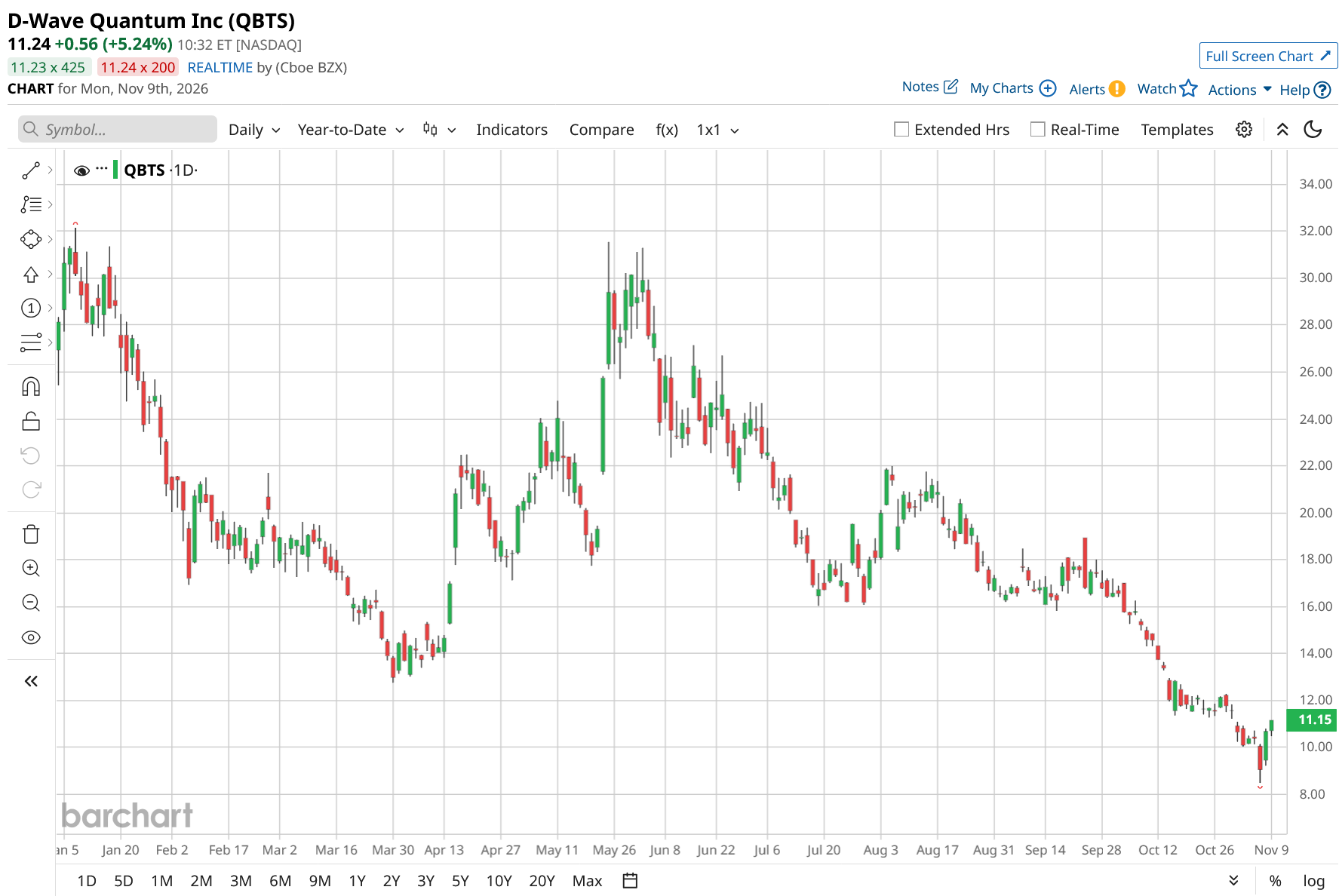
QBTS has endured a sharp pullback in 2026, with the stock down 63% over the past 52 weeks and 58% year-to-date (YTD). Shares have also slumped 25% over the past month, reflecting a broader retreat in quantum-computing stocks as investors have become more cautious about lofty valuations, cash burn, and the pace at which quantum technology can translate into meaningful commercial revenue.
The recent volatility has been particularly pronounced. QBTS fell 12.8% on Nov. 5, closing at $9.05, as quantum stocks came under pressure alongside a broader technology selloff. There was no major company-specific announcement behind the decline; rather, investors appeared to be reducing exposure to high-beta technology and speculative growth stocks. Concerns about competition from better-capitalized players also added to the cautious sentiment ahead of D-Wave’s earnings report.
However, the selling quickly reversed on Nov. 6, when QBTS jumped 18% to $10.68. The rebound came as the broader quantum-computing sector rallied after IonQ delivered a stronger quarter and raised its outlook, lifting sentiment across the industry. D-Wave shares also benefited from renewed optimism around quantum-computing demand and the potential for improving commercial momentum.
With D-Wave scheduled to report third-quarter results before the market opens on Nov. 10, the sharp two-day swing underscores just how sensitive QBTS remains to sector sentiment and expectations surrounding its upcoming results.
QBTS stock is currently trading at 136.16 times forward earnings, which is a premium to industry peers.
Revenue Flat, but Bookings Surge
D-Wave Quantum reported its second-quarter 2026 results on Aug. 6, delivering a mixed quarter in which reported revenue remained essentially flat, while bookings and contracted future revenue showed a significant improvement.
For the quarter ended Jun. 30, revenue was $3.1 million, flat year-over-year (YoY). However, the composition of revenue improved as 62.4% came from commercial customers, up from 45.1% a year earlier, while customers in the Forbes Global 2000 accounted for 47.7% of revenue versus 20.4% in Q2 2025.
The more encouraging figure was bookings, which rose 59% YoY to $2.1 million, while average booking size increased more than 87%. On a first-half basis, bookings reached $35.5 million, up 1,120%. The surge was helped by a $20 million quantum-computing system sale, with the associated revenue to be recognized in subsequent periods.
D-Wave also ended the quarter with $40.7 million in remaining performance obligations (RPOs), up 668%, with approximately 57% expected to be recognized as revenue within the following 12 months.
Profitability, however, remained a major weakness. Its gross profit fell 14% to $1.7 million, while gross margin declined to 55.4% from 63.8%. Meanwhile, D-Wave’s net loss narrowed sharply to $48 million, or $0.13 per share, from $167.3 million, or $0.55 per share. However, adjusted EBITDA loss actually widened 85% to $37.1 million.
Furthermore, management said it expected two quantum-computing system deliveries during 2026, with the related revenue expected to be concentrated in the fourth quarter. D-Wave also highlighted its longer-term technology roadmap, targeting a 20,000-qubit annealing system by 2029 and 100,000 qubits by 2031, while its new gate-model roadmap calls for a 17-physical-qubit system in 2026, 49 physical qubits in 2027, and 181 physical qubits in 2028.
In addition, analysts are forecasting loss per share of around $0.50 for fiscal 2026, a 55% YoY improvement, and again a 2% deterioration to $0.51 in 2027. The consensus loss per share estimate of $0.14 for the third quarter of 2026 indicates a 65.9% improvement YoY.
What Do Analysts Expect for QBTS Stock?
While upside looks limited in the near term, analysts remain bullish about the company’s long-term growth prospects, with most recommending QBTS stock as some variation of “Strong Buy.”
On Nov. 2, B. Riley Securities analyst Craig Ellis maintained a “Buy” rating on D-Wave Quantum but reduced the price target to $27 from $40. Despite the sizable cut, the maintained “Buy” rating indicates that B. Riley remains bullish on D-Wave’s longer-term opportunity in quantum computing.
On Nov. 5, Wedbush analyst Matt Bryson reiterated a “Buy” rating on QBTS stock while lowering his price target to $30 from $37.
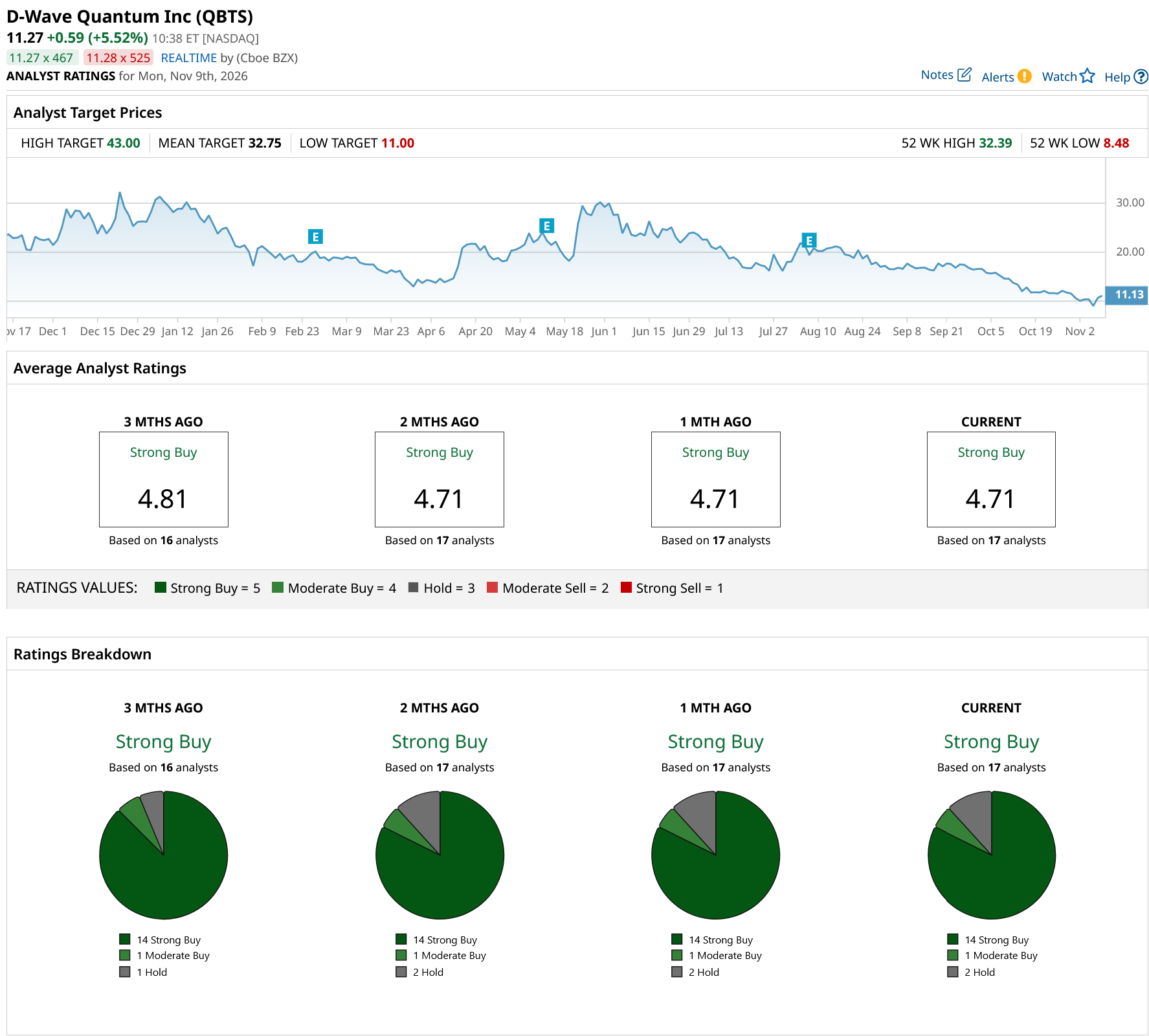
Overall, QBTS has a consensus “Strong Buy” rating. Of the 17 analysts covering the stock, 14 advise a “Strong Buy,” one suggests a “Moderate Buy,” and the remaining two analysts are on the sidelines, giving it a “Hold” rating.
QBTS’ average analyst price target of $32.75 indicates an upside of 191%, while the Street-high target price of $43 suggests that the stock could rally as much as 282%.
On the date of publication, Subhasree Kar did not directly have a position in any of the securities mentioned in this article. All information and data in this article is solely for informational purposes. For more information please view the Barchart Disclosure Policy here.