


November 9, 2026
When the CEO of one of the world's most valuable companies becomes the center of a personal scandal, investors naturally become concerned. But does a CEO's personal conduct necessarily change the financial strength of the company they lead?
That question is especially relevant today as Nvidia (NVDA), a leading manufacturer of artificial intelligence (AI) chips, faces controversy involving its founder and CEO, Jensen Huang.
History offers some interesting comparisons. While every situation is different, previous leadership scandals remind us that a company's stock price and its underlying business do not always respond the same way.
Nvidia's Leadership Under Scrutiny
On November 8, Reuters reported that Nvidia's board had launched an independent investigation into allegations that a foreign intelligence operation had targeted Huang.
Huang acknowledged being unfaithful to his wife. Separately, news reports raised questions about his relationship with a businesswoman allegedly connected to Chinese intelligence.
Nvidia's board stated that it had no reason to believe company secrets or national security had been compromised. However, the independent investigation remains ongoing, and its findings have not yet been announced.
Nvidia shares declined sharply on November 9 as investors reacted to the investigation, illustrating how quickly uncertainty surrounding a company's leadership can affect its stock price.
The news has created another source of concern for investors already watching the company's stock amid broader questions about AI spending.
But does a personal scandal necessarily mean a company's business is weakening?
History Provides Two Interesting Examples
McDonald's (MCD) — 2019
In November 2019, McDonald's dismissed CEO Steve Easterbrook after determining that a relationship with an employee violated company policy.
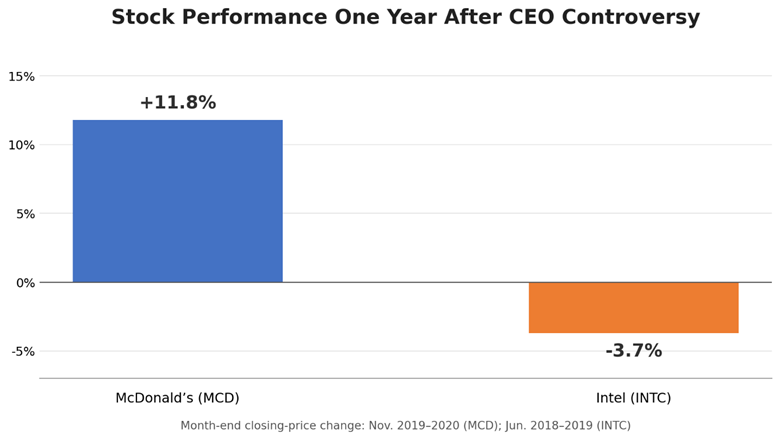
McDonald's stock finished November 2019 at approximately $194.48 per share. By November 2020, it had climbed to approximately $217.44, an increase of 11.8%.
The restaurant giant continued operating under new leadership despite the controversy.
However, the COVID-19 pandemic also affected its business during this period, making it impossible to attribute the stock's performance solely to the leadership change.
Intel (INTC) — 2018
In June 2018, Intel CEO Brian Krzanich resigned after the company learned of a past consensual relationship with an employee that violated company policy.
Interestingly, Intel simultaneously announced expectations for stronger-than-anticipated quarterly financial results.
Intel's stock finished June 2018 at approximately $49.71 per share. One year later, in June 2019, it closed at about $47.87, down 3.7%.
Intel's experience illustrates that strong financial results at one point do not guarantee future stock performance.
These two examples demonstrate that leadership scandals do not necessarily determine a company's longer-term stock performance. Other business and economic conditions remain important.
Three Strengths Nvidia Still Possesses
Despite the current controversy, Nvidia's most recently reported financial results reveal three important strengths.
1. Remarkable Revenue Growth
- In August 2026, Nvidia reported second-quarter fiscal 2027 revenue of $96.2 billion, an increase of 106% from the same quarter a year earlier.
- That means the company's quarterly sales more than doubled in one year.
- Those reported sales have not changed because of this week's headlines.
2. Strong Demand for Artificial Intelligence
- Nvidia's data center business generated $89 billion in quarterly revenue, increasing 117% from a year earlier.
- Data centers contain the powerful computing equipment used to train and operate artificial intelligence systems.
- This business remains a major driver of Nvidia's growth. The current investigation does not, by itself, establish that customer demand has weakened.
3. Strong Profitability
- Nvidia reported a gross profit margin of 75% during the same quarter.
- In simple terms, the company retained approximately 75 cents of every dollar in sales after accounting for the direct costs of producing its products and services, before other business expenses.
- That reflects considerable profitability, although future margins are never guaranteed.
In Closing…
History suggests that companies can continue operating and growing despite scandals involving their leaders. However, McDonald's and Intel also show that every situation has different circumstances and outcomes.
Nvidia's current controversy carries additional risks because of the allegations involving foreign intelligence, the importance of Huang's leadership, and the possibility of regulatory scrutiny.
Those concerns deserve attention and should not be dismissed.
Nevertheless, Nvidia's most recently reported revenue growth, demand for AI technology, and profitability remain facts.
The lesson for investors is simple: Headlines may influence stock prices immediately, but a company's longer-term success depends on its ability to generate sales, maintain profitability, and compete effectively.
Rather than allowing emotions to dictate decisions, investors may benefit from examining both the risks and the financial evidence.
After all, a CEO's personal decisions and a company's financial performance are two different things—even when the headlines bring them together.
On the date of publication, Don Dawson did not directly have a position in any of the securities mentioned in this article. All information and data in this article is solely for informational purposes. For more information please view the Barchart Disclosure Policy here.