


The Zhitong Finance App learned that as market optimism about ending the Middle East war through diplomatic channels heats up, international oil prices fell sharply on Monday, hitting their lowest level since August. Although attacks in the Middle East continue, the possibility of an agreement between the US and Iran has attracted market attention, driving crude oil prices back further.
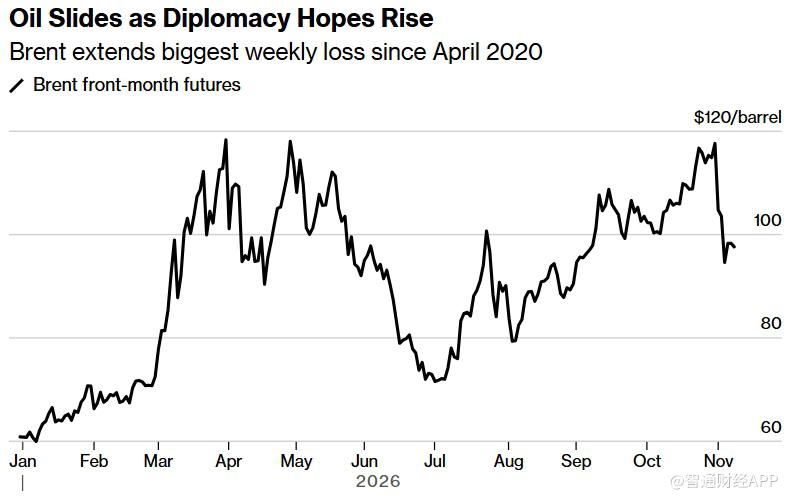
Brent crude futures, the global crude oil benchmark, fell 5.9% on Monday to close above $92 a barrel. After the Democratic Party won a landslide victory in the US midterm elections, the market believed that the Trump administration was under greater pressure and needed to seek a diplomatic solution to end the war against Iran, further weakening the geopolitical risk premium in the crude oil market.
US President Trump said last weekend that it is “extremely unlikely” that he will order a large-scale attack on Iran, but at the same time stressed that this depends on whether Iran is willing to sign a “very strong agreement.”
Affected by improved prospects for diplomatic negotiations, international oil prices have fallen sharply from the six-month high set at the end of October. Last week, without considering the monthly exchange factor of futures contracts, Brent crude oil recorded its biggest weekly decline since April 2020. However, the market is still uncertain whether the signs of relaxation released by the US can be translated into substantial progress in negotiations. Saudi Arabia's official news agency reports that the country's east-west oil pipeline was attacked in the Medina region on Monday, causing a small-scale fire. The fire has now been extinguished. Meanwhile, US Secretary of State Rubio downplayed the possibility of a breakthrough in the US-Iran negotiations.
Prior to the settlement on Monday, there was news that the US and Iran are making progress on the uranium enrichment issue. Sources pointed out that Washington allows Iran to enrich uranium at a concentration of 3.67% within the country, and Tehran has agreed. At the same time, the US is calling for a reduction in Iran's current concentration of 60% enriched uranium, and both sides are considering using third countries to help deal with Iran's highly enriched uranium issue. Furthermore, the two sides are making arrangements to discuss the return of International Atomic Energy Agency inspectors to Iran, but the specific scope of their tasks has not yet been clarified. The source also said that under the framework of the proposed agreement, the Strait of Hormuz will be immediately reopened and the maritime blockade will be lifted. The US will release Iranian assets worth 6 billion to 9 billion US dollars after reaching an agreement.
Since this issue was one of the main differences in the negotiations between the two sides, related news pushed oil prices further down to the low of the day. However, this report has yet to be independently confirmed.
Ryan McKay, senior commodity strategist at TD Securities, said, “President Trump continues to send signals that he is unwilling to further escalate the conflict with Iran, which continues to put downward pressure on crude oil prices.” He pointed out that news about peace agreement negotiations may temporarily curb the room for oil prices to rise, but if no specific agreement is reached, there may also be limited room for a further sharp drop in oil prices.
Despite the recent continuous decline, international oil prices have accumulated a cumulative increase of more than 50% since this year. The main reason is that the Middle East war has seriously disrupted regional crude oil supply and transportation. However, as crude oil exports from the Persian Gulf gradually recovered, the market became more sensitive to news that geopolitical tension might ease.
According to a survey, the Organization of Petroleum Exporting Countries (OPEC) crude oil production last month has returned to 88% of pre-war levels. However, due to the continued imposition of a maritime blockade on Iranian crude oil exports by the United States, Iran's crude oil production has dropped sharply.
Meanwhile, security risks in the Middle East region have not been eliminated. The British Maritime Trade Operations Office said that an oil tanker was hit by a UFO while passing through the Strait of Hormuz, an important oil transportation channel, over the weekend. Furthermore, the Iran-backed Houthis launched an attack in the Saudi capital Riyadh, causing damage to Saudi Aramco's office facilities. The Saudi military then launched a retaliation operation, destroying two missile launchers.
Apart from the situation in the Middle East, diplomatic developments in the Russian-Ukrainian conflict are also receiving attention from the energy market. Ukraine continues to attack Russian oil refining facilities, while Russia has repeatedly attacked Ukraine's energy and civil infrastructure. The conflict between the two sides continues.
A new round of Russian-Ukrainian negotiations mediated by the US is expected to begin in Abu Dhabi on Tuesday. Russia will send a higher level delegation this time than in previous rounds of negotiations, which may mean that after several months of diplomatic stalemate, Russia is more open to substantive negotiations.
Furthermore, the crude oil market will also receive monthly reports from the three major energy agencies this week. The US Energy Information Administration (EIA) will release its report on Tuesday, OPEC will release the latest market assessment on Wednesday, and the International Energy Agency (IEA) will release its monthly report on Friday. The judgment of relevant agencies on the prospects for global crude oil supply and demand will provide investors with an important reference for evaluating future trends in oil prices.