


The Zhitong Finance App learned that the upward logic of the foreign exchange trading market for the yen exchange rate seems to be shifting from short-term safe-haven purchases to an accelerated bet on a further narrowing of interest spreads between the US and Japan. Neil Parker, head of economic and market investment strategy at Moneycorp, who is at the top of Bloomberg Intelligence (BI)'s latest USD/JPY forecast list, predicts that the yen will rise to 155 yen per dollar by the end of this year, and the yen is expected to further appreciate to 147 points next year.
The strategist's core judgment is that the Bank of Japan still has plenty of room to raise interest rates, and the Federal Reserve may stop tightening after raising interest rates again in December. However, the yen exchange rate has recently experienced a sharp decline in global technology stocks, where safe-haven forces flocked in, rebounded after the strong non-agricultural gains, and then appreciated again. It is not yet possible to consistently summarize the recent trend as continuing to strengthen unilaterally. Parker's ranking enhances the reference value of this exchange rate forecasting trend, but its opinion itself is not equivalent to a decisive force driving the exchange rate.
The fierce confrontation between long and short expectations of the yen is essentially a market re-evaluation of the pace of interest rate hikes between the US and Japan and the sustainability of arbitrage earnings. The key to the next round of the yen market is shifting to the repricing of the monetary policy path between the US and Japan — Parker, who is at the top of Bloomberg's latest USD/JPY forecast list, predicts that the yen will rise to 155 yen per dollar by the end of this year and move further to 147 next year, which is in stark contrast with the fall to 170 predicted at the top of the list in the previous quarter.
The opinion that supports this top forecaster's bullish judgment on the yen is that the Bank of Japan may raise the policy interest rate from 1.25% to at least 2%, or even 2.25%, while the Federal Reserve may stop at 4.00% to 4.25% after raising interest rates again in December, further narrowing the interest rate spread between the US and Japan. Parker stressed that investors do not need to completely switch to overallocation of Japanese assets; simply reducing low allocations may create marginal strength to support the yen.
For arbitrage transactions that borrow low-interest yen and allocate high-interest overseas assets, this means that the interest income advantage will weaken. At the same time, the appreciation of the yen will increase the cost of repayment of financing, and exchange losses may even eat up accumulated interest income. Against the backdrop of sharp fluctuations in technology stocks increasing pressure on positions, this change in the relationship between profit and risk may cause some capital to reduce their short exposure to the yen.
The upward trend of yen appreciation under the overall acceleration of the Bank of Japan's interest rate hikes will significantly raise the cost of “borrowing low-interest yen and investing in high-yield bonds and stock assets overseas” — and this arbitrage trading model is an important logic that supports the bullish trajectory of international stock markets outside of Japan in recent years. The rise in the cost of Japanese yen borrowing, if accompanied by a rapid appreciation of the yen exchange rate, may cause some arbitrage transactions to reduce positions and amplify global risk asset fluctuations. When positions are closed, assets such as overseas stocks are sold and yen debt payments are bought back, further boosting yen, forming mutually reinforcing feedback on exchange rates and asset sell-offs, amplifying global stock market fluctuations.
Top yen forecasters expect that the narrowing of the spread between the US and Japan will push the yen to 1 US dollar to 147 yen next year
Neil Parker has been tracking the trend of the yen for nearly 30 years, during which time it experienced financial crises and sharp exchange rate fluctuations. Today, the USD/JPY forecaster, who is at the top of Bloomberg Bloomberg Intelligence's latest rankings, predicts that the yen will rise to 147 yen per dollar next year as the spread between Japan and the US narrows.
This forecast puts him on the more bullish side of the yen in a heavily divided market. Parker predicts that the yen will rise to around 155 before the end of the year, and then appreciate further; while Bloomberg's number one forecaster in the previous quarter held the opposite view, believing that the yen exchange rate may accelerate to 170 next year.
The core of the serious differences in the foreign exchange market over the trend of yen lies in Japan's interest rate prospects. Parker predicts that the Bank of Japan will raise the benchmark interest rate from 1.25% to at least 2%, and may even reach 2.25%. This tightening expectation is more aggressive than the judgment of many people in the market. Meanwhile, according to Parker's forecast, the Federal Reserve may raise interest rates again in December and then keep interest rates in the 4.00% — 4.25% range.
“Japan may be an exception when it comes to the Bank of Japan actually delivering on its promises and matching interest rates with inflation.” Parker, head of economic and market strategy at foreign exchange and payment company TTT Moneycorp Limited, said.
Japanese market participants disagree on whether stronger inflation will prompt the central bank to speed up austerity. Japan's consumer price index, which excludes fresh food and energy, rose 2.4% year on year in September. This is an indicator that the Bank of Japan closely monitors and uses to measure underlying inflation. Parker said that if this increase rises to 2.6% or higher, it may prompt the central bank to respond more strongly and speed up the pace of austerity. However, he is unsure that the central bank will act in December as soon as possible.
The difference in the pace of austerity between the two countries formed the basis for his bullish yen. He said that a further narrowing of the spread between the US and Japan by about 50 basis points — roughly equivalent to what he expects to see in the middle to second half of next year — may be enough to push investors to readjust their expectations.
“Investors don't necessarily need to switch to oversized Japanese assets.” In an interview with the media, he said, “They just need to reduce the level of underperformance.”
Since this year, the average exchange rate of the yen has averaged about 158 yen to the US dollar, and fell to 163.99 in July, after which the Japanese and US authorities intervened. Drastic market fluctuations tested Parker's predictions, but unless the economic fundamentals underpinning the predictions change, he is unwilling to adjust his judgment easily.
When making predictions, Parker will compare the market's expectations of interest rates and inflation with his own judgment to find differences that can provide a basis for exchange rate predictions.
“I try to block as much noise as possible.” He said, “I'm not concerned about more than a few macroeconomic factors, not all the speeches, comments, or other information from Japan and other major economies.”
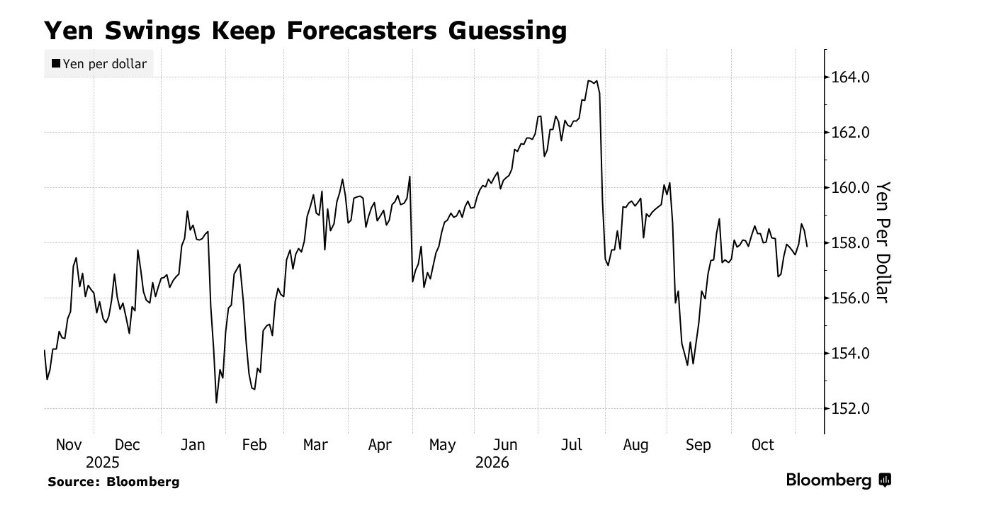
As shown in the chart above, the sharp fluctuation of the yen since the Bank of Japan returned to the path of interest rate hikes has caused forecasters to constantly change forecast points.
With a similar benchmark forecasting model approach, Parker also ranked first in Bloomberg's EUR/JPY prediction ranking. However, he said that this forecast also benefits from his long-term view of being bearish on the European economy, as well as some luck.
“In some ways, the forecast for EURJPY has more of a luckiness component than USD/JPY.” He said and mentioned that he has always been bearish on the euro against the backdrop of Europe's drastic interest rate cuts and the economy's lack of resilience. “As for the dollar against the yen, I think it can be judged more based on macro factors.”
Parker began his career in financial markets in 1995 and has been tracking yen and other major currencies for decades. According to his LinkedIn profile, he joined London-based TTT Moneycorp in 2025. The forex and payments company also ranked first in Bloomberg's latest EURUSD and USD/CHF predictions.
Parker said that in the early stages of his career, the trend of the yen was more closely linked to macro factors, so it was easier to predict. However, he believes that predicting the yen is not particularly difficult now, because the Bank of Japan reacts more positively to the data, especially the inflation data.
“The framework for exchange rate forecasting is not just about judging the direction in which the situation will develop.” Parker said, “It's about judging the direction you expect to go, and how different it is from what other players in the market expect.”
The sharp decline in technology stocks has awakened yen buying, and the US and Japan interest rate spreads are still being reassessed over and over
During the sharp decline in US technology stocks and even global technology stocks last week, the yen can be described as showing strong resilience as a safe-haven asset, but it did not develop a strong market throughout the week.
On November 5, the yen rose by about 0.46% against the US dollar, and the dollar fell to around 157.63 against the yen; it further hit 157.27 during the Asian trading session on November 6. However, strong data on adding 165,000 new non-farm payrolls in the US re-strengthened expectations of interest rate hikes. The yen then regained gains and fell to around 158.43 during the New York trading session. The cumulative depreciation for the week was close to 0.6%.
By November 9, the dollar had fallen by about 0.41% against the yen, to around 157.89. Therefore, a more accurate description of the recent trajectory of the yen is that the sharp decline in global technology stocks drove the influx of safe-haven purchases into the yen to drive a rebound in the yen exchange rate, strong employment revived the advantage of the US dollar's interest rate spread, and the subsequent weakening of the US dollar once again supported the yen.
The transmission mechanism behind it is that increased volatility in technology stocks will reduce the appeal of borrowing low-interest yen and investing in overseas risky assets; when relevant investors reduce leverage, they may buy back yen to repay the financing. At the same time, concerns about slowing AI investment and falling oil prices will weaken US growth and inflation expectations and provide impetus for the decline in US bond yields.
A team of analysts at Wall Street financial giant Goldman Sachs recently pointed out that when NASDAQ's performance is weaker than the S&P 500, the dollar often falls against the yen, so the yen has potential value to hedge against the retracement of AI transactions. However, this correlation does not mean that every fall in technology stocks will trigger the liquidation of yen arbitrage trades of the same scale.
Furthermore, the yield gap between the US and Japan treasury bonds has been encouraged to narrow, but it has not been narrowing all the time. Based on the daily yields announced by the two countries on the same date, the 10-year US Treasury bond spread widened from about 203.4 basis points on November 5 to about 216.4 basis points on November 6, reflecting the unsynchronized response of the bond markets of the two countries to safe-haven demand and employment data. The Bank of Japan maintained its policy interest rate at 1.25% in October while retaining the direction of continuing to raise interest rates; therefore, the key to whether the yen can continue to rise is whether Japan's interest rate hikes can exceed current market pricing in the future, and whether the upward space for US interest rates actually converges.
The fulcrum of 147 is the difference in interest rate hike expectations. Predicting the top of the list provides judgment rather than final pricing
Parker's forecast does not require the Federal Reserve to cut interest rates immediately. If Japan's policy interest rate rises from 1.25% to 2%, and the US only raises interest rates by 25 basis points and then stops at 4.00% — 4.25%, the US-Japan policy spread will net narrow by 50 basis points; if Japan rises further to 2.25%, the net narrowing will reach 75 basis points. In his view, this will undoubtedly reduce the interest advantage of holding US dollar assets over Japanese yen assets and raise the threshold for Japanese yen bears to continue to bear exchange rate risk.
Parker emphasized that investors don't even need to switch to overallocation of Japanese assets; they only need to reduce the low allocation, which may change the marginal flow of capital. The Bank of Japan's 2% to 2.25% monetary policy path is part of his policy outlook forecast; it is not the final interest rate announced by the Bank of Japan.
Neil Parker is known as the “top yen forecaster,” and there is a clear basis for the ranking — he was number one in the latest Bloomberg USD/JPY forecast ranking, and also topped the EUR/JPY forecast list. He entered the financial market in 1995, followed major currencies for a long time, and joined London-based Moneycorp in 2025. The method focuses on comparing the differences in interest rate and inflation expectations between oneself and the market, rather than chasing every official speech.
His exchange rate views can usually provide a contextual reference for institutional allocations and corporate foreign exchange hedging. What really affects the exchange rate is still central bank policies, interest spreads, capital flows, and position adjustments. The top of the list last quarter predicted that the yen might fall to 170 next year, in stark contrast to Parker's forecast point of 147 yen. Therefore, the core of the market debate over the trend of yen is how much interest rate hikes the Bank of Japan will eventually implement, and how many of these changes have entered medium- to long-term pricing in the exchange rate market.