


Zhitong Finance App learned that as the market re-examines the distance between AI capital expenditure and the actual return on investment in data centers, AppLovin (APP.US), an AI application leader focusing on “AI+ digital advertising”, is showing the commercial value of AI applications with advertising conversion efficiency, profit, and cash flow. On November 5, the Philadelphia Semiconductor Index fell sharply by 12.25%, but AppLovin bucked the trend and rose 31.04% after the financial report: third-quarter revenue increased 55% year-on-year, net profit increased 72%, and free cash flow reached about US$1,418 billion. The next-generation advertising model accelerated the game business again, and created conditions for e-commerce customers to expand effective marketing.
Wall Street financial giant Citigroup's latest bullish research report covering AppLovin can be described as further strengthening the clue that growth continues — the number of e-commerce stores using AppLovin Ads reached 21,011 worldwide, and the average weekly growth rate of US stores increased from 1.5% in the third quarter to 3.0% so far in the fourth quarter. Citigroup analysts agree that e-commerce may contribute most of the company's revenue growth by 2028 and support a “buy” rating and a target price of $500 with about 24 times the 2027 expected free cash flow valuation; compared to the closing price of $410 on November 9, this means that AppLovin's stock price can continue to rise even after financial disclosure drives a crazy increase of more than 50%, which means there is still room for potential growth of about 22%.
What supports the Citigroup analysts' team's judgment above is the increased efficiency of the most advanced AI model and the increasing comprehensive capabilities of AI agents, which can simultaneously improve advertisers' returns and the platform's ability to generate cash, thereby transforming the advantages of AI technology into sustainable profit growth. Citi emphasized that the core investment value surrounding Applovin is that the game advertising business has verified the profit contribution of model upgrades, while the e-commerce business is expected to continue to expand the monetized market growth space through customer access, verification of marketing effectiveness, and additional budget.
At a time when technology stocks are being sold off, AppLovin can be described as stepping out of the independent market by cashing out profits. On November 5, the Nasdaq 100 Index fell 6.36%, the Philadelphia Semiconductor Index fell 12.25%, and the AppLovin bucked the trend and rose 31.04% after the earnings report; it continued to rise for the next two trading days, closing at 410 US dollars as of November 9, a cumulative increase of about 50.9% from before the financial report was announced. The logic behind this contrast is that the market is beginning to differentiate between the uncertainty of AI investment returns and AI commercialization benefits that have already been realized — in the third quarter, AppLovin's revenue increased 55% year over year, and free cash flow reached about US$1,418 billion. The upgrading of game advertising models and e-commerce expansion together strengthened the credibility of growth.
The growth rate of US stores doubled, and e-commerce expansion began to undergo “quality inspection”
According to Citi Tracking's Store Leads data, as of November 6, the number of global e-commerce stores using AppLovin Ads reached 21,011, an increase of 3.1% per week. The average weekly growth rate of global stores rebounded from 2.3% in the second quarter to 3.1% in the third quarter, reaching a further 6.0% in the fourth quarter so far. If current trends continue, Citi estimates that the average number of stores in the fourth quarter could reach about 23,000, nearly double the 11,900 stores in the third quarter.
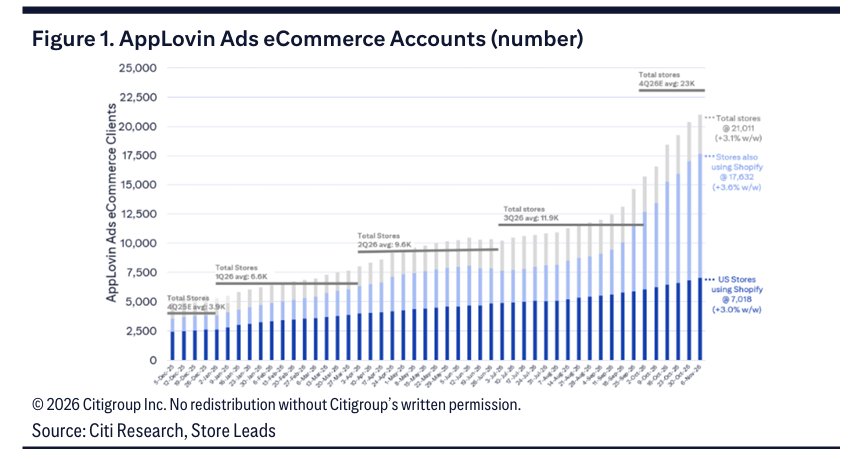
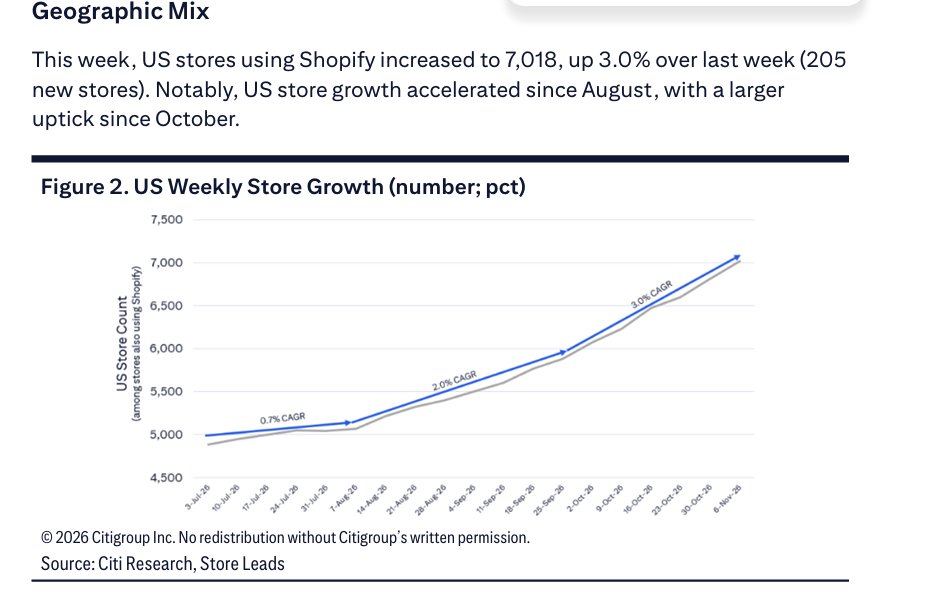
What is more noteworthy is that the number of US stores using Shopify and AppLovin at the same time reached 7,018, an increase of 205 in a single week. Growth began to accelerate in August and further accelerated in October. This has increased the potential customer base for e-commerce revenue expansion, but budget release still has to go through marketing optimization, return on ad spend (ROAS) verification, and incremental effectiveness testing, and there is a natural climbing process between store access and revenue recognition.
The customer structure explains why Citi places special emphasis on US growth. In the Shopify and AppLovin cross-sample, the share of US stores fell to 39.8%, and the combined share of mainland China and Hong Kong rose to 46.2%. The latter increased by 392 in a single week, an increase of 5.0%; Store Leads believes that this includes more dropshipping merchants, so the increase in global sites cannot be directly equivalent to the growth of independent paid advertisers.
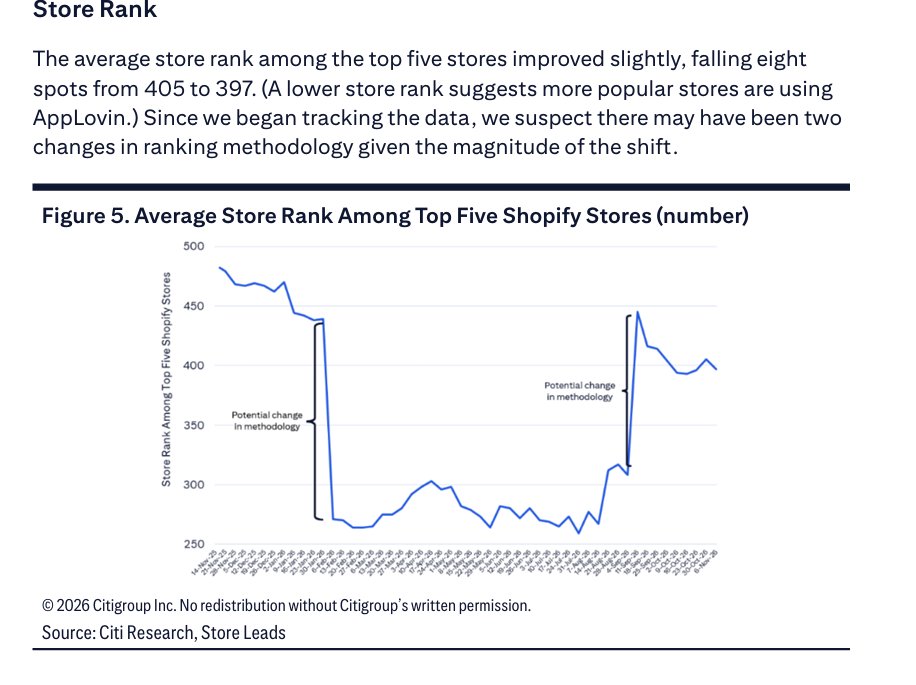
In terms of industry distribution, with the exception of food and beverage and sports, the number of stores in all categories increased, and the share of unclassified stores rose to 13.4%; the average ranking of the five most popular stores improved from 405 to 397, but Citi also suggested that the historical rankings may have gone through two statistical method adjustments. Together, these indicators support “expanded coverage and accelerated customer expansion in the US,” and it is not yet possible to directly prove that a single store's budget is doubling at the same time. However, there is no doubt that the value of the accelerated growth rate of the US market is adding more recognizable business signals to the number of stores around the world.
The increase in the number of global stores was partly driven by the expansion of dropshipping merchants in the Asia-Pacific region, while the average weekly growth rate of US stores increased from 1.5% in the third quarter to 3.0% so far in the fourth quarter, indicating that AppLovin's customer expansion in the US market is also accelerating. This latest trend provides further support for Citi's optimism about e-commerce growth — more merchants will access the platform, which is expected to gradually increase the budget after verifying the effectiveness of advertising, which translates into a continuous increase in revenue.
The game model cashes out profits first, and e-commerce determines how far the room for growth can go
Financial reports have verified the monetization capacity of the model upgrade: third-quarter revenue of US$2.85 billion, higher than the agreed estimate of US$2.07 billion; diluted earnings per share of US$4.30, higher than expectations of US$4.03; net profit of US$1,439 million, up 72% year on year; adjusted EBITDA of US$1,842 million, up 59% year on year, and profit margin of about 84%.
More importantly, the company's management gave strong guidance. The company's revenue guidance for the fourth quarter was US$2,365-US$2,395 million, 5.8% higher than the market forecast of US$2.25 billion; the median adjusted EBITDA guidance was US$2.01 billion, 6.9% higher than the forecast of US$1.88 billion. The company also added $3.2 billion in repurchase authorizations, increasing the remaining amount to $3.6 billion at the end of October. The simultaneous improvement of current performance, guidance for the next quarter, and return on capital can be said to have provided a specific basis for stock price revaluation after financial reporting.
The company's earnings call further explained that exceeding expectations in the third quarter came first from the core game business: the next-generation model was only partially deployed, which has driven the game business to grow by nearly 50% year on year; consumer advertiser spending achieved double digit month-on-month and three-digit year-on-year growth. More complex models improved forecasting results in new customers and sparse data scenarios, while optimization of inference services reduced data center costs as a share of revenue, and revenue growth was transferred to 87% of adjusted EBITDA.
As a result, Citi is optimistic about a longer-term business relay — the financial giant predicts that by 2028, e-commerce may contribute most of the company's future revenue growth, and support the target price of $500 with a free cash flow valuation of about 24 times the 2027 expected. The key to implementation is whether new merchants can continue to expand effective marketing and whether model improvements can maintain customer returns; the report focuses on e-commerce volume, Unity competition, and whether potential small-scale SaaS mergers and acquisitions can efficiently transform customer leads. Its short-term bullish observations continued until December 10, but the relevant catalytic judgments began in September, and the third-quarter results have provided verification of previous expectations.
How AppLovin Turns AI Capabilities into Ad Revenue
AppLovin operates a marketing platform that connects advertising demand with application traffic: AppLovin Ads helps advertisers automatically acquire customers and contributes the vast majority of revenue; MAX helps app developers to auction ad positions and increase traffic monetization; Adjust provides attribution, analysis, and anti-fraud; and Wurl services networked TV content distribution and advertising monetization. Its core revenue is mainly recognized based on the amount collected from advertisers minus fees paid to traffic publishers.
Looking at the underlying technical mechanism, AXON uses user behavior, advertising materials, and conversion feedback for forecasting and bidding; the more accurate the prediction, the more likely the advertiser is to expand the budget while maintaining the target ROAS. Generative AI can also reduce material production and testing costs and expand explorable ad portfolios. Therefore, AppLovin benefits from the direct path of AI applications, increasing the commercial value created by each advertising budget unit, and then sharing the resulting expanded marketing scale.
The SEC document clearly lists Meta and Google as advertisers and important partners; Wayfair, Kitsch, and Ridge are public e-commerce customer cases. The Kitsch case shows that the scale of its AppLovin launch increased 3.4 times the same year on year, and the new customer ROAS also increased by 50.1%; Wayfair verified incremental revenue through regional comparative experiments and back-office transaction data, reflecting the evidentiary standards required for large brands to increase their budgets. Shopify integration reduces the cost of tracking code installation, product catalog sync, and purchase attribution.
After the financial report was revealed, Wall Street firms generally raised their price targets for AppLovin
Wedbush maintained “outperforming the market”, and its target price rose from $560 to $600, corresponding to a 46.3% increase in market capitalization of US$198,79 billion. The upgrade of its valued game model has not yet been completed, and the guidelines only include improvements that are already visible. RBC maintained “outperforming the market”, with the target price rising from $500 to $520, corresponding to a 26.8% increase in market value and a market capitalization of US$172.29 billion; the bank emphasized that previously delayed model optimizations have been implemented, and infrastructure efficiency and revenue growth have offset additional training and computational costs.
Morgan Stanley maintained an “increase in holdings”, and the target price rose from $400 to $450; BTIG maintained a “buy”, rising from $396 to $450, both corresponding to a 9.8% increase in market value and a market value of US$149.10 billion. Damo believes that the results respond to concerns about insufficient innovation, increased competition, and slowing growth; BTIG focused on a hybrid model combining the recommendation system (RecSys) and the Big Language Model (LLM) to raise the 2027 revenue forecast from US$9.851 billion to US$10.482 billion, and the adjusted EBITDA forecast rose from US$8.200 billion to US$8.713 billion.
Needham maintains a “buy” and a target price of $475, corresponding to a 15.9% increase and a market value of 157.38 billion US dollars. He believes that the model's improved processing of sparse data will benefit smaller advertisers. UBS maintained a “buy”, and the target price rose from $414 to $462, corresponding to a 12.7% increase in market value of US$153.07 billion.
More prudent institutions have also raised their targets, but have yet to move to positive ratings. Goldman Sachs remains “neutral,” with a target price increase of about 8.5% and a market value of 147.44 billion US dollars, which recognizes game growth and operating leverage improvements; Bank of America remains “neutral”, rising from $325 to $380. This target is already about 7.3% lower than the latest closing price, and the corresponding market value is about US$125.90 billion. Bank of America raised its 2027 revenue growth forecast from 23% to 25%, but it still wants to see the full model deployment and further evidence of continued high growth.