


The Zhitong Finance App learned that Morgan Stanley published a research report to maintain the real-time 3D game engine company Unity Software (U.US) “gain” rating, with a target price of 62 US dollars. The bank believes that Unity's third-quarter results have further strengthened its independent fundamental bull market logic, and the accelerated growth of the Vector advertising platform provided a realistic basis for the bank's $95 bull market valuation; at the same time, Silver Lake Capital (Silver Lake) and the Saudi Public Investment Fund (PIF) have reportedly been in contact with the Saudi Public Investment Fund (PIF) to acquire Unity, making the potential merger and acquisition value a “valuable bullish option” and a source of downward protection.
According to earlier reports, Unity recently held acquisition discussions with consortia including Silver Lake Capital and Saudi PIF. The consortium reached out to the company a few weeks before Unity released its third-quarter results and discussed a valuation of around $25 billion. Unity is allegedly working with investment banks to evaluate options. The company declined to comment, and there is still uncertainty about any deal. Silverlake Capital currently holds about 8% of Unity's shares, and both Silverlake Capital and PIF have previously participated in an Electronic Arts (EA) privatization transaction worth 55 billion US dollars, which was completed in August.
According to Morgan Stanley's estimates, the corporate value of 25 billion US dollars corresponds to about 49.60 US dollars per share of Unity, which is about 16 times the bank's 2028 EBITDA forecast, which is about 5% off compared to the reported 52 US dollar reference stock price.
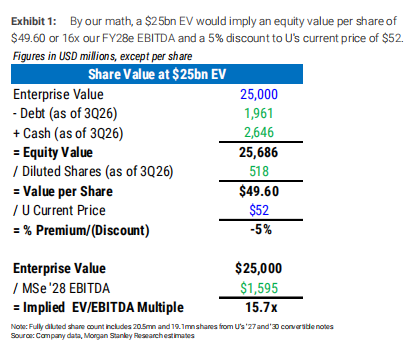
The bank believes that before the report came out, Unity's stock price did not reflect a high speculative merger and acquisition premium. There have been merger and acquisition headlines in Unity's history: AppLovin (APP.US) publicly proposed the acquisition of Unity in 2022 but was unsuccessful. Unity completed the acquisition of ironSource during the same period; after the long-term CEO left the office at the end of 2023, the market also speculated that Unity might attract strategic interest, and the stock price had already declined sharply at the time.
However, Morgan Stanley is cautious about collaborating between mobile ad networks and mobile gaming companies. PIF owns major mobile game studios such as Scopely and Niantic, but it's unclear whether there is significant collaboration between Unity and these traditional mobile game assets. Unity's game engine business may benefit from neutrality; vertically integrated studios and ad networks theoretically collaborate, but real-world case records are mixed. AppLovin and Zynga both tried to combine studios with ad networks, but both companies spun off related assets a few years later.
Vector Growth and Fundamental Bull Market Logic
Additionally, Morgan Stanley believes that the third-quarter results make it more optimistic about Unity's independent fundamentals bull market scenario, and believes there is more than one path to the $95 bull market valuation. The year-to-date incremental EBITDA margin of approximately 80% shows that further growth in Vector could drive a significant increase in future profit forecasts. Therefore, although the bank is confident in Unity's strategic value, it believes that the fundamental story itself is already appealing, and that the merger and acquisition value should mainly be viewed as bullish options and downside protection.
The bank lists key catalysts for the next 12 months. In the fourth quarter, Unity needed to maintain Vector's momentum during the holiday advertising season. Unity's AI-driven advertising platform grew 40% month-on-month in the third quarter, higher than management's 20% guidance, and an additional 21% to 23% month-on-month growth was embedded in the fourth quarter outlook. Continued improvements in advertiser returns, adoption of new products, and recent increases in spending by new advertisers will be important evidence to verify the sustainability of growth.
Runtime data adoption and model improvements are key in 2027. Over 90% of new projects choose to join runtime data sharing, yet only 30% of Vector's top 1000 spenders currently share data. Morgan Stanley believes there are significant opportunities to expand adoption and improve how these signals are used. Unity can use this data to continuously improve ad targeting models to maintain improved profit forecasts in 2027.
Another catalyst for 2027 is the planned launch of Unity Spark. This product is a browser-side creation platform designed to allow users to build games without programming experience. Closed testing is planned this year, and it will be fully launched in 2027. Unity's collaboration with Google is likely to expand distribution and creator base. According to the report, there is a potential increase in advertising and discovery demand from direct monetization and larger game supply, but adoption and revenue contributions are still uncertain.
risk factors
The report details a number of key risks. New AI tools may disrupt Unity Create's business or increase competition in game development, and the market is concerned about the reduction in reliance on traditional engines or the spread of simpler and cheaper alternatives; Unity must maintain its position in the developer workflow while integrating new AI technology. The bull market argument relies on continuous improvement in Vector ad performance. If model improvements decline in returns or competitors innovate faster, it may slow advertisers' budget growth and limit profit growth. Vector's differentiated data opportunities rely on engine customer collaboration, and developers may limit sharing or demand greater financial benefits due to data usage concerns, thereby limiting Unity's advantage of operating the engine and ad network simultaneously.
Furthermore, major game investor holdings may complicate Unity's position as a neutral technology partner. If Unity is under the same parent company as major game publishers such as EA and Scopely, competing publishers may no longer be willing to share sensitive data. The report says there is currently no evidence of behavioral change, but confidence in data isolation is critical. Greater monetization of the Create business also needs to balance developers' trust. Higher prices, minimum commitments, and consumption charges may hinder adoption or weaken the customer relationships that support Create and Grow.
Unity also relies on mobile platforms beyond its control, and changes in Apple (AAPL.US) and Google (GOOGL.US) policies on iOS/Android could damage targeting and measurement, or affect the economics and adoption of direct payment products. Unity has significant exposure to developer-advertiser relationships in China, and is sensitive to local needs, regulations, geopolitics, and technical or data flow restrictions. The dispute between Unity and AppLovin over access to the AD Quality SDK and related data continues. AppLovin alleges improper collection and use of its advertising data, and Unity denies the allegations; adverse results may result in financial penalties and/or product adjustments, and the impact on Vector is uncertain.
Industry Peer Influence and Stock Price Performance
If the acquisition is confirmed, Morgan Stanley believes it will also have potential implications for industry peers.
For AppLovin, this highlights the strategic value of mobile ad technology and the profit potential of these ad networks after scaling up; in a market where conversion rates are still low, the success of one company does not necessarily come at the expense of another; both Unity and AppLovin can increase profits and returns for advertisers. The key question is whether Unity's future investment priorities or business practices will change.
For Roblox (RBLX.US), the core business impact is limited, but Unity Spark's continued investment is related to the competitive landscape of AI-enabled creation and discovery. It is necessary to focus on whether Unity and Google can transform the creation of easier to use games into continuous consumer participation and large-scale distribution.
For Take-Two (TTWO.US) and game publishers, the impact is limited, but it may reinforce investors' interest in the broader game ecosystem; there is a fundamental difference between Unity's development software, runtime data, and advertising mix and the publisher's IP mix.