


- Celanese reported third quarter 2026 sales of US$2,556 million, net income of US$74 million and basic earnings per share from continuing operations of US$0.68, compared with a loss in the prior year period.
- Celanese and Röchling Industrial are working together on CO2-derived POM ECO-C materials that aim to cut product carbon footprints without changing customers’ existing designs or production processes.
- This article examines how Celanese's profitability in the third quarter, as reflected in its earnings, relates to the existing investment narrative.
Scan beyond Celanese and spot other chemical and industrial materials stocks with resilient fundamentals using our curated list of list of solid balance sheet and fundamentals (25 results).
Celanese Investment Narrative Recap
To hold Celanese, you need to be comfortable with a chemicals group that is profitable again but still working through a messy earnings base. The analyst consensus narrative on Simply Wall St leans on cost savings, integration benefits and steady free cash flow as the key supports. The latest quarter delivered positive earnings, yet interest coverage remains a watchpoint and customer destocking in key end markets can quickly dull that progress.
The short term swing factor is whether volumes and pricing in acetyls and Engineered Materials stabilize enough for cost programs to show through cleanly. The biggest risk is that inventory and footprint adjustments, plus joint venture weakness, keep margins under pressure even if sales hold around current levels. On this set of numbers, the earnings beat looks helpful but not transformational.
The Röchling Industrial agreement around POM ECO C ties directly into one of the clearer operational catalysts. Celanese is already spending on lower carbon materials, and this arrangement shows that these products can move from concept into real commercial usage across stock shape applications that matter to industrial customers.
If adoption of POM ECO C and similar grades scales, that can support the sustainability angle that analysts already flag and potentially improve mix in Engineered Materials. Execution risk is real though. The business still needs to manage existing capacity, capital intensity and joint venture income while layering on these new products, so investors will likely track how much revenue and margin detail management provides on these solutions in future updates.
What The Current Celanese Forecasts Assume
Celanese's latest consensus blueprint leans on a fairly simple revenue story and a much more ambitious profit story. Analysts see sales holding roughly steady over the next few years rather than climbing at a defined pace, while profitability does more of the heavy lifting through margin improvement. That mix of flat top line and fatter earnings is central to how the current targets are being framed.
On the earnings side, the starting point in these estimates is current profit of about US$272.0 million. Consensus points to earnings of US$782.3 million by 2029, which would mean profit roughly tripling from where it is today. Forecast margins are expected to move from 2.8% now to 7.9% in three years, so most of the heavy work in this story is assumed to come from better conversion of revenue into net income rather than from stronger growth in sales.
Celanese's narrative projects US$9.9b revenue and US$782.3 million earnings by 2029. This requires fairly flat yearly revenue growth and about US$510 million earnings increase from US$272.0 million today.
Those profit expectations rely on a few key building blocks. Analysts are baking in the execution of cost savings, footprint changes and working capital actions that lift margins closer to the forecast level. They are also assuming that share count only creeps higher, with projected growth in shares outstanding of 0.23% per year over the next three years, so most of the forecast earnings per share outcome would come from higher aggregate profit rather than financial engineering.
Valuation work in the consensus set then ties these operating assumptions to a future multiple. To get to the current price target, the stock would need to trade at a P/E of 12.2x on those 2029 earnings of US$782.3 million. That compares with about 18.8x today and with an industry P/E for US chemicals that is quoted at 23.4x in the same report. In other words, the scenario that underpins the target price assumes not only higher earnings but also a lower earnings multiple than both the present level and the sector snapshot.
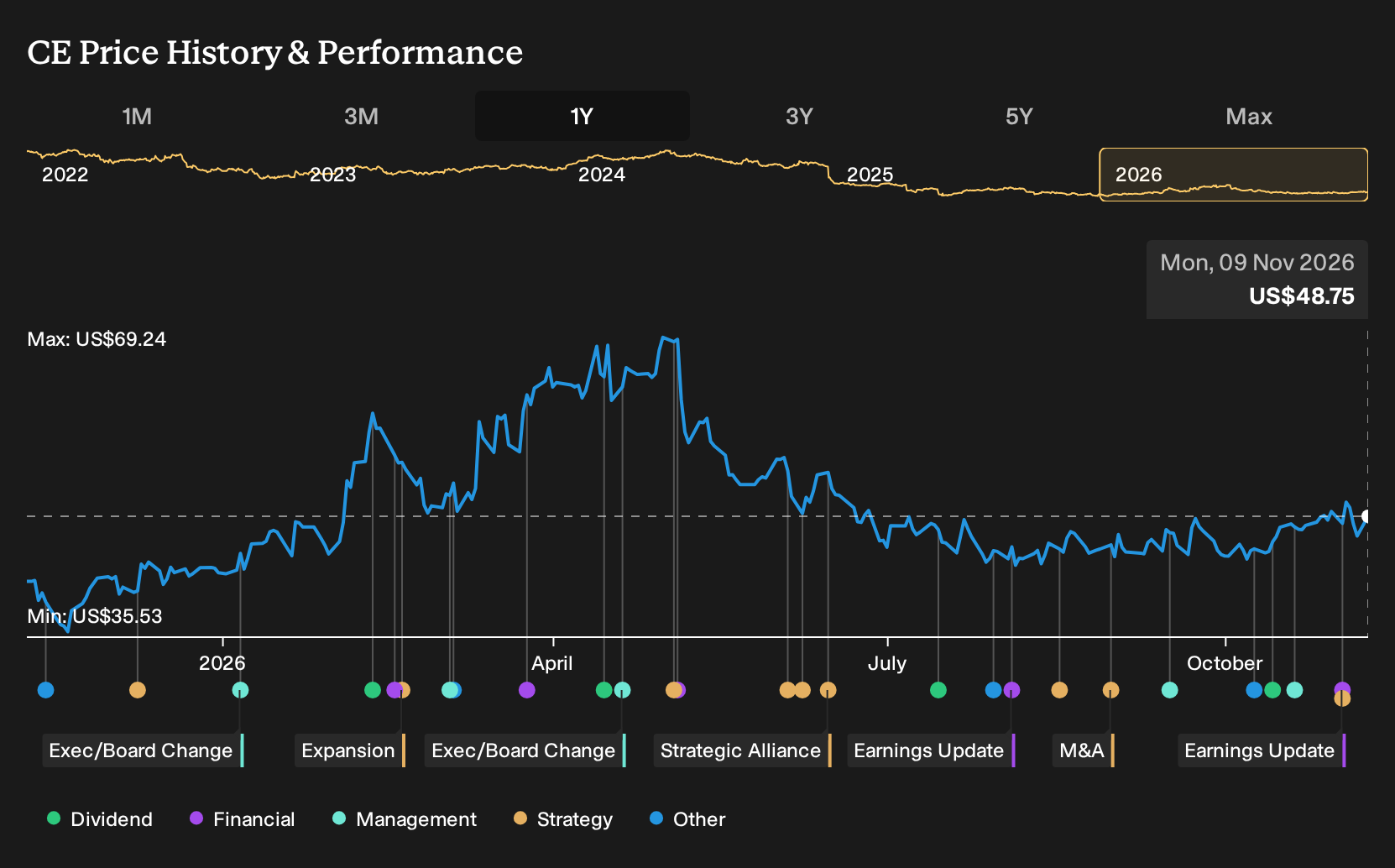
The resulting analyst price objective of US$62.89 sits 26.1% above the quoted share price of US$46.49 cited in the report. Some forecasters go higher, up to US$86.00, while the most cautious stand around US$52.00. This spread underlines how much uncertainty still hangs over the margin pathway and over how investors might value Celanese once the current cost programs and portfolio adjustments have played through.
Uncover why Celanese's fair value indicates a 29% potential upside to its current price, which could narrow quickly.
Exploring Other Perspectives
You now have two very different stories around Celanese. The bullish angle treats the Röchling POM ECO C deal as proof that sustainable chemistries can support a richer mix, with top analysts previously penciling in US$11.1b revenue and US$1.1b earnings by 2029. Those figures show how optimistic some forecasts were before this latest news and invite you to compare them with your own view.
Explore 3 other Celanese fair value estimates, including one that suggests potential upside of up to 129% from the current price.
Form Your Own Verdict
Disagree with existing narratives? Extraordinary investment returns rarely come from following the herd, so go with your instincts.
- A great starting point for your Celanese research is our analysis highlighting 5 key rewards and 2 important warning signs that could impact your investment decision.
- See our latest analysis for Celanese. The report includes a comprehensive fundamental analysis summarized in a single visual, the Snowflake, making it easy to evaluate Celanese's overall financial health at a glance.
Looking for more Celanese-style investment ideas?
If the Celanese setup has sharpened your thinking around balance sheets, earnings power and risk, it can help to scan a broader watchlist using the Simply Wall St Screener so you can test the same framework on other opportunities.
- If capital preservation is high on your list, start with companies that score well on financial resilience through the 30 resilient stocks with low risk scores.
- If income is a priority, focus on businesses that pair higher yields with robustness by reviewing our curated set of 6 dividend fortresses.
- If you want to widen your net beyond widely followed tickers, look through a targeted pool of 19 high quality undiscovered gems.
Have feedback on this article? Concerned about the content? Get in touch with us directly. Alternatively, email editorial-team@simplywallst.com