


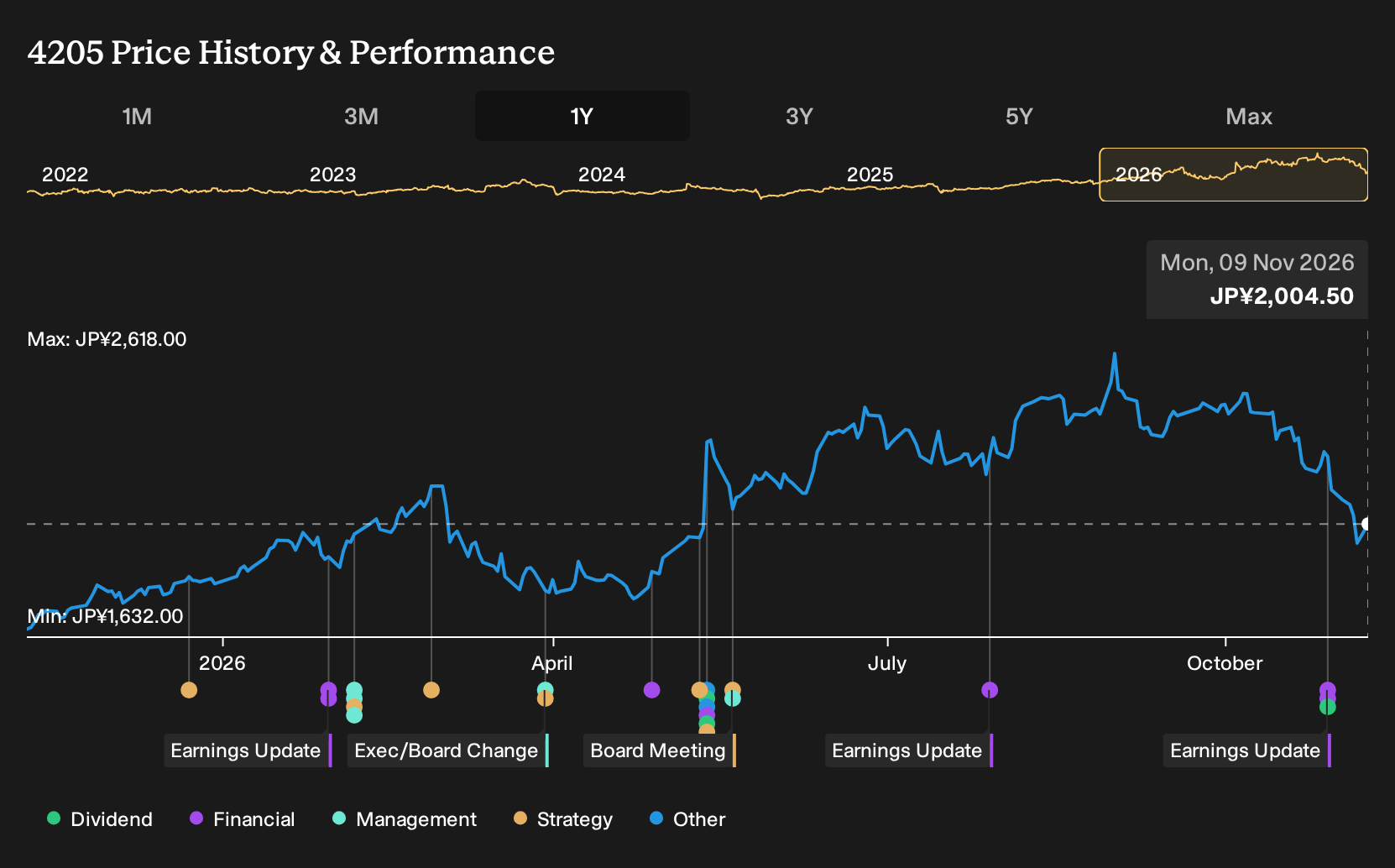
- Zeon Corporation raised its full year guidance for the period ending March 31, 2027, projecting ¥430,000 million in net sales, ¥45,500 million in operating profit, ¥43,000 million in profit attributable to owners, ¥224.56 basic EPS, and lifting its second quarter dividend to ¥39 per share.
- The revised outlook reflects expectations for stronger Elastomer and Specialty Materials performance, supported by selling price adjustments, steady demand for optical films and battery materials, and the impact of a weaker yen.
- This article examines how Zeon’s higher earnings guidance and dividend outlook may reshape the investment narrative for this specialty materials group.
What Is Zeon's Investment Narrative?
To own Zeon, you need to be comfortable with a materials group that lives and dies by execution in two engines. The Elastomer segment is all about keeping pricing in step with raw material costs and currency swings. The new guidance leans on those price revisions and a weaker yen, which makes the near term story very much about management discipline on contracts and feedstock, not just demand. The half year numbers, with ¥224,872 million in sales and ¥26,274 million in net income, show the current run rate behind that guidance.
On the other side, the Specialty Materials arm depends on steady orders for optical film and battery related products. The raised forecast and the higher interim dividend to ¥39 per share indicate that management is willing to lean into that demand trend and return more cash, even as external forecasts still point to earnings declining on average over the next three years. In the short term, the key swing factors now sit in how resilient that end market appetite stays and how much capital Zeon needs to keep pouring into capacity and new materials lines without stretching its balance sheet.
Even so, there is a less comfortable angle to this story once you line the richer guidance up against one particular pressure point...
There's only one way to know the right time to buy, sell or hold Zeon. Head to Simply Wall St's company report for the latest analysis of Zeon's Fair Value.
Form Your Own Verdict
Don't just follow the ticker; dig into the data and build a conviction that's truly your own.
- A great starting point for your Zeon research is our analysis highlighting 4 key rewards and 2 important warning signs that could impact your investment decision.
- See our latest analysis for Zeon. The report includes a comprehensive fundamental analysis summarized in a single visual, the Snowflake, making it easy to evaluate Zeon's overall financial health at a glance.
Looking For More Investment Ideas Beyond Zeon?
If Zeon has sharpened your appetite for income, quality or potential mispricing, the next step is to widen the lens and compare it with other candidates using the Simply Wall St Screener.
- For investors who want potential mispricing paired with solid fundamentals, start by reviewing our hand picked 22 high quality undervalued stocks that may already be discounting conservative expectations.
- If resilience and balance sheet strength matter most to you, filter for companies in the list of solid balance sheet and fundamentals (23 results) to see which businesses pair financial stability with fundamental support.
- Those hunting for under followed ideas can scan the 76 high quality undiscovered gems and see which quieter stocks still line up with your quality and valuation checklist.
Have feedback on this article? Concerned about the content? Get in touch with us directly. Alternatively, email editorial-team@simplywallst.com