


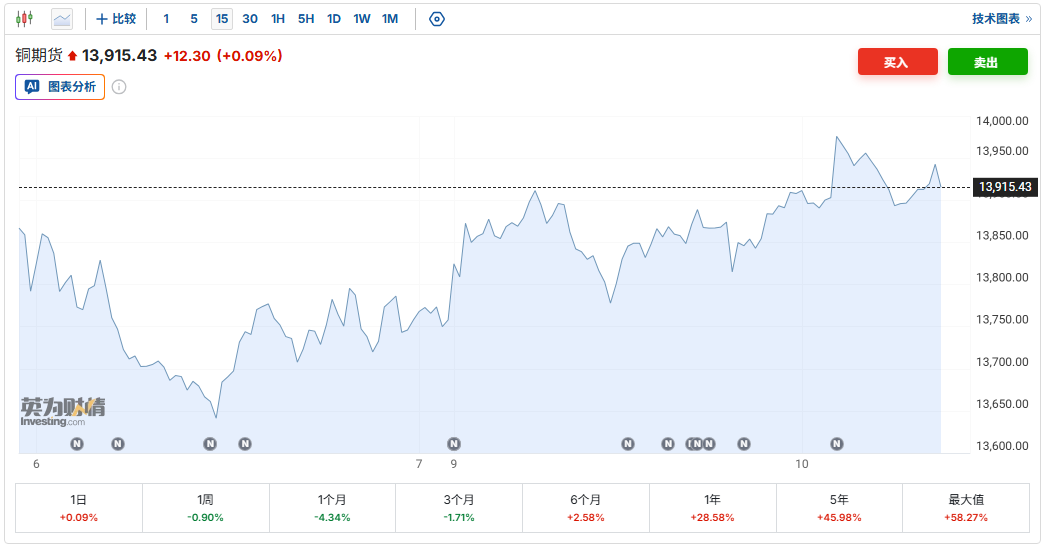
The Zhitong Finance App learned that, driven by the rise in technology stocks, copper prices continued the rebound trend from last week's sharp drop. Copper is widely used in power infrastructure and data center construction, so its price trend is closely related to the performance of technology stocks. As of press release, London Metal Exchange (LME) copper futures rose nearly 0.1% to 13915.43/ton.
US stocks surged across the board on Monday. The Dow rose 2.15%; the NASDAQ rose 2.74%, the biggest one-day gain since July 30; and the S&P 500 index rose 2.34%, the biggest one-day increase since April 8. Most of the tech giants rose, with Tesla (TSLA.US), SpaceX (SPCX.US), and Meta (META.US) surging more than 5%, Amazon (AMZN.US) up nearly 3%, Microsoft (MSFT.US) 2.75%, Apple (AAPL.IS) 2.43%, and Google (GOOGL.US) up 0.73%.
The semiconductor sector soared across the board. The Philadelphia Semiconductor Index surged 6.85%. Among them, AMD (AMD.US) rose more than 13%, applied materials (AMAT.US) rose 11%, Seagate (STX.US) and Western Digital (WDC.US) rose nearly 10%, Micron (MU.US), SNDK.US (SNDK.US), and Arm (ARM.US) rose more than 6%, and SK Hynix (SKHY.US) and Intel (INTC.US) rose more than 5%. Furthermore, the optical communications sector soared, with leading stocks Coherent (COHR.US) rising more than 16%, Lumentum (LITE.US) rising more than 10%, and Corning (GLW.US) and Mwell Technology (MRVL.US) rising more than 9%.
Global stock markets generally rose on Tuesday. Among them, the Korea Composite Stock Price Index (Kospi), which has a high weight in Korean technology stocks, became the best-performing major stock index in the Asia-Pacific region. In the Chinese market, the tight supply situation continued to ferment, driving copper spot surges rapidly to record levels.
In recent months, this trend in industrial metals has been in sync with artificial intelligence (AI) concept stocks. Last week, copper prices fell 2.7% to their lowest level in three months due to market concerns that the Democratic Party's overall victory in the US midterm elections might mean that AI regulation will be further strengthened.
In recent years, AI data center construction has become an important new driving force for copper demand growth. As large technology companies continue to expand their data centers, market demand for high-voltage power equipment, transformers, cables, and power grid upgrades is growing at the same time. Compared with the AI chip itself, the power infrastructure construction behind the data center also consumes industrial metals such as copper, which cannot be ignored.
A study published in the academic journal “Resources Policy” in August 2026 quantified 20 minerals involved in AI data center infrastructure. The study found that copper accounted for 83% of the total amount of minerals calculated; while the copper consumed by power grid transmission and distribution processes accounted for 64% of the total copper demand. This shows that the AI industry's demand for copper comes not only from server and chip manufacturing, but more importantly from the large-scale infrastructure needed to power data centers.
Therefore, if the Democratic Party pushes for stricter data center approvals, power cost sharing requirements, or environmental regulations, leading to the postponement or even cancellation of some projects, the market may re-evaluate the pace of AI infrastructure construction in the next few years and lower expectations for the increase in copper demand.
However, the slowdown in AI data center demand does not mean that the long-term demand logic for copper will be completely reversed. Global power grid upgrades, electrification transformation, and new energy infrastructure construction are still important supports for copper demand. What the market really needs to evaluate is whether the growth rate of AI data center investment will decline in stages, and whether demand for other terminals can fill the potential gap.
It is worth mentioning that as the Trump administration is about to enter a “lame duck period,” the market speculates that the possibility of expanding tariffs on copper imports is decreasing. Previously, the Trump administration's prospect of imposing import tariffs on refined copper — driving copper resources into the US and distorting the balance between supply and demand in the global copper market — was an important reason for keeping copper prices at a high level. Since the US began considering imposing additional tariffs on copper imports in early 2025, traders have used the price difference between the US and London markets to ship large amounts of copper resources to the US to complete inventory layout before potential tariffs come into effect.
The uncertainty of the US government's copper import tariff policy means that the market may still be affected by changes in tariff expectations in the short term. If the US finally decides not to tax refined copper or delays related measures, US stocks previously established by traders to evade potential tariffs may gradually flow back to the international market, thereby easing supply constraints outside of the US and weakening the tariff premium included in copper prices. Conversely, if the US finally decides to impose tariffs on refined copper starting in 2027, traders may once again speed up the transfer of copper resources to the US to complete preparation before the tariffs come into effect. Not only is this likely to further boost US inventories, but it may also exacerbate supply constraints in other regions in the short term.