


The Zhitong Finance App learned that US President Trump's statement to downplay the risk of the escalation of the war in Iran boosted market expectations that the conflict would gradually cool down, and European gas prices fell in response. As of press release, the European benchmark Dutch TTF natural gas futures price fell 0.23% in recent months to 82.31 euros/megawatt-hour. Last month, European gas prices soared to their highest level since 2022, but as of November, prices had dropped by more than 20% cumulatively.
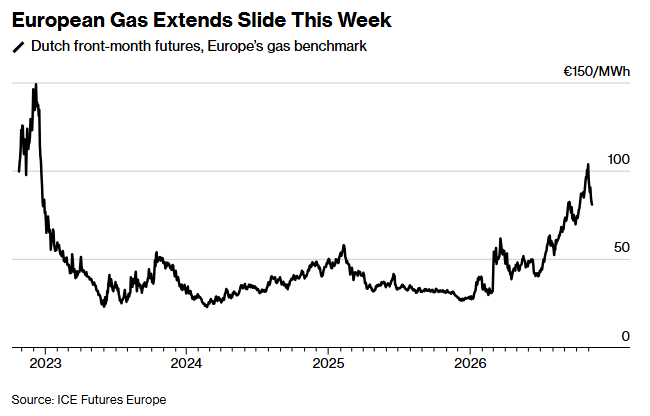
European gas continues to decline this week
Since the US midterm elections, market hopes for progress in peace negotiations and the restoration of energy supply in the Middle East have heated up. US congressional Democrats are considering whether to use the December 11 government shutdown deadline to pressure Trump to end the conflict.
Trump told reporters on Monday that there currently seems to be no need for the US to take military action against Iran. Trump said, “At this stage... military action doesn't seem necessary. But we are waiting very hard and are ready to act as soon as the situation changes.” He also said, “I think this conflict will soon be over.”
However, European winter gas stocks are at an abnormally low level. Over the past few days, European gas inventory consumption has increased significantly, and the EU average gas storage level has dropped to 72%, which is lower than the average of 89% over the same period of the past five years. Germany's gas storage level is only 59%. Some parts of Europe have recently experienced cold waves and the simultaneous weakening of wind power (leading to a decline in wind power generation), further increasing the pressure on gas stocks in the region.
Low inventory levels in Germany, Europe's largest economy, have prompted the German gas storage industry organization INES to issue a warning. The organization said that if extreme cold weather occurs this winter, Germany's gas supply will not be fully guaranteed. Currently, the market expects temperatures in Germany to be mild to average this winter, but some meteorologists warn that there is still a risk of cold waves in the late heating season.
Europe's dependence on global liquefied natural gas (LNG) supply will increase further in the coming months due to low inventory levels, so it is particularly vulnerable to price fluctuations. And unless exports from the Middle East recover — the Middle East accounts for about one-fifth of global liquefied natural gas (LNG) flows before the war — the market still expects gas prices to remain high.
The good news is that the amount of LNG loaded into tankers in Qatar has rebounded over the past few weeks, indicating that although shipping in the Strait of Hormuz continues to be disrupted, this major exporter is seeking to supply more LNG cargo to the global market.
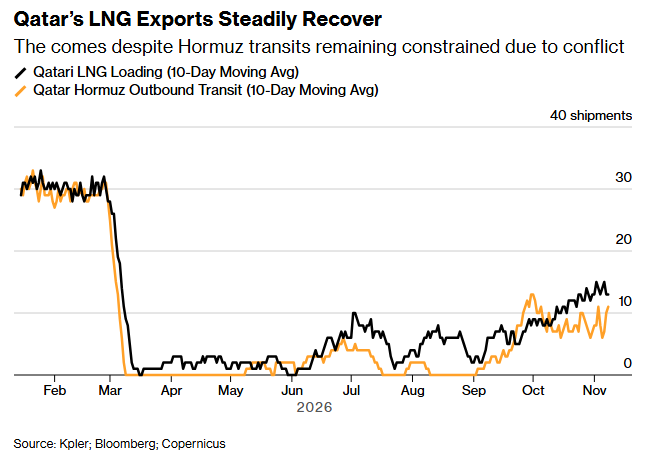
Although passage through the Strait of Hormuz is still restricted due to the conflict, Qatar's LNG exports are gradually resuming
According to the data, based on the 10-day moving average, the number of LNG carriers departing from the Las Laffan (Las Laffan) facility in Qatar so far this month is between 13 and 15. This figure is slightly higher than the October average of about 11 ships, but it is still only about half of the pre-war shipping speed.
However, the increase in shipping volume has yet to translate into a similar increase in the estimated eastbound shipping volume of the Strait of Hormuz. The Strait of Hormuz is an important waterway connecting Qatar with Asia and Europe. According to the data, in the 10 days up to November 8, a total of 11 carriers loaded with Qatari LNG left the strait.
Although the speed of ships passing through the strait has generally remained stable over the past month, it is not uncommon for there to be a mismatch between loading volume and departure data. Both sets of data rely on information points that are difficult to verify, since most ships carrying cargo in Ras Lafan or passing through the Strait of Hormuz do not send their own location information.
As winter weather turns colder in the northern hemisphere, competition between Europe and Asia over the limited supply of available natural gas is likely to intensify further. If Qatar's LNG supply continues to increase and enter a wider global market, it will help ease supply pressure.