


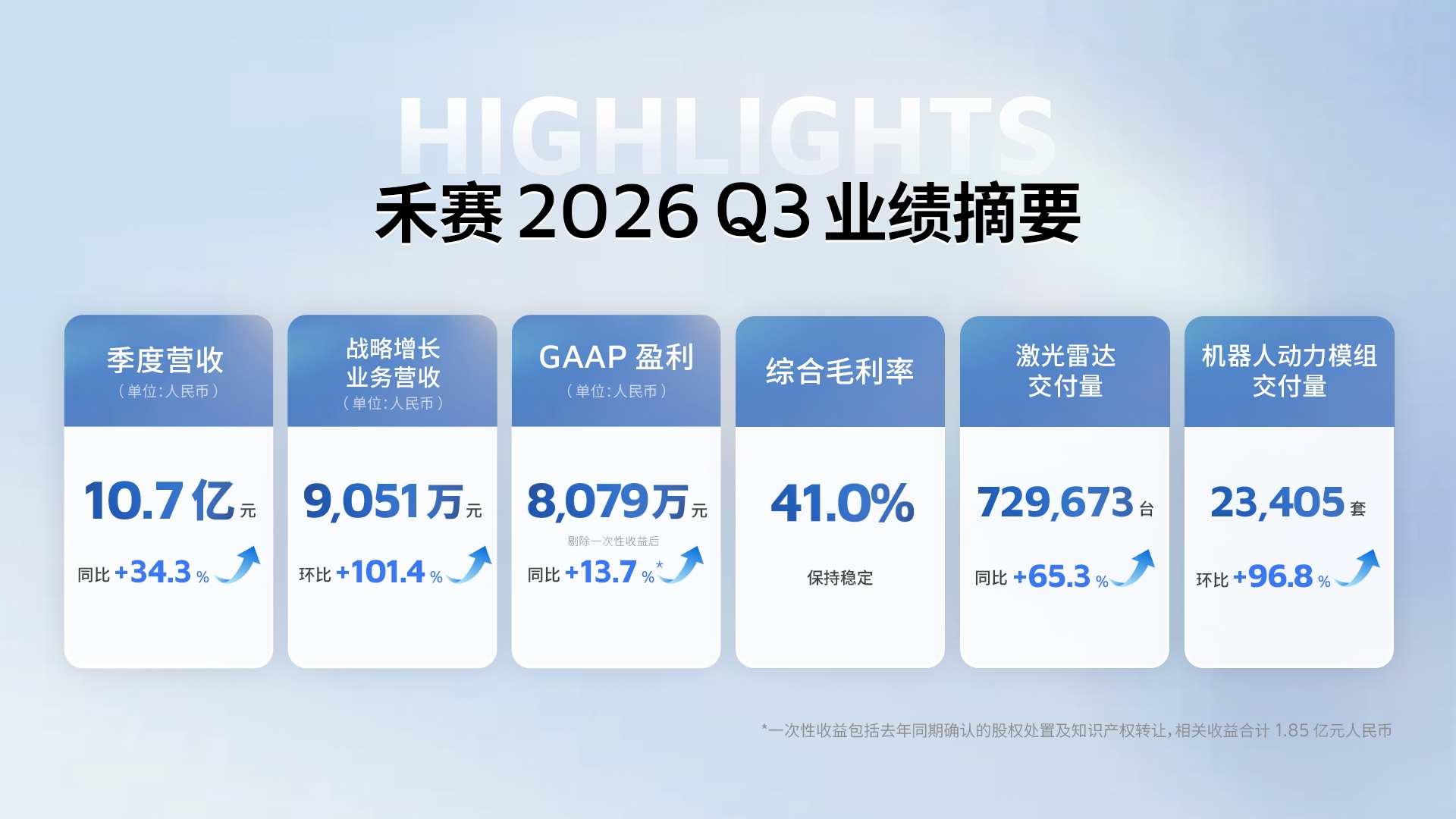
Zhitong Finance learned that on November 10, HSAI.US (02525) released unaudited financial data for the third quarter of 2026. In the third quarter, Hesai had revenue of RMB 1.07 billion and GAAP net profit of RMB 80.79 million. It has achieved GAAP profit for six consecutive quarters. Among them, Hesai Strategy increased business revenue by 90.51 million yuan, an increase of 101.4% over the previous month.
Hesai's strategic growth business continues to unleash growth momentum. In the third quarter, the delivery volume of power modules for Hesai robots was 23,405 sets, a month-on-month increase of 96.8%. The monthly production capacity increased to 10,000 sets, and full-body joint modules have also entered mass production. By the end of September 2026, a total of 35,295 sets of Hesai robot power modules had been shipped, and it is expected that the annual shipment volume will reach six digits in 2027. Kosmo, the 3D world data engine of Hesai, has been officially released, and Kosmo One, the world's first 8K ultra-high-definition AI space camera, and Kosmo World, an AI-driven cloud platform, have been launched simultaneously.
The number of Hesai lidars delivered this quarter was 729,673 units, an increase of 65.3% year over year. The delivery volume of robot power modules was 23,405 sets, an increase of 96.8% over the previous month. The monthly production capacity increased to 10,000 sets, and full-body joint modules have also entered mass production.
Kosmo, the 3D world data engine, was officially released, and commercialization was implemented at an accelerated pace
In October, Kosmo, the 3D world data engine, was officially released globally, and Kosmo One, the world's first 8K ultra-high-definition AI space camera, and Kosmo World, an AI-driven cloud platform, were launched simultaneously.
Kosmo World, a one-stop 3D content creation and management platform, is responsible for transforming collected data into an intelligent space that AI can understand, interact, and train. The underlying layer is Kosmo Spatial Core (KSC), a native 3D space reconstruction and understanding system for Hesai AI.
The data generated by Kosmo can also be visually adapted to the camera characteristics of the target robot, allowing the robot to train in the “own eyes” world, further narrowing the gap between simulation and reality. From pre-training and post-training to evaluation and deployment, this set of capabilities covers the entire process of physical intelligent training.
In terms of commercialization, since the first batch of prototypes was shipped in July 2026, Kosmo has begun to contribute revenue and continues to expand diverse application scenarios.
In the field of film and television entertainment, Hesai Kosmo collaborated with RenderMan, an industrial-grade renderer owned by Pixar, a well-known Hollywood animation studio.
In the field of physical intelligence, Kosmo has reached strategic cooperation with Galaxy General Robotics and Force Smart, enabling cutting-edge breakthroughs in embodied intelligence. In the field of space commerce, Kosmo reached a strategic cooperation with Gaode, a subsidiary of Alibaba. The first batch of 1,000 pilots covered shopping malls, retail stores, restaurants, hotels and brand stores.
Accelerated release of robot power modules, with cumulative delivery of over 35,000 sets
As the core execution component for robot movement and operation, the performance and cost of the power module directly affect the performance and commercialization process of the whole machine. In the case of a humanoid robot, the number of driving joints is close to 100, and the cost of related components accounts for more than 50% of the total material cost (BOM) of the machine.
Compared with similar products, the Hexai power module has been reduced by 37%, the power density has been increased to 3 times, and has good motion transparency and reverse driving ability, providing key execution support for the robot's high-speed movement and fine operation.
Hesai power modules have empowered AI robotics company Sharpa. Sharpa's first flagship tactile dexterous hand, Wave (W01), is based on the Hesai power module and has 22 active degrees of freedom, achieving 1:1 homogeneity with a human hand. As the industry's first highly flexible reversable dexterous player to achieve mass production, the W01 has entered the Nvidia Isaac GR00T humanoid robot reference program and has been adopted by top universities and research institutes around the world such as Berkeley, Stanford, and Nanyang Technological.
By the end of September 2026, Hesai had shipped more than 35,000 sets of robot power modules, and it is expected that the annual shipment volume will reach six digits in 2027.
Building a solid foundation for physical AI perception, leading the lidar market
According to data from the Gaiser Automobile Research Institute, in September, the market share of Hesai ADAS main lidar was 43%, continuing to rank first in the industry. According to the Yole Group report, Hesai's Robotaxi lidar market share reached 62% in 2025, ranking first in the world, and continues to consolidate its leading position in the global market.
In September, physical AI infrastructure company Hesai Technology reached a new strategic cooperation with JD to support the continuous implementation of JD's unmanned logistics vehicles, robots and other businesses with high-precision three-dimensional spatial sensing capabilities such as 6D full-color lidar, and jointly expand the application boundaries of physical AI in the real world.
At the same time, Hesai continued to deepen cooperation with global car companies, and was selected by many leading car companies this quarter:
• The ultra-thousand-line lidar ETX has been selected by 5 of the world's leading car companies, including a top European car company, Cadillac, Geely, Great Wall Motor and a leading NEV company, with orders of more than 1 million units.
• Multi-lidar solutions are rapidly penetrating into more models, and FTX blindness lidar has been selected by Zero Sports and a top European car company.
• ATX's new lidar has been designated by Wuling and will be used in high-volume Volkswagen models.
With dual engines, Hesai creates key infrastructure for physical AI
Digital AI has taken off, and physical AI infrastructure still needs to be built — which means new industrial opportunities are opening up. To move from the digital world to the real world, AI requires two types of infrastructure: one is the ability to understand three-dimensional data in the real world, and the other is the ability to drive the robot's movements. The 3D world data engine and robot motion engine are currently the best industry opportunities. They are also highly compatible with Hesai's underlying ability genes and professional product building experience — they will become Hesai's second growth engine. In the past ten years, what Hesai did was let machines see the world; in the next ten years, what we need to do is let robots understand and change the world.
Li Yifan, co-founder and CEO of Hesai Technology, said, “In the third quarter of 2026, Hesai accelerated the deployment of robotics and physical AI infrastructure. The lidar business continues to generate stable cash flow. Its growth momentum mainly comes from three aspects: first, ETX, the ultra-thousand-line lidar, has been selected by 5 leading car companies, including a top European car company and Cadillac; second, the penetration rate of multi-lidar solutions in China and overseas markets continues to increase; and third, it has acquired new Wuling and Chery projects to further expand lidar to high-volume Volkswagen models and export markets. Meanwhile, in the field of robotics, Yole Group reports that Hesai ranked first in the world with a 62% share of the Robotaxi lidar market in 2025. We are also cooperating with JD, the largest retailer by revenue in China, to help it build the world's largest team of physical robots with spatial sensing capabilities such as 6D full-color lidar.
SGI is rapidly growing into Hesai's next growth engine, expanding new opportunities for robotics and physical AI around data and hardware infrastructure. In October, we launched Kosmo, a 3D world data engine to the world, which can transform real-world environments into high-fidelity, editable 3D assets that can be directly used by AI. A few months after the first batch of prototypes were shipped, Kosmo has begun contributing revenue and cooperating with the world's top companies and organizations, including Pixar RenderMan. The scope of application covers fields such as robot training, film and television entertainment, cultural tourism, cultural tourism, cultural tourism and expo, and space navigation. On the other hand, the power module business, which is a robot motion engine, also ushered in rapid growth in shipments; following the dexterous hand module, full-body joint modules have also entered mass production, with shipments reaching 23,405 sets in the third quarter, an increase of 97% over the previous quarter. Our journey in physical AI has just begun.”
Fan Peng, CFO of Hesai Technology, said, “In the third quarter, our growth strategy progressed steadily: the core lidar business remained profitable and continued to expand, and SGI's commercialization process was further accelerated. This quarter, Hesai achieved revenue of 1,068 billion yuan, an increase of about 34% over the previous year. The number of lidar shipments reached 729,673 units, and the number of robot power modules shipped 23,405 sets. SGI's growth rate has exceeded expectations, and revenue for the first three quarters has surpassed the original annual target of 100 million yuan. Robot power modules usually account for more than 50% of the material cost for humanoid robots. Currently, they are being rapidly released, with cumulative shipments reaching 35,295 sets by the end of the third quarter. Based on these developments, and Kosmo's new revenue streams, we reaffirm SGI's 2026 revenue guideline of $2-3 billion. As customer validation continues to deepen, we are increasing our investment in SGI while maintaining financial discipline. Net profit for the quarter reached $80.79 million and achieved GAAP profit for the sixth consecutive quarter. Among them, the operating profit of the core lidar business reached 145 million yuan, a sharp increase of 88% over the previous year. Our goal is clear: to be the leading infrastructure platform for the robotic and physical AI era.”