


- Put your dollar on the counter because it is time for the November round of USDA'S Keno game, this time using AI to ‘double check’ the numbers.
- Regarding USDA Keno game, what the industry in general cannot wrap its head around, never has wrapped its collective head around, is it is about funds, not fundamentals.
- In other news, trading algorithms were again triggered by the same old comments from the US president, driven the Energies sector lower overnight.
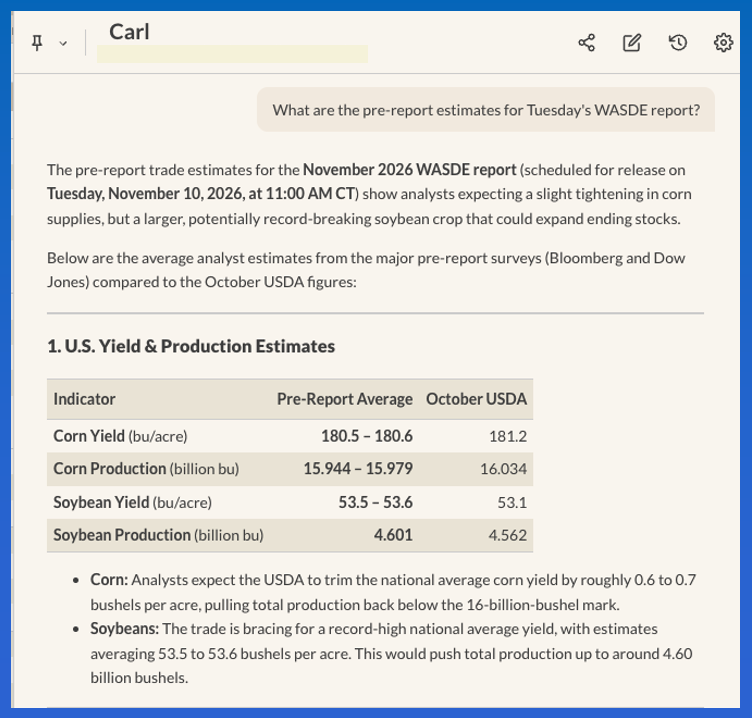
Morning Summary: It’s hard to believe a week ago today the US was facing the uncertainty of a mid-term election, though the Energies sector tipped the hand of the expected outcome. This week, as we head into another final day of the latest positioning week for fund traders in the commodity complex, the Grains sector has yet another Keno game on the docket. Yes, it is indeed time for the November USDA WASDE report, this one including the added fun and frivolity of the government using an AI agent it created itself – think about that for a moment – to “double check its numbers”. As I said, this is going to be fun. I’ll talk about it more detail momentarily. As for other markets pre-dawn Tuesday, things are generally quiet except for the Energies sector. Here we see continued selling overnight with WTI crude oil (CLZ26) losing as much as $2.97 (3.4%) while diesel fuel (HOZ26) dropped as much as 18.9 cents (4.5%). What’s the headline this morning? “(The US president) says Iran war to end ‘fairly soon’, plays down prospect of new strikes”. Of course it will. I said this after last week’s election when Democrats won both chambers of Congress. Which is what Energies were showing us beforehand.
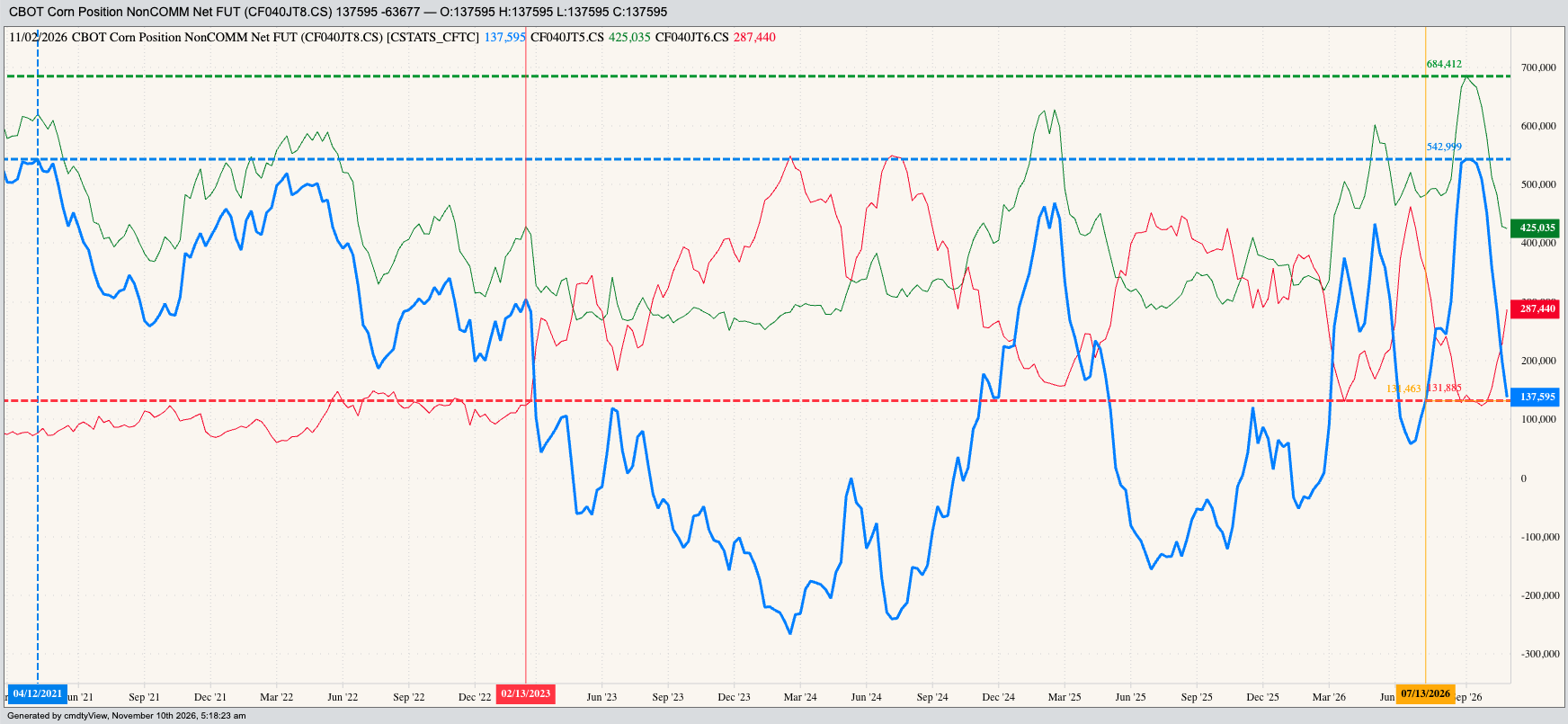
Corn: Okay, let’s get into today’s Keno game, brought to you by USDA’s own AI program. What do I think the new system will tell us about national average corn yield and total production? “Blue” and “choo-choo train”. Just kidding, though something absolutely ludicrous would not be out of line with USDA’s standard operating procedure. Recent history has shown what I’ve long screamed into the wind: 1) The numbers are not real. 2) The reports are not intended to shed light on real US ag market fundamentals. And 3) The function of these reports is to generate trade. For the record, USDA has been successful in all three of those objectives. Recall the October Keno game generated record large algorithm trading in the corn market, a win for the exchanges, brokers, and so on. Does it matter if US farmers lost because USDA “corrected” an error from September? Not even slightly. What am I actually expecting with today’s Keno numbers? Given the corn market is sharply oversold, and funds have decreased the net-long futures position by 405,400 contracts the past 8 weeks, my guess is the national average yield number will come in near or below the average pre-report guess of 180.5 bushels per acre, triggering algorithms to buy.
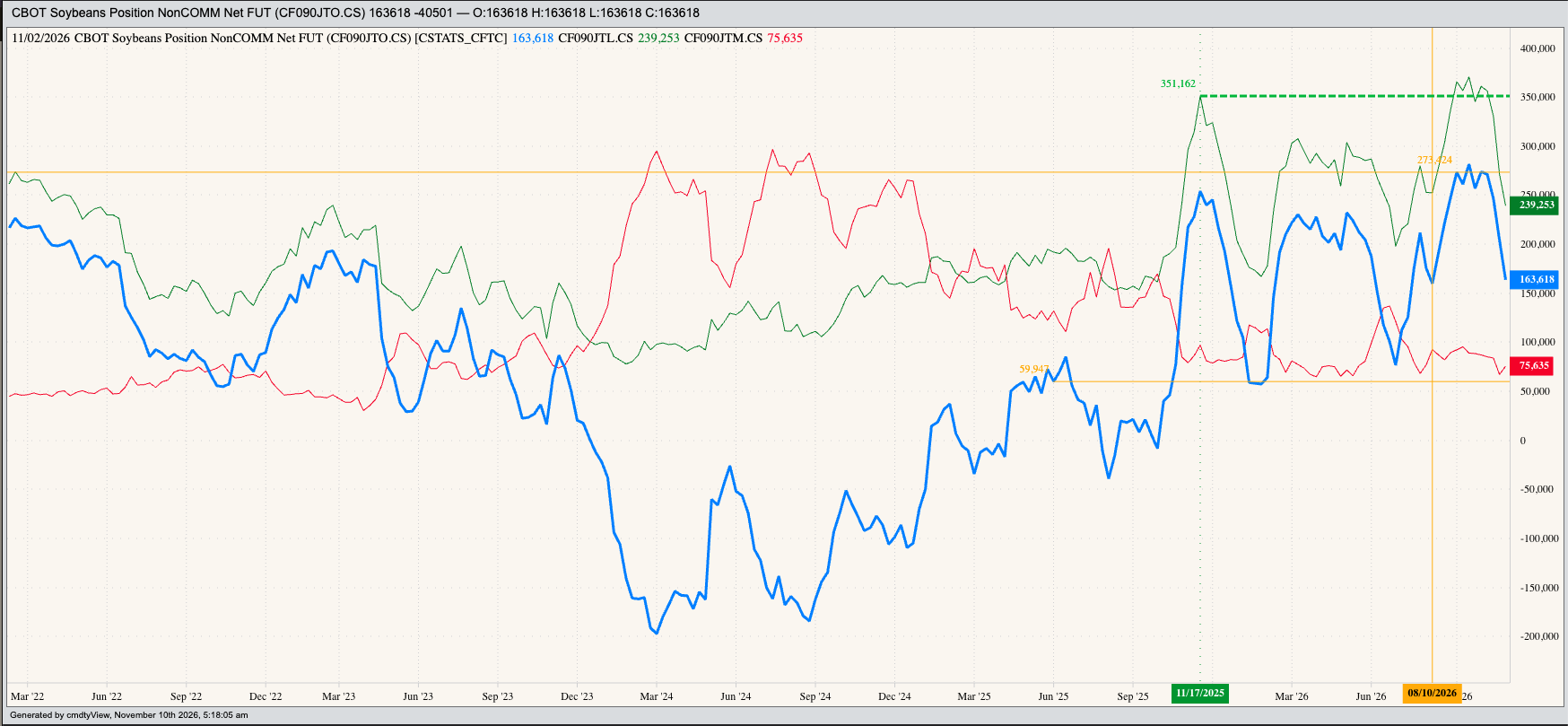
Soybeans: It’s a similar story in the soybean market as we look ahead to Tuesday. To begin with, the noncommercial net-long futures position has decreased from the recent record large of 281,580 contracts on Tuesday, September 22 to the latest figure of 163,620 contracts on Tuesday, November 3, a total of 117,960 contracts. However, unlike corn, this drop was mostly a result of long liquidation as the recent record large position of 370,525 contracts fell to the latest figure of 239,250 contracts, a total of 131,275 contracts. This tells us funds have been getting out of short futures positions as well as long. Why would Watson be moving out of soybeans, generally speaking? Because Brazil’s crop is improving and the US has been made a secondary player on the global stage over the past decade. What will likely be the key soybean numbers in today’s Keno game? The easy choice is US national average yield, with the pre-report average guess coming in at 53.5 bushels per acre versus the October number of 53.1 bpa. In reality, though, there are two other things to keep an eye on: 1) The ‘adjustment’ to corn yield and production and 2) the latest estimate on global ending stocks. Regarding the latter, the pre-report guess is 124.7 million metric tons as compared to the October estimate of 124.3 mmt.
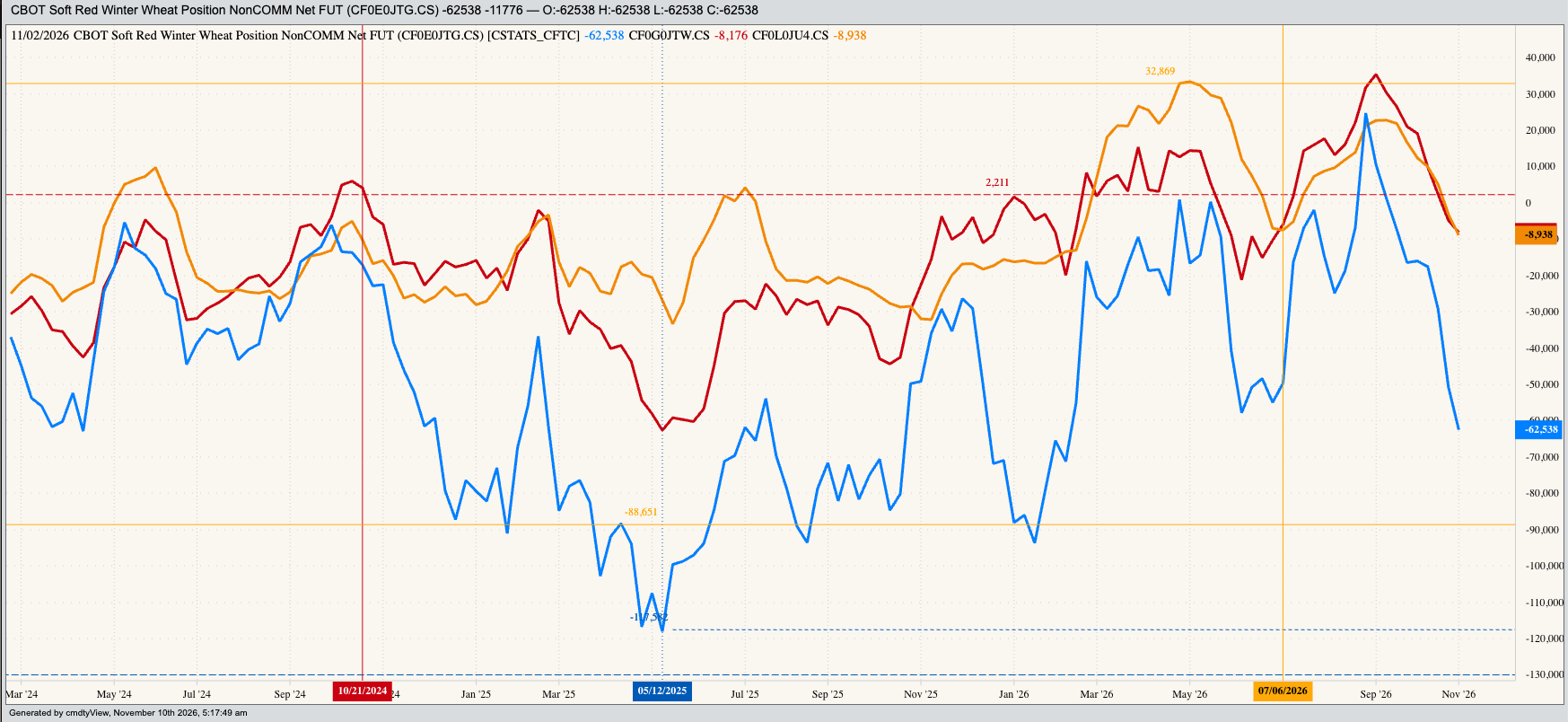
Wheat: If USDA’s WASDE reports are the equivalent of Keno games, the last resort of losing gamblers who pay their last dollar to have the house generate ‘random’ numbers and tell them if they’ve won (yes, that is actually what happens), then the wheat sub-sector is the penny version of the game. Not because wheat isn’t important, I still have a wall chart titled “Wheat: The Greatest Market of Them All”, but because the big gambling money is in corn and soybeans. Heading into today’s, the heavier traded December SRW contract has closed lower 10 consecutive weeks, then finished 3.25 cents in the red to open this week. Is wheat oversold? Does it matter? For the record, based on stochastics (a technical momentum statistic) December SRW is sharply oversold on both its short-term daily and intermediate-term weekly charts. And when I say “sharply”, I use 20% to signal oversold (80% for overbought) and the Dec daily percentages are below 10% with weeklies below 5%. Meanwhile, the past 10 weeks have seen Watson move from a net-long futures position of 24,700 contracts to a net-short of 62,540 contracts. Does that have anything to do with market fundamentals? Not at all. Just like USDA’s WASDE reports.
On the date of publication, Darin Newsom did not directly have a position in any of the securities mentioned in this article. All information and data in this article is solely for informational purposes. For more information please view the Barchart Disclosure Policy here.