


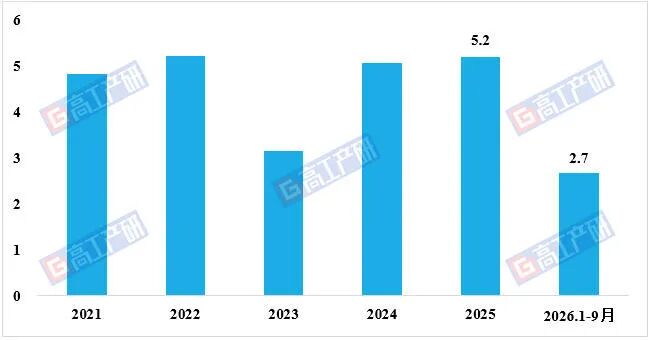
The Zhitong Finance App learned that, according to the Advanced Industrial Research Institute (GGII) Jiaotong Insurance Calibration Data, sales of new energy buses were around 50,000 units in 2021-2022, mainly due to bus updates and a recovery in tourist passenger traffic; sales declined significantly in 2023, due to declining subsidies, compounded financial pressure, and procurement contraction; in 2024-2025, sales rebounded with bus renewal policies, replacement of old vehicles, and export growth.
From January to September 2026, sales of 27,000 new energy buses were affected by the phased delivery pace. Most domestic bus tenders were placed in the second half of the year, and the electrification penetration of tourism and cross-city passenger transport is still slow. Overall, new energy buses are a policy-driven market, and sales fluctuate with the pace of renewal cycles, finances, and exports.
Sales volume of new energy buses in China from January to September 2021 to 2026 (unit: 10,000 units)
Data source: Jiaotong Insurance, Advanced Industrial Research Institute (GGII), November 2026
The competitive landscape
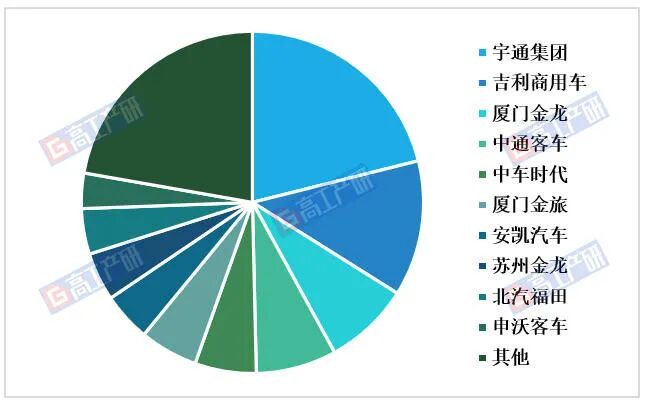
According to GGII data, from January to September 2026, the NEV market showed a competitive trend of “one super many”. Yutong Group ranked first with a 21.09% share, and the leading advantage was stable; Geely Commercial Vehicles ranked second with 12.83%, showing significant growth. The shares of Xiamen Jinlong, Zhongtong Bus, CRRC Era, Xiamen Golden Travel, Ankai Auto, Suzhou Jinlong, Beiqi Foton, and Sunwo Bus are relatively close, creating a parallel situation where various companies rely on different scenarios such as buses, passenger transportation, and overseas orders.
Sales share of new energy bus companies in China from January to September 2026 (%)
Data source: Jiaotong Insurance, Advanced Industrial Research Institute (GGII), November 2026
Charged capacity
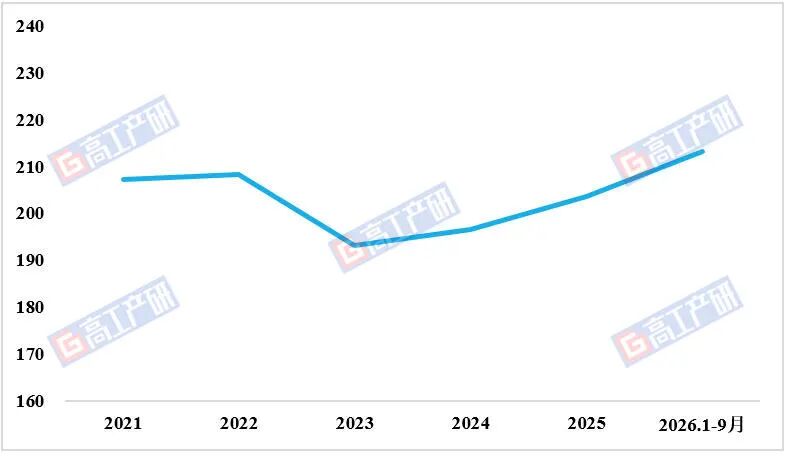
Judging from the average amount of electricity charged by a new energy bus, the overall trend is fluctuating. There was a phased decline in 2023, mainly due to a sharp increase in the share of 6-7 meter series model purchases in 2023. From 2024, the data gradually recovered and reached 213.2 kWh from January to September 2026, a record high. The amount of electricity charged by bicycles continues to rise, due to the increase in the share of tourist buses, cross-city passenger transportation, and overseas export orders. The market's demand for long battery life and high battery life redundancy has increased, directly driving up the scale of battery support for single cars.
Average charge capacity of batteries for new energy buses in China from January to September 2021 to 2026 (unit: kWh/unit)
Data source: Jiaotong Insurance, Advanced Industrial Research Institute (GGII), November 2026
Installed capacity
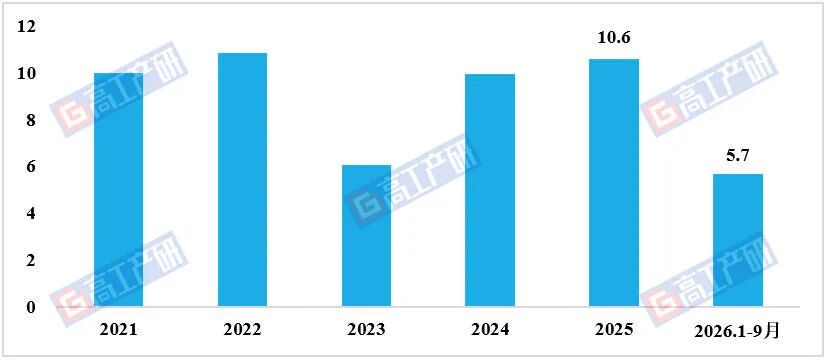
The installed volume of batteries used in new energy buses showed obvious cyclical characteristics as sales fluctuated. The installed capacity from January to September 2026 was 5.7 GWh. Against the backdrop of phased sales pressure, the increase in bicycle charging capacity hedged some of the pressure from sales. Long-life models continued to drive up the supporting value of bicycle batteries, and are becoming the core driver of the increase in battery demand.
Installed capacity of batteries for new energy buses in China from January to September 2021 to 2026 (Unit: GWh)
Data source: Jiaotong Insurance, Advanced Industrial Research Institute (GGII), November 2026
Battery pattern
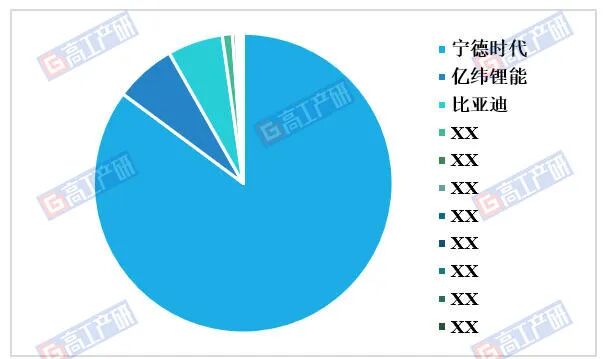
According to GGII data, competition among new energy bus battery companies from January to September 2026 was highly concentrated. Among them, Ningde Era (300750.SZ) occupied an absolute dominant position with a share of over 85%, while Everweft Lithium (300014.SZ) and BYD (002594.SZ) ranked second and third, all winning about 6% of the market share. The share of other battery manufacturers is 1% or less, and the size is too small. The entry threshold for battery circuits for new energy buses is high, and the pattern is more concentrated compared to other NEV segments.
Percentage of installed capacity of China's new energy bus battery companies from January to September 2026 (%)
Data source: Jiaotong Insurance, Advanced Industrial Research Institute (GGII), November 2026