


The Zhitong Finance App learned that US small business owners are preparing to pass on the cost pressure. According to the US National Federation of Independent Business (NFIB) October survey released on Tuesday, the net ratio of planned price increases in the next three months is 37%, the highest in more than four years; the small business optimism index of 97.8 is basically the same as 97.9 in September, slightly higher than the 97.7 expected by the market. The key point is 37%, not 97.8: it describes not businessmen crushed by costs, but rather a group of pricers who think they have the ability to pass along and intend to take action.
The will to raise prices is back, but it's not the same kind as 2022
37% is the net ratio, that is, the share of companies that plan to raise prices minus the share of companies that plan to reduce prices. The 2022 round stemmed from overheating demand compounded by supply chain breakdowns. Companies are lining up at the door; this round is different: currently, it is more due to rising supply-side energy costs driving up the desire to raise prices, more owners rating their business conditions as “good” or “excellent”, and actual sales are also improving. The price increase is not due to despair, but rather companies judge that they can push out the costs themselves.
NFIB chief economist Bill Dunkelberg said, “Small business optimism did not change much in October. Owners are still dealing with long-standing challenges, but there have also been some encouraging developments.”
On the other side, capital expenditure plans have weakened slightly — willing to raise prices, willing to raise wages, but unwilling to expand production; this is defensive pricing, which corresponds to “preserve profit margins first.”
Cost drivers are converted to taxes, people, and wages
According to the “Single Most Important Issue”, labor quality and availability topped the list with 25%, ranking first for the fourth month in a row. The real change came in second place: 21% of landlords listed taxes as the number one issue, the highest since May 2021, up 10 percentage points from month to month. A monthly jump of 10 points is not common in NFIB surveys, but it shows that policy costs are replacing simple investment costs as a new variable. Inflation itself ranked third with 17%.
The wage line is still under pressure. According to the October employment report released by the NFIB on November 6, 24% of net landlords plan to raise wages over the next three months, the highest since December 2025; 36% of owners have unsatisfied job vacancies. Wages are the most rigid part of the cost, and the hardest leg for service sector inflation to cool down — they won't fall back as gasoline prices drop.
The combination of the three forms a closed loop: wages are rising, tax expectations are rising, investment costs are still high, and the demand side is still holding up. The rational choice is to raise prices — this is the microscopic source of core inflationary stickiness.
Comparing CPI and the Federal Reserve: Are oil prices giving a “fake cooling”?
In September, the US CPI rose 0.6% month-on-month and 3.7% year-on-year, and gasoline rose 9.1% month-on-month, contributing more than half of the monthly increase; core CPI rose 0.3% month-on-month and 2.6% year-on-year, all higher than in August. The market expects an overall increase of 0.3% month-on-month and a 0.2% increase in core in October. The year-on-year comparison was not published this month: during the government shutdown in October 2025, the Bureau of Labor Statistics did not collect price data, lacked a base period, and only published a month-on-month comparison. As a result, tonight's readings will appear “cleaner” than usual.
Oil prices are indeed giving way: due to expectations of easing the US-Iran conflict and the midterm election results, international oil prices fell by more than 10% last week. But the core items didn't follow suit — the three-month annualized growth rate of core CPI rose from 2% in August to 3.4%, and PPI rose 6.3% year on year in September, the biggest increase in more than three years.
The pressure on the investment side is still in the pipeline. 37% of the NFIB is proof that the pipeline has not yet been cleared: the CPI records the prices that have occurred, and the NFIB is asking about the intentions for the next three months; while small businesses are the pricing makers of the “last link” of restaurants, retail, and construction, their price increase plans can better indicate the direction of core service inflation than consumer confidence surveys.
The Federal Reserve raised interest rates by 25 basis points to 3.75% — 4.00% in September, for the first time since July 2023, and remained on hold in October; at the December 8-9 meeting, federal funds rate futures were almost completely priced plus 25 basis points.
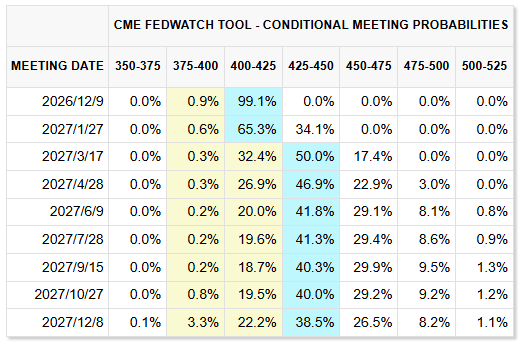
The survey doesn't change the December vote, but it affects 2027 — if tonight's core CPI falls at 0.2%, the market can easily conclude that “interest rate hikes are nearing the end”; while the 37% price increase plan indicates that even if energy suppresses the overall figure, corporate pricing is still re-embedded around 3% of inflation into the economy. Christopher Hodge, chief US economist at Natixis, believes that inflation stickiness is higher than target and employment is stable. There is reason to raise interest rates again in December, and next year it may enter a longer suspension period.
Currently, falling oil prices and the 1-year inflation forecast in the November University of Michigan Consumer Survey fell from 4.7% to 4.3%, all giving the Federal Reserve a reason to slow down. However, the disagreement was not “whether to raise interest rates”, but “where to stop and for how long.”
As far as the market is concerned, small-cap stocks and regional banks are most sensitive to short-term interest rates, and the “higher for longer” 2027 hurts valuations even more than a December rate hike. For enterprises, the differentiation ratio of the ability to raise prices is even more important: chains and professional service providers with pricing power can pass on wages and tax burdens, while under-profit catering, retail, and construction subcontractors can only be caught between minimum wages, financing costs, and customer pressure -- 37% of the two types of businesses are hidden below.