


The Zhitong Finance App learned that although US stocks rebounded strongly on Monday after experiencing a sharp decline last week, Wall Street position data shows that the market's potential selling pressure has not yet been fully released. Goldman Sachs Group's main broker business data shows that during the period when the S&P 500 index recorded its worst weekly performance since 2025, global macro hedge funds hardly cut their stock exposure. Meanwhile, retail investors and hedge funds that focus on individual stock trading are leaving the market one after another.
This difference in positions means that if market sentiment worsens again in the future, macro-hedge funds that still maintain high stock exposure may become a source of a new round of selling pressure. In particular, in the next two weeks, the US stock market will be intensively ushered in a number of important events, including the financial report released by Nvidia (NVDA.US) on November 17 and the much-anticipated initial public offering (IPO) of Anthropic. According to reports, Anthropic plans to determine the IPO price on November 18. Additionally, November 20 will also mark the monthly option expiration date.
The latest CPI data released on Tuesday was stronger than expected. Traders further increased their bets on the Federal Reserve's interest rate hike in December, and the yield on 2-year to 5-year US Treasury bonds rose by more than 10 basis points. Earlier, Federal Reserve Governor Waller expressed support for interest rate hikes in London and said that if inflation continues to accelerate, he will prefer to raise interest rates by 50 basis points. Affected by this, traders have fully taken into account the expectations of the Federal Reserve's interest rate hike of 25 basis points in December. US stock futures fell sharply, and Nasdaq 100 futures fell 1.5%, hitting pre-market lows.
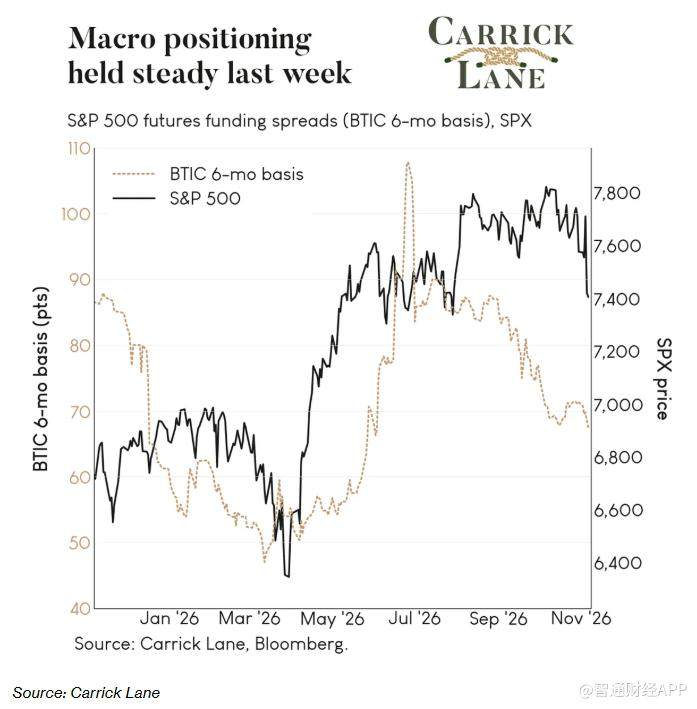
John Marshall, partner at Carrick Lane, said in a report to clients: “The good news is that market positions have fallen back from the highest level in history to the average level. The bad news is that the decline in holdings is not enough for investors to start buying stocks based on this indicator alone.”
According to Goldman Sachs main broker business data, individual stocks experienced the largest net sale in four months last week, while macro-traded products such as stock indices and exchange-traded funds (ETFs) recorded net purchases. This shows that although some investors have drastically reduced their risk exposure, macro funds that trade through instruments such as stock index futures, ETFs, and swaps are still relatively optimistic.
Marshall pointed out that another measure of macro-fund activity is the financing costs associated with investing in stocks. Last week, financing spreads related to S&P 500 futures remained stable. He also said that in recent months, macro investors have reacted more clearly to changes in oil prices and interest rates, while their sensitivity to news related to artificial intelligence (AI) technology has declined.
In addition to macro-fund holdings, quantitative trading strategies may also amplify market fluctuations. According to trading signals tracked by Goldman Sachs, about 60% of the global stock market has turned negative. Its model predicts that S&P 500 futures may face potential sales of about 28 billion US dollars in the next week, and the potential sales volume in the next month may reach 45 billion US dollars.
The options market is also risky. Traders pointed out that negative Gamma exposure in the current market may amplify share price fluctuations. In a negative gamma environment, in order to hedge risks, options traders often need to further sell stocks when the stock market falls and increase purchases when the stock market rises, thereby increasing two-way market fluctuations.
According to the volatility model of the options analysis agency SpotGamma, the S&P 500 index has a wide range of negative gamma exposure in the 7000 to 7,550 points range. On Monday, the S&P 500 rose 2.4% to close at 7549.94 points, which is close to the upper edge of this range.
SpotGamma analysts pointed out that the timing of the next few important events will determine when the potential pressure on the market can be relieved. Nvidia will announce financial results on November 17. Chicago Board Options Exchange Volatility Index (VIX) monthly options will expire on November 18, followed by stock index monthly options on November 20. The agency said in the report: “Until these positions are cleared, the data shows that the market may still experience large two-way fluctuations.”
Technical analysis indicators also indicate that the recent adjustments in US stocks may not be completely over. BTIG pointed out that many indicators measuring market breadth and investor sentiment have yet to reach levels generally corresponding to a sustained market bottom.
Currently, about 62% of the S&P 500 constituent stocks are still above their 200-day moving average, and in historically stable market bottoms, this ratio is usually less than 30%. This means that although the stock market has recently experienced significant adjustments, judging from the breadth of the market, there is no typical overall oversold state.
Furthermore, although the indicator measuring investors' demand for put options over the next month has begun to rise, it is still far below the level when the market bottomed out in March and July of this year. BTIG analyst Jonathan Krinsky believes that investors have yet to show the panic that usually accompanies a full market, so it is still difficult to confirm that US stocks have formed a reliable bottom.
Technological trends in the semiconductor sector are also sending warning signals. The Philadelphia Semiconductor Index closed below the 200-day moving average for the first time since May 2025. Krinsky pointed out that although similar technical falls sometimes trigger a strong rebound, historical data showed that the average return for 50 trading days after such signals appeared was negative, so they cannot be viewed as a clear buying signal.
Overall, although the strong rebound in US stocks on Monday eased some market pressure, macro hedge funds maintained high stock exposure. The quantitative trading model showed that the potential sales volume was not small. In addition, the negative gamma risk and technical indicators of the options market have not been fully adjusted, which means that the market may still face large fluctuations in the short term. As key events such as subsequent Nvidia earnings reports and Anthropic's listing arrive one after another, it remains to be seen whether US stocks can continue to rebound.