


Walmart (WMT) has stepped into home energy with an investment in Texas based Base Power, tying the retailer’s scale to residential batteries and electricity plans that could reshape how customers think about utility costs.
Recent trading backs up the story. Walmart’s share price has gained 12.85% over the past 30 days and 10.95% over 90 days, while total shareholder return sits at 23.72% over one year and well over 1x over five years. This suggests momentum is building as investors weigh moves into areas like automation, retail media and now home energy.
Scan how Walmart’s push into automation, AI driven retail media and home energy compares with other potential compounders on our curated list of 19 high quality undiscovered gems.
Walmart now trades close to the average analyst target, yet its recent run and new energy push have created a wider spread between the headline price and fair value estimates. Which side of that gap really reflects the business you are buying?
Most Popular Narrative: 19% Undervalued
Walmart last closed at $125.66, while the most followed narrative on Simply Wall St pegs fair value at $154.58, which implies a sizeable valuation gap that investors are trying to explain through the retailer’s newer profit engines.
According to prakhar_ef9px, an investor in the Simply Wall St Community who wrote the narrative, much of the optimism sits in what Walmart can pull from its “Other” segment that reaches beyond the familiar grocery basket and warehouse aisles.
Walmart’s “Other” SBU is poised for continued success, leveraging innovation and agility to capture new market share. While risks exist, the segment’s performance and strategic initiatives suggest a promising outlook. Investors and stakeholders should watch for further developments in digital integration and specialty category expansion as key drivers of future growth.
See why 71 investors see Walmart as 19% undervalued.
Result: Fair Value of $154.58 (UNDERVALUED)
Still, this story can break if Walmart’s “Other” gains slow, or if new ventures like Base Power absorb heavy investment without clear financial benefits.
Find out about the key risks to this Walmart narrative.
Another View: What Walmart's P/E Is Telling You
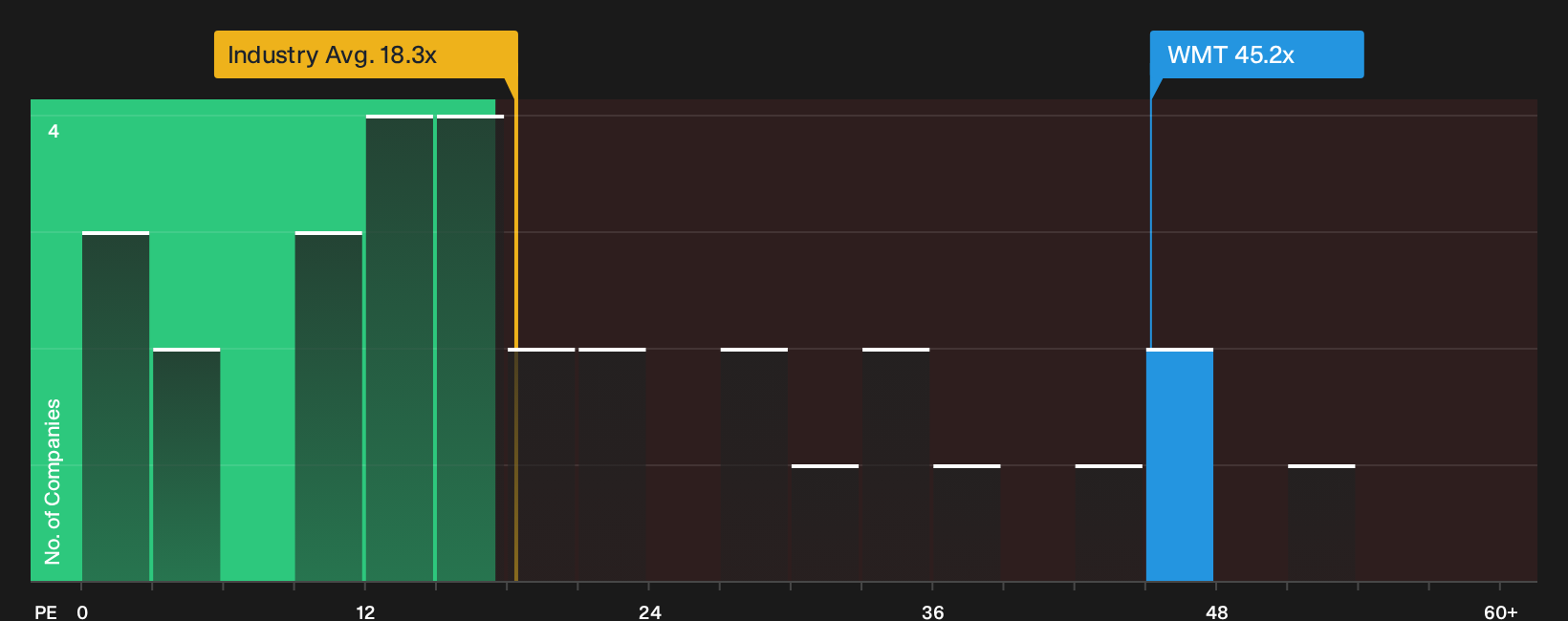
The fair value of $154.58 in the community narrative leans on growth and profitability assumptions. The market’s own yardstick, the P/E ratio, sketches a very different picture for Walmart. The stock trades on 45.2x earnings compared with 25.5x for peers and 18.3x for the wider US Consumer Retailing group. The fair ratio sits at 42.6x.
That means investors are already paying a premium to both similar retailers and the level our fair ratio suggests the market could move toward. The gap is not huge versus 42.6x, yet the jump from 18.3x industry levels is significant. Is that extra multiple paying for real future cash generation or mainly for the comfort of a trusted brand?
See what the numbers say about this price — find out in our valuation breakdown.
Next Steps
Sentiment around Walmart is split between optimism on new profit streams and concern about risks that could cap that story. If you want to move past headlines and see the balance for yourself, start by weighing Walmart’s 2 key rewards and 1 important warning sign.
Looking for more investment ideas beyond Walmart?
If Walmart has you thinking differently about where returns might come from next, it makes sense to widen the search and line up a few fresh contenders.
- Target dependable compounding by scanning companies with strong cash generation and pricing power using the 33 high quality undervalued stocks.
- Prioritise resilience by checking the 30 resilient stocks with low risk scores that screens for businesses with steadier fundamentals and fewer red flags.
- Balance potential upside with financial strength by running your eye over the list of solid balance sheet and fundamentals (25 results) before the next leg of the market moves without you.
Have feedback on this article? Concerned about the content? Get in touch with us directly. Alternatively, email editorial-team@simplywallst.com