


High-profile tech analyst Dan Ives estimates roughly a 15% probability that Jensen Huang loses his post as CEO of Nvidia (NVDA), implying an 85% chance he survives the board's independent investigation into his affair with Alice Huang, a former Megaspeed executive whom U.S. intelligence suspects of working for Beijing.
Ives's estimate closely tracks prediction-market odds of about 14% to 16% for a departure announcement by year-end, while other investors put the range at 10% to 20% or assign 75% survival odds, suggesting the market views removal as a real but minority outcome.
The scandal has pushed CEO succession plans, normally an afterthought for a megacap chipmaker, to the center of the Nvidia trade.
The Number That Actually Matters
The more consequential, and notably underappreciated, part of Ives's note is the cost of removal. The Yorkville analyst argues Nvidia would be worth 25% to 30% less without Huang, implying a share price near $129 based on Monday’s close.
In his warning of additional downside, Ives calls out the acute key-man risk — the danger of a company's value hinging on one executive — given that Nvidia has no publicly known succession plan and Huang has roughly 60 direct reports.
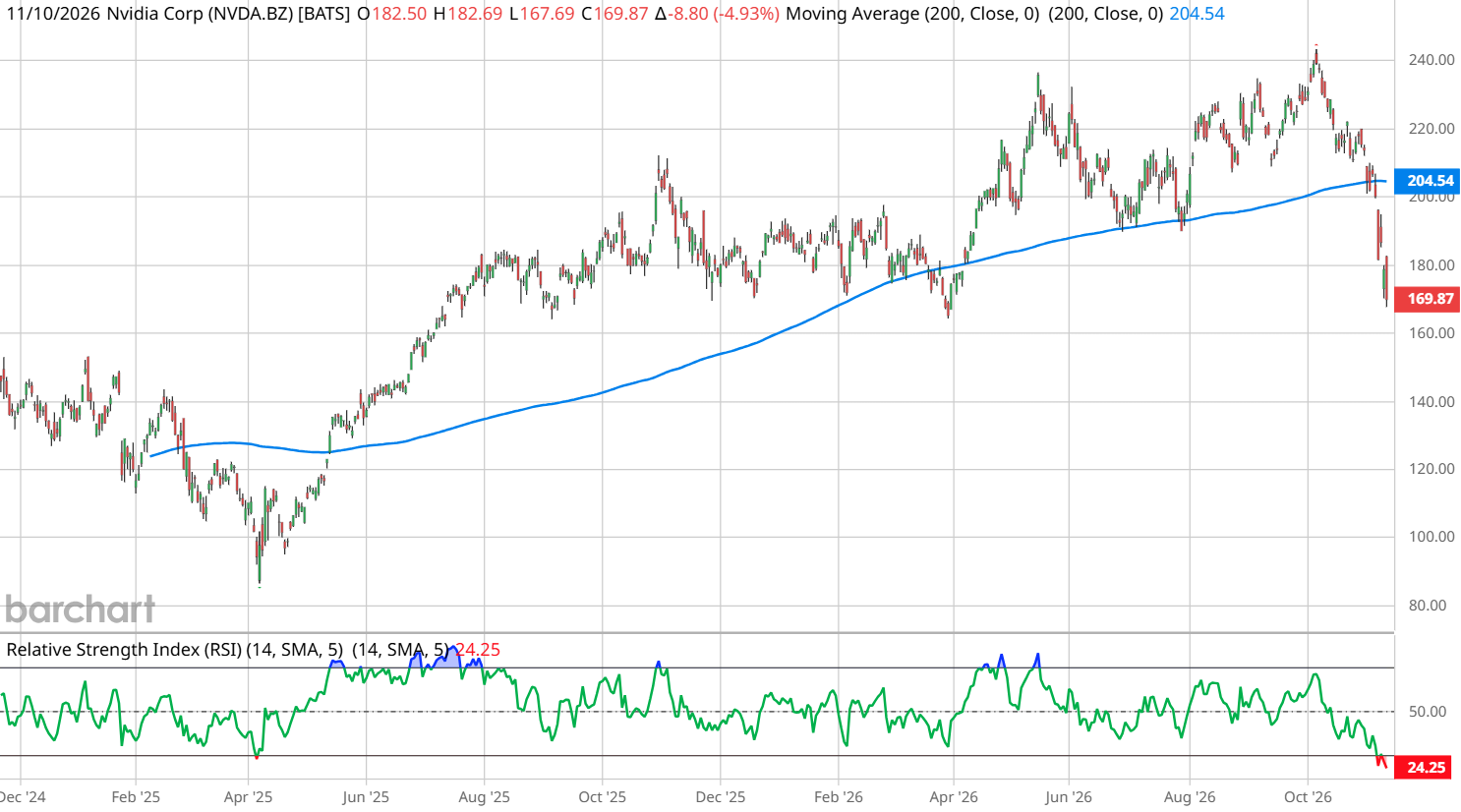
NVDA started the week with a 4.3% drop to finish Monday at $178.67, a session in which the stock erased about $190 billion in market value, and shares are down another 5% today. The stock is trading well below its 200-day moving average, with the Relative Strength Index (RSI) signaling short-term oversold conditions.
Is NVDA's Risk Profile Getting Worse?
The risk profile is deteriorating even as Ives keeps his “Outperform” rating, with a new report alleging the relationship helped at least $7.5 billion of chips reach China.
A shareholder class action has been filed and the FBI is reviewing the matter, while House committee chairs want a closed-door briefing on November 18 — one day after Nvidia is set to report quarterly earnings.
A Democratic-controlled Congress arrives in January and could intensify scrutiny of export controls, stretching the overhang well beyond the current news cycle.
Each of those threads runs on its own timeline, which makes a quick, clean resolution to the Nvidia spy scandal unlikely.
Why Huang Probably Stays
However, several offsetting factors favor survival, including Huang's roughly 3.4% NVDA stake, a long-tenured board that has publicly expressed confidence in him, and presidential support.
Demand for AI compute that still exceeds supply also strengthens his hand, reinforcing how central Nvidia remains to the buildout under his leadership.
Relatively modest Wall Street price-target cuts to $285 and $300 from Citi and Wells Fargo, respectively, still sit roughly 60% and 68% above Monday's close, respectively, backing the view that Huang survives. Those cuts signal caution rather than capitulation.
History Says Day 1 Isn't the Danger
Comparable precedents at companies like Intel (INTC), McDonald's (MCD) and Wynn Resorts (WYNN) show the heaviest losses came in the months after an executive's exit, not on the day of the announcement.
In other words, the initial selloff has historically understated the eventual damage.
That pattern matters because NVDA stock is already down about 28% from its October peak, meaning a removal would compound an existing drawdown rather than reset it.
The Next Catalyst to Watch
Nvidia reports earnings on November 17, and the following day's congressional briefing ensures the governance question will compete with the numbers for investors' attention.
The analysis concludes that Ives's 15% probability looks reasonable, but the asymmetric downside justifies trimming concentrated positions rather than simply buying the dip.
For the market's most-watched AI stock, the real question isn't whether Huang stays — it's whether shareholders are paid enough to offset the 15% risk that he doesn't.
This article was created with the support of automated content tools from our partners at Sigma.AI. Together, our financial data and AI solutions help us to deliver more informed market headline analysis to readers faster than ever.
On the date of publication, Sarah Holzmann did not directly have a position in any of the securities mentioned in this article. All information and data in this article is solely for informational purposes. For more information please view the Barchart Disclosure Policy here.