


October's consumer price report sent the 10-year Treasury yield ($TNX) up to 5.01%, vaulting back over the closely watched 5% threshold for the first time all month, while the 30-year yield ($TYX) touched 5.3% after the headline consumer price index (CPI) rose 0.4% against a 0.3% consensus.
Core CPI rose 0.3% versus expectations for 0.2%, its third straight 0.3% print, and that figure carried unusual weight this time.
Hours before the release, Fed Governor Christopher Waller said a core reading of 0.3% or higher would justify considering a “jumbo” 50-basis-point hike, and warned that hiking by the more typical 25 bps would risk the Fed's credibility.
October's data met his threshold exactly, a stunning bit of timing that could turn his hypothetical into a live policy debate just weeks before the December meeting.
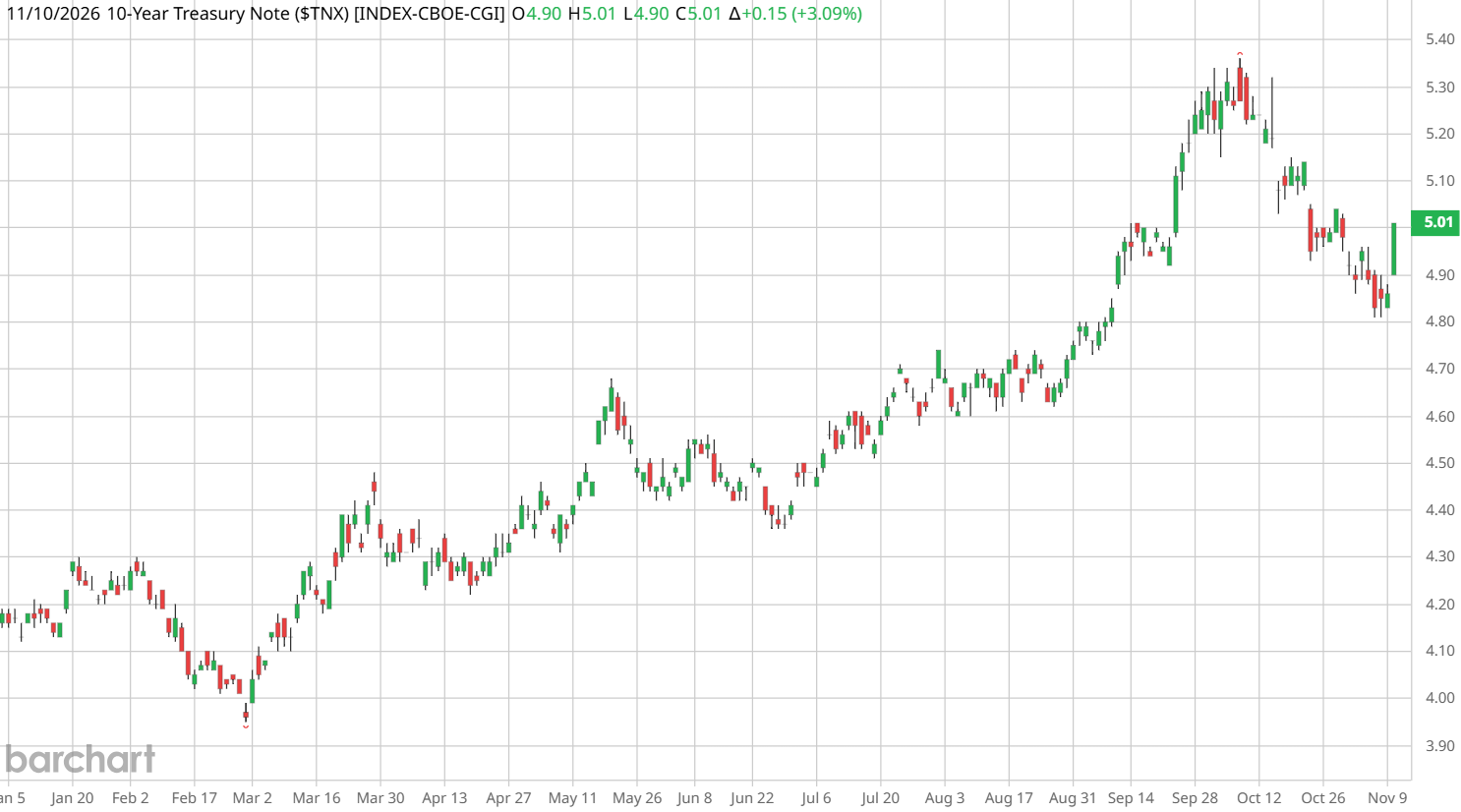
The 2-Year Just Blew Past the Funds Rate
The policy-sensitive 2-year Treasury yield jumped as much as 19 basis points to around 4.75%, its largest one-day gain since April 2025 and well above the 4% top of the Fed's current 3.75%–4% target range.
Dallas Fed President Lorie Logan added that at least two more quarter-point hikes are needed, possibly at a faster pace this winter.
Fed funds futures now price in a 100% chance of a December 9 hike, according to CME FedWatch, with odds of a half-point increase climbing from zero to 12.5% in a notable but modest shift given Waller's explicit roadmap.
Don't Blame Energy for This One
The details argue against dismissing the print as energy noise, with medical care commodities prices up 0.5% and shelter costs rising by 0.3%.
Annualized three-month core inflation reached 3.7%, a pace last seen more than two years ago.
Meanwhile, the core PCE tracking estimate, the Fed's preferred inflation gauge, sits near 0.34%, above a 4% annualized pace.
Why Warsh May Still Settle for 25 Basis Points
Fed Chair Kevin Warsh's real constraint is financial conditions rather than the inflation data, which is why most forecasters still see a 25-basis-point move as the base case even though Waller's threshold was met.
Equities remain fragile after violent post-midterm swings and AI-related weakness, giving policymakers reason to avoid a jumbo hike that could tighten conditions further.
Brent crude (CBF27) has also fallen more than 20% from its late-October high, and November's CPI data arrives the day after the meeting, so the Fed must decide without seeing whether October was an outlier.
What Higher Yields Mean for Markets
The setup points to further front-end repricing, a firmer dollar, and pressure on long-duration equities, gold (GCZ26), and crypto.
With the 2-year sitting roughly 75 basis points above the top of the funds range, the bond market is effectively signaling that current policy is behind the curve.
The Next Catalyst to Watch
Friday's producer price data is the final major test before the December 9 decision, and a hot reading could tip the balance toward a jumbo move.
A soft PPI print, by contrast, would likely reinforce the 25-basis-point base case that Warsh's financial conditions concerns favor.
Either way, a three-month core pace of 3.7% leaves little room for the Fed to declare victory.
The question for the Fed is no longer whether to hike in December but by how much, and the bond market has already started answering.
This article was created with the support of automated content tools from our partners at Sigma.AI. Together, our financial data and AI solutions help us to deliver more informed market headline analysis to readers faster than ever.
On the date of publication, Sarah Holzmann did not directly have a position in any of the securities mentioned in this article. All information and data in this article is solely for informational purposes. For more information please view the Barchart Disclosure Policy here.