


The Zhitong Finance App learned that after global AI-themed stock stocks, especially popular semiconductor stocks related to memory chips, experienced a sharp pullback recently, Wall Street financial giants Bank of America, Nomura, and top research institutes such as TrendForce, a well-known market research platform, provided a new basis for fundamental growth in dips: the high level of revenue and profit in the memory chip industry may last longer than what is currently reflected in stock prices.
In the week ending November 6, Micron had a cumulative decline of about 22%. The subsequent rebound was also impacted by higher than expected inflation and interest rate hikes. There was a stark contrast between the valuation adjustments of storage stocks and the industrial climate. Bank of America's latest judgment provides a fundamental basis for the diff allocation: even using a lower price increase assumption than TrendForce and considering the price correction of some products in 2027, the global storage industry's revenue is still expected to reach 1.47 trillion and 1.58 trillion US dollars in 2027 and 2028, respectively, continuing to drive record revenue and profit continuation.
What supports the bullish predictions of top Wall Street investment institutions such as Bank of America can be described as the RSI-led AI training paradigm, and AI agent applications around efficient AI inference processes that continue to expand demand for HBM, server memory, and enterprise-grade SSDs, while advanced manufacturing processes, capacity conversion, and yield climbing limit supply release, and long-term supply agreements further increase sales visibility. The potential “dipping investment value” brought about by this round of AI computing power and the sharp retracement of semiconductor stocks depends critically on whether the market's pessimistic discount on “peaking profits” far exceeds the extent of actual deterioration in supply and demand: if storage leaders can continue to deliver cash flow and shareholder returns, undervaluation after a sharp decline is expected to become a new starting point for rearranging the storage supercycle.
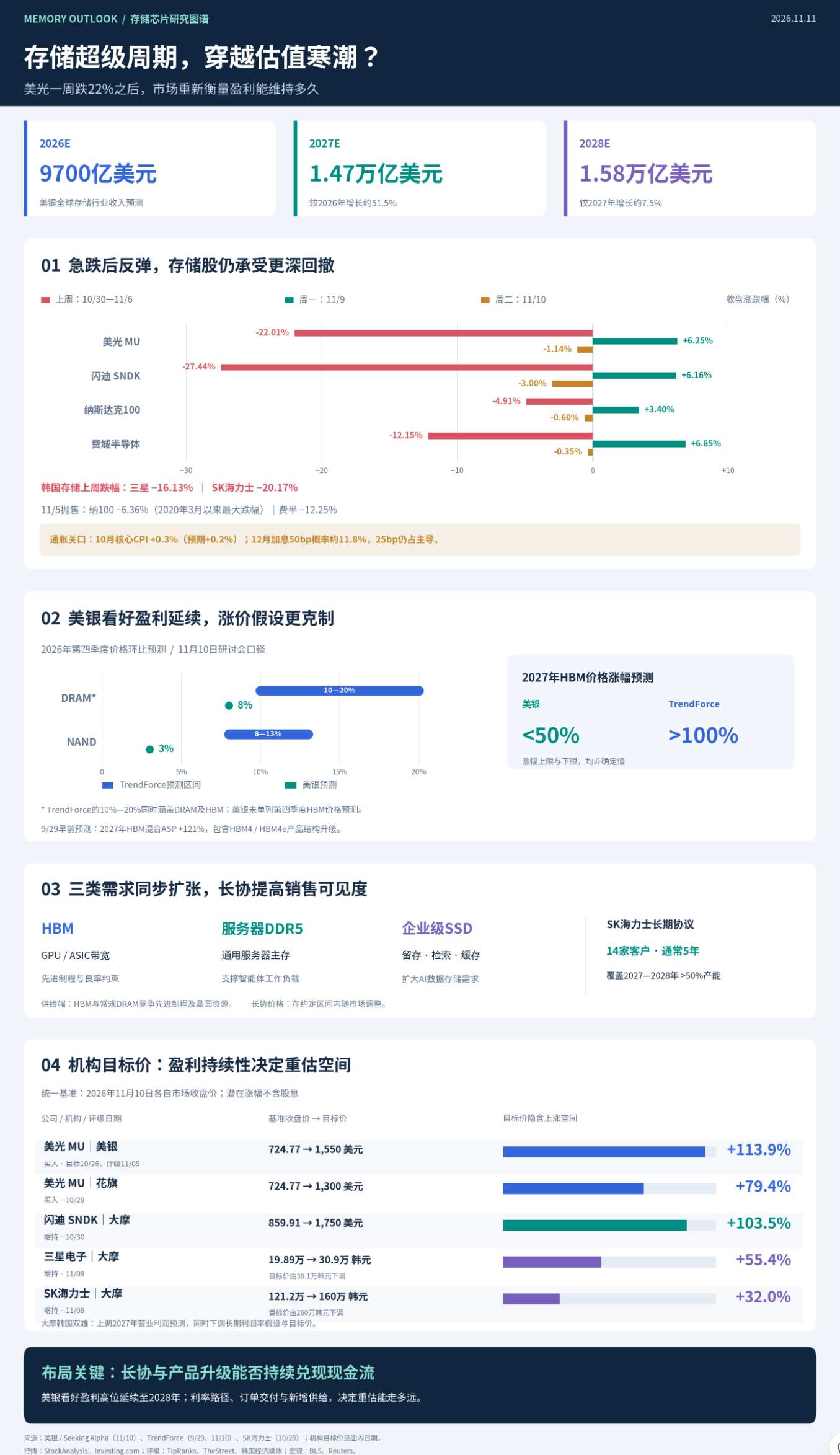
Bank of America expects the global storage industry's revenue to increase from $970 billion in 2026 to $1.47 trillion in 2027 and $1.58 trillion in 2028, increasing by about 51.5% and 7.5% respectively in the next two years. Even with a price increase that is significantly lower than TrendForce's, Bank of America analysts still determine that the storage industry is expected to continue record revenue and profits until 2028.
Meanwhile, after experiencing a severe setback last week and a rebound on Monday, Micron and SanDisk were once again impacted by expectations of inflation and interest rate hikes on Tuesday, but it is worth noting that the extent of this decline was clearly moderate — the VIX Panic Index even fell from 19.92 to 19.46, which largely indicates that the market is re-evaluating the pressure on the Fed's interest rate path and has yet to repeat the panic sell-off of last Thursday. These signs can be highlighted, and the market seems to be re-measuring whether profits created by scarce supply can continue to offset the valuation pressure brought about by rising interest rates and adjustments in AI capital expenditure expectations.
Bank of America firmly expects the storage supercycle to continue until 2028
In the latest research report on bullish memory chip-themed companies, the Bank of America strategist team quoted Avril Wu, a senior analyst at TrendForce (TrendForce), as saying that the memory chip industry's current upward cycle may continue until 2027 and avoid entering a downward cycle in 2028.
Wu said at a webinar hosted by Bank of America on November 10 that the price of memory chips is likely to continue to rise. It is expected that in the fourth quarter of 2026, the price of DRAM and high-bandwidth memory will rise 10% to 20% compared to the previous quarter, and the price of NAND flash memory will rise 8% to 13%.
She also expects HBM prices to more than double in 2027, and long-term supply agreements may help reduce price fluctuations after 2028.
Bank of America generally agreed with this optimistic outlook for the industry, but adopted a more conservative price assumption. The forecast is that DRAM prices will rise 8% month-on-month in the fourth quarter, NAND prices will rise 3%, and the price correction may begin as early as 2027.
The bank's strategist team also expects HBM's price increase to less than 50% in 2027, in contrast to TrendForce's judgment that the price will more than double.
Bank of America strategists also said that their latest forecast data shows that global storage industry revenue will reach 970 billion US dollars in 2026, 1.47 trillion US dollars in 2027, and 1.58 trillion US dollars in 2028, which indicates that the industry is expected to maintain record revenue and profit levels until 2028.
As Meta Muse and OpenAI's GPT-6 Astra fully detonate a wave of AI agents, “AI FOMO transactions” (meaning investors are worried about missing out on rising opportunities in AI-related assets, and are therefore chasing down or making up for previously lowered positions) are expected to continue. Looking at the underlying architecture of AI computing power infrastructure, Muse and Astra are expected to further expand the scope of use of AI agents. The massive expansion of AI inference workloads brought by them will also increase the demand for model inference, tool execution, and state management, while deepening the competitive pressure on some software companies.
Judging from the technical mechanism, AI agents expand one answer to repeated reasoning, retrieval, tool execution, and state saving. The GPU and TPU are responsible for model calculation, and the CPU is responsible for tool and task orchestration. HBM holds high-bandwidth access data, server DRAM hosts the operating environment, and SSD and HDD respectively provide high-performance access and high-capacity storage. At the same time, network infrastructure, data center high-speed optical interconnection, power supply, and cooling determine the actual utilization rate of expensive accelerators. Therefore, cloud revenue acceleration can support multiple hardware links at the same time; how much profit a specific company obtains still depends on performance advantages, supply bottlenecks, and bargaining power.
It can be said that optimism about market fundamentals is still strong in the eye of AI trading and technology stock sell-offs — that is, the memory chip sector, which has recently been hit hard. In addition to Bank of America investing in optimistic profit and storage price increases, KeyBanc's recent Asian research data shows that AI data centers are still absorbing the supply of AI computing power resources such as storage on a large scale, driving the price increase to 2027.
After studying the Asian market, KeyBanc predicts that the HBM hybrid price is expected to rise sharply by 80% to 100% in the first quarter of 2027. At the DRAM memory price level, KeyBanc predicts that the fourth quarter of 2026 will rise 15% to 20% month-on-month under a strong price increase base in the third quarter, and 10% to 15% in the first quarter of 2027; in terms of future NAND pricing, it is predicted that the fourth quarter of 2026 will rise about 20% month-on-month under a strong base in the third quarter, and 10% to 15% in the first quarter of 2027.
The rebound in storage was hit by interest rate hikes: stock prices first traded the risk of inflation and the Federal Reserve's continued interest rate hike, but profits and orders are still being fulfilled at an accelerated pace
On November 5 in the US East, the Nasdaq 100 index fell sharply by 6.36%, the biggest one-day decline since March 2020. The total amount of constituent stocks evaporated about 2.3 trillion US dollars, setting a record for loss in market capitalization in a single day; the Philadelphia Semiconductor Index plummeted 12.25%. After the Democratic Party gained control of both houses of Congress, investors worried that AI supervision, data center approval, and electricity cost sharing requirements would become stricter, which could delay the commissioning of computing power projects and chip procurement. These policy concerns are compounded with the original overvalued and congested positions, amplifying the market's repricing of the time to repay the return on AI investment.
The storage sector can be described as having withstood a deeper sharp pullback. Based on the closing prices from October 30 to November 6, Micron and SanDisk fell by 22.01% and 27.44% respectively, while Samsung Electronics and SK Hynix fell by about 16.13% and 20.17% respectively, both weaker than the NASDAQ 100 and Fee Half declines of about 4.91% and 12.15% during the same period.
On November 9, global technology stocks generally rebounded. The Nasdaq 100 and Fee Half rose 3.40% and 6.85% respectively, while Micron and SanDisk rose 6.25% and 6.16% respectively. Capital has repurchased storage leaders, but this round of growth has not made up for previous losses. It also shows that the “cash flow safe haven” view put forward by some Wall Street analysts is a judgment on operations and valuation, and cannot be directly equated with resisting short-term stock price declines.
Tuesday's inflation data once again raised the rebound threshold. The US overall and core CPI rose 0.4% and 0.3% respectively in October, both higher than market expectations of 0.3% and 0.2%. The core CPI rose 0.3% for the third month in a row. Before the data was released, Waller said that if the core CPI reaches 0.3% or higher, an interest rate hike of 50 basis points in December should be considered. After the data was released, the market's pricing for this larger rate hike rose to about 11.8%, but 25 basis points are still mainstream expectations; bets on cumulative interest rate hikes as of 2027 have increased from two 25 basis points to three times, including December of this year. Deutsche Bank also added an interest rate hike forecast for January next year between the original rate hike forecasts for December and next March.
The logic of the extension of the Federal Reserve's interest rate hike expectations is that employment and economic growth are still resilient, while service prices, energy cost transmission, and AI construction demand all maintain inflationary pressure. For memory chip stocks, higher interest rates not only increase the discount rate for future profits, but may also raise customer financing costs and extend the data center construction cycle. On Tuesday, Nasdaq 100 and Fee Half fell by about 0.60% and 0.35%, respectively, while Micron and SanDisk fell by about 1.1% and 3.0% respectively: this also shows to a certain extent that the market continues to withstand interest rate revaluation, but has not repeated the decline of last Thursday.
Can the storage supercycle survive the cold wave of valuation? The key is how long the high profit figures can be kept
The Bank of America, TrendForce, Keybanc and other institutions jointly judged that the storage boom is still supported, and the differences focus on the extent of price increases and correction times. TrendForce expects DRAM and HBM prices to rise 10% to 20% month-on-month and NAND to rise 8% to 13% in the fourth quarter. Bank of America's predictions for DRAM and NAND are only 8% and 3% respectively; for HBM in 2027, the former is expected to more than double prices, while the latter is expected to increase by less than 50%.
A more conservative price path can still support high revenue and profits, which means that Bank of America strategists' optimistic judgments will also rely on significant increases in shipments, product upgrades, and order continuity. This is also the most investmentally-significant part of the Bank of America's idea that the “storage supercycle will continue until 2028.”
Technical support comes from the simultaneous requirements of AI systems for different storage levels: HBM provides high-bandwidth data supply for GPUs and ASICs, server DDR5 supports main storage requirements, and enterprise-grade SSDs are responsible for data retention, retrieval and caching. At the same time, HBM competes with traditional DRAM for limited advanced processes and wafer resources, and it takes time for new product yield and packaging output to climb. It is worth noting that Trendforce's previous forecast of a 121% increase in the average price of HBM hybrid sales in 2027 also includes an increase in the share of more expensive HBM4 and the introduction of HBM4e. It is incomprehensible that the price of all products of the same specification will generally double.
Long-term agreements are increasing the visibility of demand. SK Hynix recently revealed that it has signed long-term agreements with 14 major customers, usually for a period of five years, and the number of completed contracts covers more than half of its production capacity from 2027 to 2028. The contract price is adjusted according to the market within the agreed range, so Changxie mainly enhances capacity utilization, predictability of sales and profits, rather than completely locking down future profits. For capital-intensive memory chip companies, this change helps reduce the mismatch between production expansion and customer procurement.
Bank of America analyst Vivek Arya's team recently explained the current opportunity from the stock price cycle: as of November 5, Fee Half fell about 38% from the June high, exceeding the average retracement of about 32% in the past four major downturns; however, the 136-day adjustment period was only about 54% of the historical average of 253 days. Bank of America analyst Vivek Arya's team sees the beginning of 2027 as a window where the sell-off may end, based on the fact that stock prices are usually 6-9 months ahead of actual sales declines. The forward price-earnings ratio fell to 13.7 times, about 22% off the S&P 500, indicating that pessimistic expectations have entered the price in large numbers; however, the Bank of America also estimated that if AI capital expenditure in 2027 is 20% lower than expected, the earnings per share of related chip companies may face downward pressure of 35% to 40%.
Nomura CW Chung's team places more importance on cash flow allocation: cloud vendors bear upfront construction investment, while storage vendors accumulate cash through scarce products and price increases. According to the stock price and profit forecasts used in its report, Samsung and SK Hynix expect price-earnings ratios of about 3.2 times and 2.8 times respectively in 2027; tight supply continues until 2028, the increase in long-term cooperation, and the expansion of shareholder returns is the basis for believing that the market is excessively discounted. Citibank analyst Atif Malik also reiterated Micron's “buy” rating and target price of $1,300 on October 29, believing that investors have underestimated the extent to which DRAM and HBM supply will continue to be tight from 2027 to 2028, and that the customer agreement has enhanced revenue visibility.
Morgan Stanley analyst Shawn Kim's latest adjustments revealed another layer of disagreement: the November 9 report raised Samsung and SK Hynix's 2027 operating profit forecasts, but lowered target prices by 19% and 38%, respectively, while maintaining “increased holdings.” The concern is that if the release of additional production capacity at the end of 2027 is met with a delay in data center delivery, it will reduce longer-term profit margins. This shows that the institutional debate has extended from whether they can make money now to how many years high profits can be maintained.
Overall, comprehensive supply and demand, long-term coordination, and valuation changes. This round of sharp retracement in memory chip stock prices and valuations has enabled leaders with strong HBM competitiveness, server-level high-performance DRAM/NAND storage product portfolios, and cash accumulation capabilities to enter a bargain configuration window with a more fundamental basis. The value of an investment depends largely on how much free cash flow a company can leave behind after more conservative price and margin assumptions. If demand fulfillment, product upgrades, and shareholder returns continue to verify profit resilience, current discounts on “peaking profits” may become the source of the next round of revaluation.
Based on the closing prices of the respective markets on November 10, the recent verifiable institutional target prices still give storage leaders a lot of room to rise. The stock price of US memory chip giant Micron (MU.US) closed at $724.77. Bank of America continued to maintain a “buy” rating on November 9. The target price of $1,550 corresponds to a potential increase of about 113.9%; Citibank maintained a “buy” target price of $1,300 on October 29, corresponding to an increase of about 79.4%.
Both organizations mentioned above emphasized 2027-2028 DRAM and HBM supply constraints, as well as long-term supply agreements supporting sales and profit visibility. On the side of SanDisk (SNDK.US), Morgan Stanley maintained an “plus” rating and a target price of $1,750 on October 30, which implied an increase of about 103.5% compared to the closing price of $859.91 on November 10. It is optimistic that the increase in data center demand will improve its business structure, and at the same time, it uses cross-cycle profit measurement estimates.
Korea Storage's latest ratings reflect the institutional position of “continuing to be optimistic about recent profits and re-evaluating long-term profit margins.” In its November 9 report, Morgan Stanley lowered the target price of Samsung Electronics' common stock from 381,000 won to 309,000 won, and lowered SK Hynix's target price from 2.6 million won to 1.6 million won, both maintaining “additional holdings”; based on the closing prices of 199,900 won and 1,212,000 won on November 10, respectively, the potential growth potential was 55.4% and 32.0%, respectively. The bank raised both companies' operating profit forecasts for 2027 at the same time. The target price reduction was mainly due to a re-evaluation of new supply, the pace of data center delivery, and long-term profit margins around 2028.