


The Zhitong Finance App learned that in early trading in the Asian market on Wednesday, the US dollar index maintained its gains and hovered near a two-week high. A previous higher-than-expected inflation report and hawkish remarks from Federal Reserve officials strengthened the market's bets on the Fed's interest rate hike next month.
According to the data, the US dollar index, which measures the strength of the US dollar against a basket of six currencies, remained stable at 102.22, close to the highest level since October 28. EUR/USD and GBP/USD were flat at 1.1168 and 1.3345, respectively; USD/JPY was flat at 158.715; AUD/USD rose 0.1% to 0.6870, recovering slightly from a seven-month low; and New Zealand dollar was flat at 0.5605 against the US dollar.
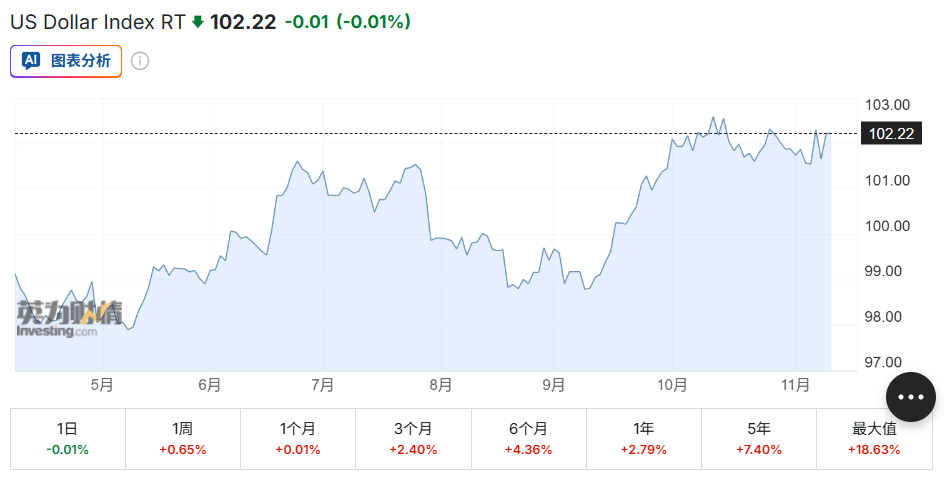
Chris Weston, head of research at Pepperstone Group Ltd., said that the interest rate market is not just pricing another rate hike, but is questioning how restrictive US monetary policy may eventually be, which is a more weighty debate for risky assets.
On the previous trading day, the index rose 0.5%, as the increase in the US consumer price index in October exceeded market expectations, and rising food and lodging costs became the driving force; at the same time, Federal Reserve Governor Waller said that the possibility of raising interest rates by 50 basis points was not ruled out in December.
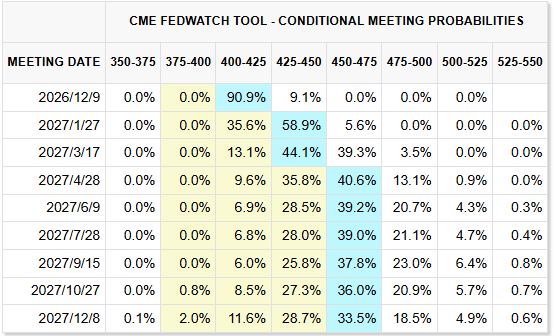
Voting members of the Federal Reserve Interest Rate Committee expressed unease over high inflation, further consolidating market expectations for continued interest rate hikes, and prompted traders to almost abandon their bets on the Federal Reserve's next policy meeting, which ends on December 9.
According to CME Group's FedWatch tool, federal funds rate futures currently show that the probability of raising interest rates by 25 basis points next month is 90.9%, up from 84% the previous day; the market has completely ruled out the possibility of suspending interest rate hikes, and believes that the probability of raising interest rates by 50 basis points is 9.1%. At the same time, the probability of raising interest rates for the second time in January next year is higher than 50%.
US 10-year Treasury yields rose 13.8 basis points to 4.996%. On the cryptocurrency side, Bitcoin fell 0.3% to $73,566.45, and Ethereum fell 0.5% to $2,044.61, both trading near nearly three-month lows.
Reliance on equity capital inflows or drag down exchange rates
While short-term interest rate hikes are expected to support the US dollar, Deutsche Bank strategists suggest medium term pressure on the US dollar from the perspective of capital flow and hedging behavior.
Strategists, including George Saravelos, the bank's head of global foreign exchange research, pointed out in the report that the US dollar's increasing dependence on stock capital inflows may erode the decentralized benefits brought about by holding unhedged US assets, and put downward pressure on the US dollar over time.
According to the report, historically, foreign investors have benefited from the characteristic that the US dollar often strengthens when the US stock market falls, which provides it with a buffer for losses; however, as the relationship between the US dollar and stock market sentiment becomes closer, this negative correlation is gradually breaking down, which may prompt foreign capital managers to increase the hedging ratio of the US dollar, thereby suppressing the US dollar.
Deutsche Bank examined the dollar hedging ratio of pension and life insurance companies from more than ten countries. The report shows that some countries and regions, such as Sweden, Switzerland, and the Eurozone, still have relatively high exposure to the US dollar, while Chile, Canada, and the United Kingdom have made significant adjustments.
The strategist said that further changes in the correlation between the US dollar and stocks will be a key driver for future hedging ratio decisions. However, the report also pointed out that although the weakening of the negative correlation between the US dollar and the stock market is weakening the diversified benefits of unhedged US dollar assets, higher hedging costs and lower foreign exchange volatility continue to encourage investors to maintain their exposure to the US dollar.