


For a long time, the golf industry has often been regarded as the “flower of the high mountain” of the capital market due to its high net worth attributes, circle barriers, and asset-heavy characteristics. Today, with the recovery of high-end sports consumption and the maturity of the pan-golf ecosystem, this track is ushering in an ice-breaking moment for capitalization. Recently, golf pan-service operator Golf Taste officially submitted a prospectus to the US Securities and Exchange Commission (SEC). The company plans to issue 5 million shares in this IPO, accounting for 36.14% after issuance. The market value is estimated at about 83 million US dollars based on a median price of 6 US dollars. It is planned to be listed on the NASDAQ, under the stock code GLG, and Pacific Century Securities (Pacific Century Securities) will act as the sole bookkeeper.
The inflection point of growth across the profit and loss line has been reached
According to the prospectus, Golf Taste was founded in 2012 and is headquartered in Hong Kong. It follows the “asset-light plus membership” route — an integrated golf lifestyle platform that provides golf training, coaching and event management services for individual and corporate customers in Hong Kong.
The company's business can be divided into three parts. The first is group services, including golf training courses, coaching, and the management and promotion of high-end exclusive corporate golf networking activities. The second is golf-related tournament and exhibition management services, such as the Hong Kong Golf Show (“HKGS”); the third is golf membership cards and golf payment cards (collectively, “golf cards”). This is a golf-centered membership platform that provides lifestyle privileges, partner merchant benefits, and transaction-related benefits.
Judging from financial data, the most prominent characteristic of golf taste is the explosive expansion of revenue and the substantial correction of net profit. Compared with annual data, the company's total revenue jumped from HK$199,000 (HKD, same below) in 2024 to HK$10.331,000 in 2025, an impressive increase of 5085.4%. In the subsequent semi-annual cycle (six months ending June 30, 2026), total revenue also recorded HK$284.3, a significant increase of 490.5% over the previous year.
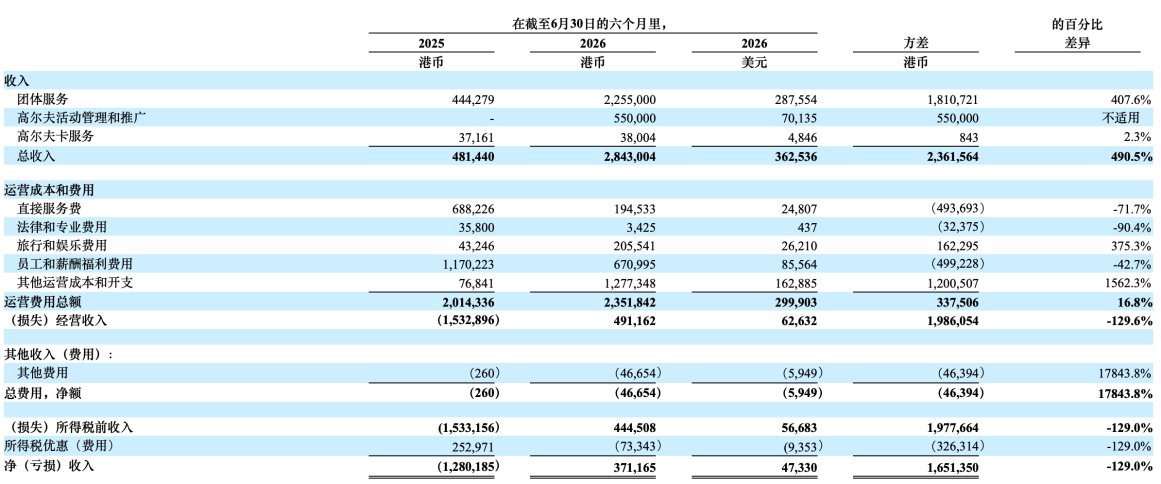
Along with the surge in revenue, profit-side data is even more eye-catching. For the full year of 2025, the company recorded operating revenue of HK$6.537 million, successfully turning a loss into a profit (loss of HK$4.127 million in 2024), and net profit reached HK$5.4598 million, an increase of 258.4% over the previous year. In the first half of 2026, the company's net profit was HK$3712,000, which also achieved a loss of 129.0% compared to the loss of HK$1.28 million in the same period last year.
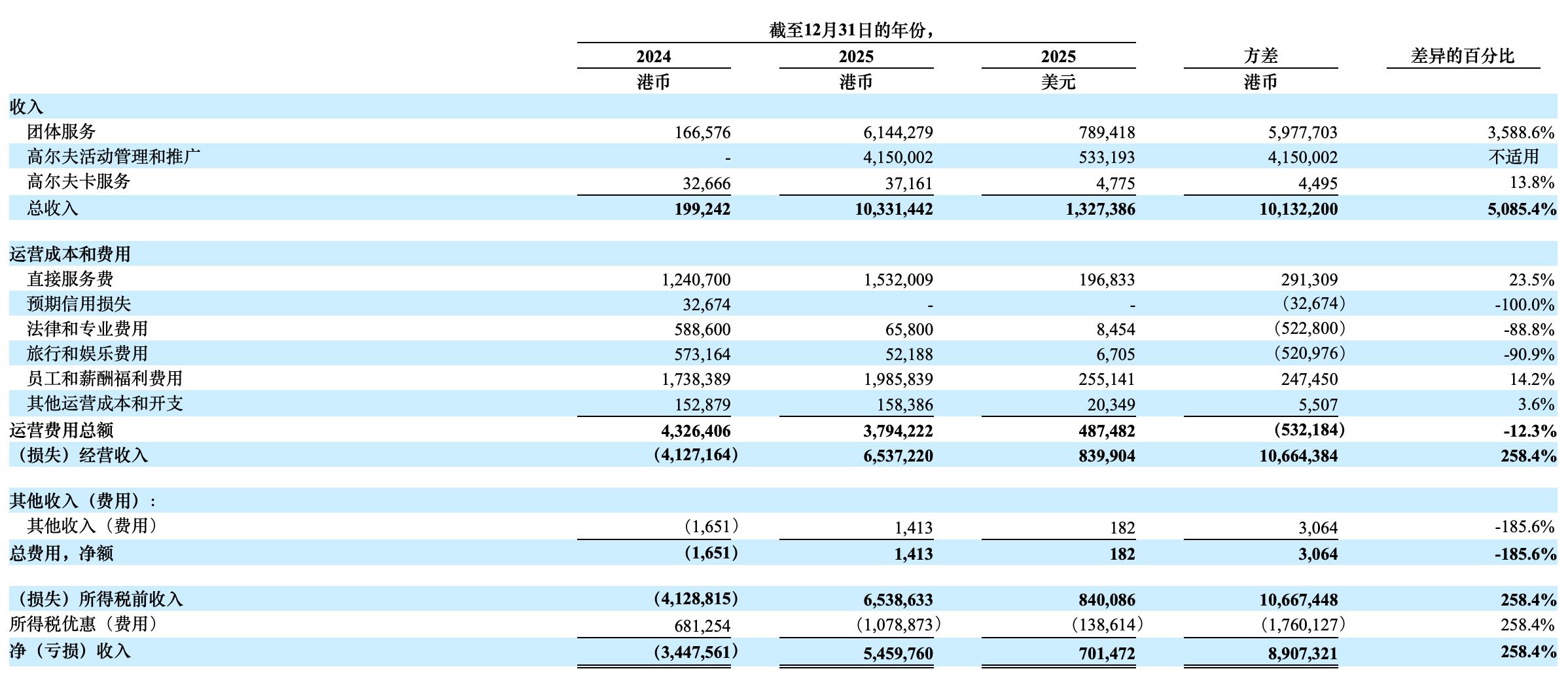
Behind the sharp increase in revenue and profit boom, it is due to the company's effective pressure reduction on operating costs. Taking the 2025 annual data as an example, while revenue soared 50 times, total operating expenses bucked the trend and fell by 12.3% to HK$3.794 million.
It is worth noting that for the six months ended June 30, 2026, although the net cash provided by the company's operating activities was still negative (-HK$174,000), compared to HK$1.585 million in the same period in 2025, the cash outflow has narrowed sharply by nearly 90%, and the trend of repairing the “hematopoietic” capacity of the main business itself is extremely clear.
The transformation of the “ecological platform” to restructure the golf business matrix has arrived
The overall improvement of financial data is by no means a source of emptiness. What is behind this is that golf taste has built a three-way lifestyle with group service as the cornerstone, event promotion as a growth pole, and membership card service as a moat.
As the company's revenue pillar, the group services sector has shown strong explosive power. The sector's revenue in 2024 was only HK$166,000; in 2025, it soared to HK$6.144 million (an increase of 3588.6%). It also contributed HK$2.255 million in the first half of 2026, an increase of 407.6% over the previous year. Group service customers have a high unit price and a strong repurchase rate. It not only provides the company with stable cash flow, but has also built a social platform for high-net-worth people, laying the foundation for a huge customer base for subsequent cross-sales.

Golf event management and promotion is the most imaginative section of the entire financial report. The business did not generate revenue in 2024, but by 2025, the sector had risen to prominence, with annual revenue reaching HK$4.15 million, accounting for nearly 40% of that year's total revenue; it also achieved revenue of HK$55,000 in the first half of 2026. The data change from “none” to “yes” is a demonstration of the company's strong event planning and brand operation capabilities.
In today's sports industry, event IP (intellectual property) is the highest-level form of monetization. By managing and promoting golf activities, the company not only directly obtained high-margin service fees, but also upgraded itself from a “venue/service provider” to a “golf lifestyle exporter”. This asset-light operating model has greatly reduced marginal costs and is the core engine for a sharp rise in profit margins.
Although the revenue volume of the golf card service is small (HK$37,000 in 2025, HK$38,000 in the first half of 2026, a slight increase of 2.3% over the previous year), its strategic significance should not be underestimated. As a typical membership product, the golf card business is a “funnel” for screening high-net-worth customers, bringing the company not only steady income over a period of time.
The current state of the golf industry in China is that the supply of golf courses is shrinking, but the participating population and consumption patterns are expanding. The number of operating stadiums nationwide dropped from 687 in 2017 to 335 in June 2025. Land use restrictions are rigid restrictions. However, during the same period, the number of participants reached 5.4 million, and continued to grow for 11 years; the number of rounds played in indoor stadiums jumped from 4.61 million rounds in 2021 to over 1.07 million in 2024, an increase of 118% over three years, with an average annual growth rate of over 20%.
This combination of “supply contraction - demand migration” shapes the current real opportunity structure of the Chinese golf industry: scarce outdoor course resources are driving core playing behavior towards high customer unit prices and high exclusivity scenarios, while indoor and simulators have greatly broadened the entrance for participants. As a result, the incremental value of the industry no longer mainly comes from “owning a stadium,” but from the ability to organize high-value groups in scarce scenarios and capture new customer groups at incremental entrances.
China's professional golf market is about US$1,995 billion in 2025, and is expected to reach US$3.411 billion in 2034. The CAGR is about 6.11%. The growth rate is not aggressive. This means that the overall beta of the industry is limited, and excess revenue will inevitably come from structural arbitrage — whoever can cut through the value gap between core people and incremental people in a lighter way can get a growth rate far higher than the industry average.
The three major business segments of Golfball Taste form a clear progressive chain: group services capture high-net-worth corporate customers and core groups to solve the “who will come” problem; event promotion uses zero-asset methods to create highly sticky social scenarios and event touchpoints to solve the problem of “using what to continue to retain and upgrade the experience”; card services complete hierarchical screening to establish a recognizable user base for cross-selling and solve the problem of “who to sell more to”.
The end point of this chain is an organizer that doesn't own a stadium, doesn't have heavy assets, but has control over high-net-worth people's relationship networks and lifestyle portals. In an industry where the supply of stadiums is limited, core people are scarce, and event IP is still in the early pricing stage, this “asset-light card” growth logic is more sustainable than simple scale expansion.
However, the key verification indicator for the company's future growth logic is whether the penetration rate of the group service customer base to the activity side and card side continues to rise — this is the watershed moment when the “three dimensional state” changes from narrative to structural profitability.