


- Procter & Gamble has promoted Shalini Saraswat to Brand Director and Business Head for Pantene India, after several brand leadership roles across Tide and Head & Shoulders in the country, adding fresh leadership to a key hair care franchise.
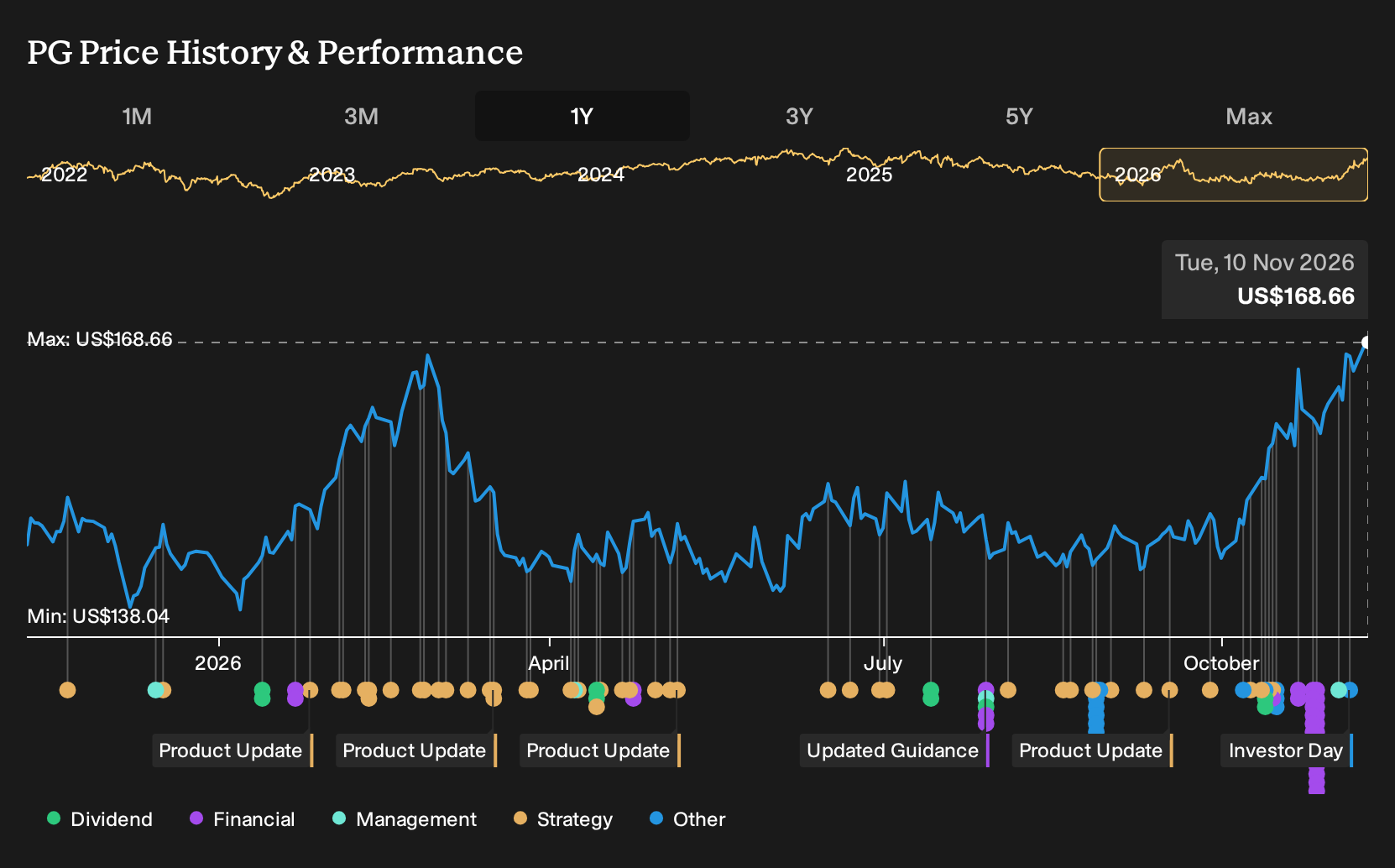
- The appointment deepens Procter & Gamble’s local brand stewardship in India at the same time its Beauty segment reports 5% organic sales growth supported by Pantene and SK-II product push and execution.
- We now examine how Procter & Gamble’s investment narrative could be shaped by Beauty segment performance and Pantene’s new India leadership.
Procter & Gamble Investment Narrative Recap
To own Procter & Gamble, you need to be comfortable with a slow growing, high quality consumer products business where steady earnings and dividends matter more than rapid expansion. According to andre_santos, an investor in the Simply Wall St Community, the key belief is that wide moat brands and stable operating margins can support long term cash generation even with modest revenue growth.
Right now the main near term swing factor is execution in core categories as consumers grow more cautious and competition stays intense, especially in Beauty where margins have previously been under pressure. The Pantene India leadership change looks incremental rather than a major short term catalyst. Competitive pricing and any further margin squeeze remain the bigger near term risks.
The most relevant update alongside the Pantene move is Procter & Gamble’s recent 5% organic sales growth in Beauty, helped by Pantene and SK II. That indicates management is already leaning on this division for incremental growth, even as the broader group deals with a discouraged U.S. consumer and conservative guidance compared with some peers.
Shalini Saraswat’s appointment fits into that Beauty focus. Pantene India now sits under a leader with experience across Tide and Head & Shoulders, which ties hair care back into broader brand building and pricing execution. For investors tracking catalysts, progress here sits alongside steady earnings forecasts, reliable dividends at about 2.58%, and ongoing pressure from competition and high debt levels flagged in the risk checks.
On andre_santos’ numbers, Procter & Gamble reaches a fair value of $107.52 through a blend of 3.5% annual revenue growth and a future profit margin of 17.5%. These inputs feed into discounted cash flow, earnings-based and dividend models that are then averaged into a single estimate.
Uncover why Procter & Gamble's fair value indicates a 36% potential downside to its current price, suggesting a premium that may not hold.
Exploring Other Perspectives
Seventeen fair value estimates from the Simply Wall St Community stretch from US$107.52 to about US$205, so some retail investors see Procter & Gamble as close to fairly priced while others model far richer outcomes. Set those differences against Beauty segment momentum and the new Pantene India leadership, and you get a clear message: opinions can diverge sharply. Explore several viewpoints before deciding how Procter & Gamble fits your portfolio.
Explore 16 other Procter & Gamble fair value estimates, including one that suggests potential upside of as much as 22% from the current price!
The Verdict Is Yours
Don't just follow the ticker. Dig into the data and build a conviction that's truly your own.
- A great starting point for your Procter & Gamble research is our analysis highlighting 3 key rewards and 2 important warning signs that could impact your investment decision.
- See our latest analysis for Procter & Gamble. The report includes a comprehensive fundamental analysis summarized in a single visual, the Snowflake, making it easy to evaluate Procter & Gamble's overall financial health at a glance.
Looking For More Ideas Beyond Procter & Gamble?
Once you are comfortable with where Procter & Gamble fits in your portfolio, it can help to line it up against other opportunities with different risk and income profiles using the Simply Wall St Screener.
- If capital preservation comes first for you, start with resilient businesses that score well on risk by scanning our 30 resilient stocks with low risk scores.
- For income focused investing, look at companies that combine higher yields with durability by reviewing the 5 dividend fortresses.
- If you prefer quality at a reasonable price, compare Procter & Gamble with companies that have strong fundamentals and trade below estimated worth using the 36 high quality undervalued stocks.
Have feedback on this article? Concerned about the content? Get in touch with us directly. Alternatively, email editorial-team@simplywallst.com