


The Zhitong Finance App learned that at a time when global technology stocks, especially in the AI computing power and semiconductor sector, have plummeted and fluctuated sharply, a recent research report released by Wall Street financial giant J.P. Morgan Chase shows that AI capital expenditure has been transformed into demand for chips, servers, and power equipment, but productivity dividends sufficient to drive the entire economy to continue to reduce costs and increase efficiency have not been realized simultaneously. The core content of this research report means that upstream core chip and key component suppliers around the world's burgeoning AI infrastructure process can continue to receive orders and profit growth, while a wide range of technology stocks, including new cloud forces and large-scale cloud computing platforms, are also under valuation pressure from higher interest rates and longer return fulfillment cycles.
The J.P. Morgan Global Economics Research Team Joseph Lupton released a research report called “Productivity Prosperity: AI's Contribution Isn't as Big as It Seems” on November 10, continuing the team's previous macroeconomic judgment of “strong economic growth, inflationary stickiness, long-term high interest rates, and future AI-driven productivity changes”, revealing that there is a waiting period between AI productivity and AI dividend payout and trillion-dollar AI capital expenditure. The broad productivity dividends may come later than the market expected.
After AI devices are deployed, application development, data integration, process restructuring, and employee training are also required to fully unlock productivity benefits. This process may take longer than market consensus expectations. The J.P. Morgan Chase research report cites the historical phenomenon of “computers are everywhere, but not visible in productivity statistics” in 1987, as well as productivity improvements that followed in the 1990s, to show that the spread of technology is lagging behind.
There are three different fulfillment processes: suppliers receive orders, computing power operators achieve profits, and widespread productivity increases after enterprises apply AI. As financing costs rise and the market shortens the waiting time for returns, strong orders and pressure on equity bonds may well coexist. J.P. Morgan's research provides a macroeconomic explanation for this “AI return on investment time difference.” According to the J.P. Morgan research report, more conservative academic research estimates that AI will bring a cumulative total factor productivity (TFP) increase of less than 0.5% over the next ten years; more optimistic academic studies estimate that AI may increase the annual productivity growth rate by 0.8-1.3 percentage points.
After CoreWeave sounded a credit alarm, J.P. Morgan revealed a “return time difference”
Computing power orders continue to expand, but the credit market is beginning to ask: How much capital do companies need to invest, and how long do they have to wait to obtain cash returns sufficient to cover financing costs? CoreWeave's recently disclosed revenue backlog reached US$132.5 billion, but net interest expenses for the third quarter reached US$846 million, clearly exceeding US$207 million in operating profit, which intuitively reflects the tension between growing demand and financing burdens.
Before AI leader CoreWeave (NeoCloud) leader CoreWeave released its latest performance report, the credit market was already sounding the alarm that the return on AI investment might fall far short of expectations, and even debt pressure could cause CoreWeave to go bankrupt before receiving strong cash flow. From September 25 to October 26, the five-year credit default swap (CDS) interest rate spread for CoreWeave (CRWV.US), which is the core stock sell-off in the “AI computing power sell-off storm” and the “AI bubble bursting argument”, rose from 835 to 1,148 basis points. Under the assumption of a 40% recovery rate, the model estimate corresponds to a 5-year cumulative implied default probability of about 62% — this indicator also focuses on the credit risk premium, which is not directly equivalent to the company's actual default probability for the next five years; furthermore, The CDS spread for the Meta period rose from 98 to 121 over the same period.
The CoreWeave CDS spread then narrowed to 1041.4 basis points on the 27th, indicating that the pressure began to ease. On November 5, its five-year CDS rose further above 1,289 basis points, and then declined somewhat. This data also continues to highlight — the historically high 10-year US Treasury yield raises the overall financing benchmark, and credit spreads are then stratified according to cash flow, leverage, and reliance on refinancing.
Joseph Lupton, a global economics research team at J.P. Morgan Chase, pointed out in a November 10 study that recent improvements in labor productivity come more from deepening capital and increasing intensity of use of factors of production. The broad efficiency dividends brought by AI through process restructuring, data integration, and organizational adjustments will still take time to be realized.
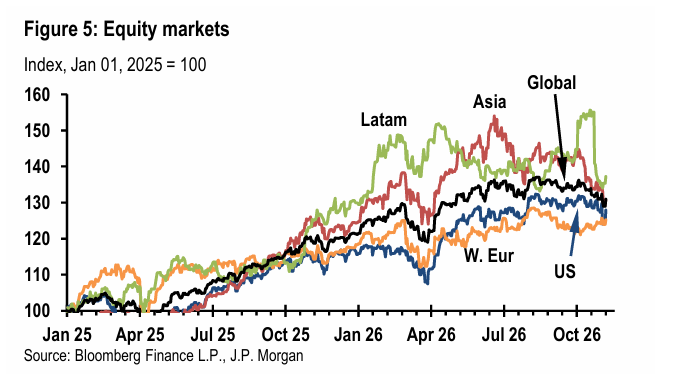
To a large extent, this also means that orders for chips, servers, and power equipment can grow first, but the continuous return on investment for computing power operators and end users may not arrive at the same time; in an environment where interest rates rise and credit spreads widen, this waiting period itself will increase the financing burden and reduce the present value of forward earnings. The increase in production and revenue during the AI construction phase was first transmitted to chip, server and related equipment manufacturers. This is why the stock prices of Asian AI infrastructure-related manufacturing leaders have been extremely strong in recent years.
If the increase in stock correlation further triggers the closure of crowded and scattered transactions, the adjustment may be amplified. What determines whether AI assets can regain their premium will be the speed at which orders are converted into cash, whether financing capacity can support delivery, and whether cost reduction and efficiency increases on the application side can be gradually realized.
The chip rebound collided with interest rate hikes and the market re-measured the return on AI investment
US stocks closed in the US East on November 5, and the Nasdaq 100 index fell sharply by 6.36%, the biggest one-day decline since March 2020. The total market value of constituent stocks evaporated about 2.3 trillion US dollars; the Philadelphia Semiconductor Index plummeted 12.25%. After the Democratic Party gained control of both houses of Congress, the market feared that AI supervision and data center construction restrictions would be tightened, and that project delivery, equipment procurement, and revenue fulfillment might be delayed. Policy concerns triggered systemic strategies such as valuation adjustments and trend tracking to subsequently reduce positions, further amplifying the sell-off.
On November 9, pessimistic expectations were revised. NASDAQ 100 and Fee Half rebounded by 3.40% and 6.85%, respectively; Micron and SanDisk rose 6.25% and 6.16% respectively. However, Nvidia bucked the trend and fell by about 4.3% due to company-specific news. By Tuesday, November 10, Micron and SanDisk had dropped by about 1.1% and 3.0%, respectively, indicating that capital was still repeatedly balancing strong industrial demand and macroeconomic valuation pressure. It is worth noting that the extent of the fall in technology stocks this time was clearly moderate. VIX also fell from 19.92 to 19.46, which largely indicates that the market is re-evaluating the pressure on the Fed's interest rate path and has not repeated the panic sell-off of last Thursday.
According to data released on November 10, the overall and core CPI of the US rose 0.4% and 0.3% month-on-month respectively in October, higher than expectations of 0.3% and 0.2%; the actual core readings hit the “consider a 50 basis point increase in December” conditions previously proposed by the FOMC Standing Committee and Federal Reserve Governor Waller. The Dow, S&P 500, and Nasdaq Composite then closed down 0.30%, 0.38%, and 0.74%, respectively. Market pricing shows that the probability of raising interest rates by 50 basis points in December will rise to 11.8%, and 25 basis points is still the main expectation; traders also increased their bets of 25 basis points each time from the current level to three more interest rate hikes in mid-2027, including the expected December rate hike. The change in market concerns is that this round of interest rate hikes and austerity by the Federal Reserve may be faster and longer.
Increased hourly output does not mean that AI has brought about a comprehensive efficiency revolution
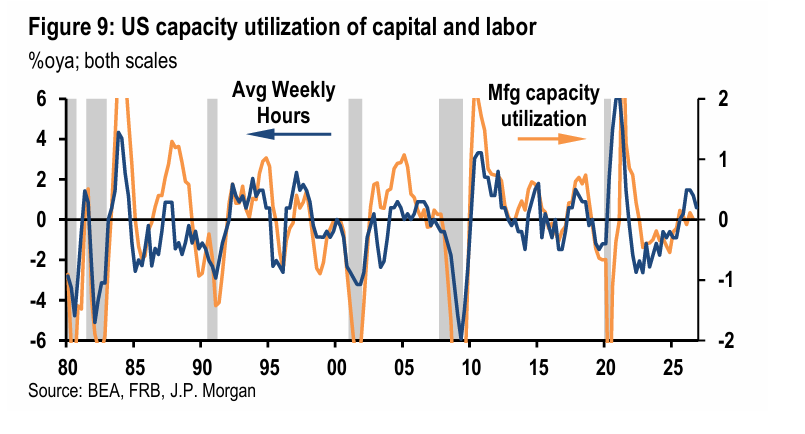
J.P. Morgan began by breaking down three concepts that are easily confused: capital deepening (capital deepening), factor utilization intensity (factor utilization), and total factor productivity (TFP). More equipment and software can be deployed to each worker, which can increase hourly output; more intensive equipment operation and less idle in the workflow can also increase output; and after eliminating these changes, it is still possible to produce more products and services with established inputs, which is closer to widespread efficiency improvements.
The deepening of capital itself can also include technological advances embedded in new devices, so this breakdown cannot be understood as AI not contributing at all. Capital deepening also includes technological advancements embedded in new devices. For example, more advanced AI chips improve computational efficiency, and some of their contributions will be included in capital deepening. Therefore, J.P. Morgan believes that recent productivity improvements mainly come from deepening capital, which does not mean that AI has not contributed, but rather that AI has not gone through extensive applications and business process changes, resulting in fully visible total factor productivity improvements.
Key figures show that labor productivity in the US has grown by 2.6% annualized in the past three years, which is significantly higher than 1.4% during the previous economic expansion period. However, the breakdown quoted in the report shows that capital deepening explains about half of this, explains the intensity of factor utilization by about 20%, and TFP contributes about one-third. The latter has grown at an annualized rate of about 0.9% over the past three years. Technological and non-technology capital contributed a total of about 1-1.5 percentage points, of which data center-related investments alone may contribute up to about 0.5 percentage points. These approximate shares suggest that recent productivity improvements have largely depended on increased capital and fuller use of existing inputs.
What is more noteworthy is the incremental trend: according to the report, TFP growth after adjustment for utilization has stagnated in the past year. Data updated by the San Francisco Federal Reserve on November 9 provides similar evidence — in the past four quarters up to the third quarter of 2026, TFP without utilization adjustment increased by 1.27%, and declined by 0.22% after adjustment. This supports the judgment that “broad efficiency dividends have yet to be fully demonstrated”, and it cannot be determined that individual companies' AI applications are not profitable based on this.
Judging from the enterprise deployment mechanism, only part of the investment was completed by purchasing GPUs and connecting to large models. Productivity returns also require usable data, application development, rights governance, workflow reengineering, and employee training. In the early stages of deployment, these supporting investments occurred first, and process benefits were then released, forming the Productivity J-Curve (Productivity J-Curve) emphasized in the research report. As a result, the increase in computing power procurement, the increase in cloud service revenue, and the increase in terminal enterprise efficiency are interrelated but unsynchronized cashing processes.
Suppliers get orders first, and the economy still needs to cross the gap between costs and interest rates
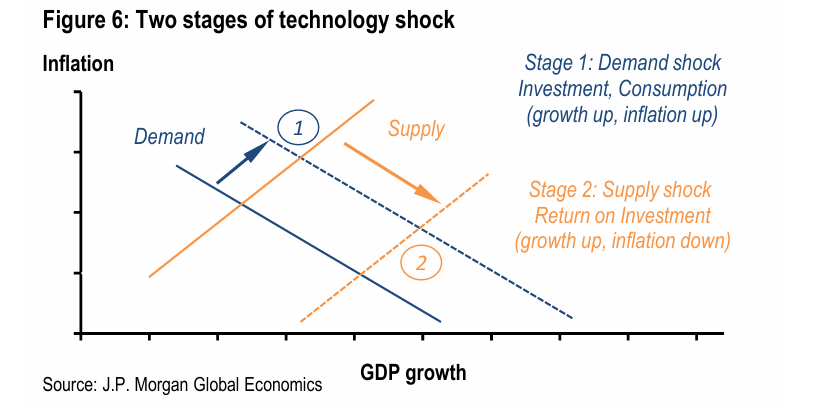
J.P. Morgan divides the technological boom into two phases: investment and return. In the first phase, consumer demand brought about by AI capital expenditure and rising assets took the lead, and capital goods suppliers took the lead in receiving revenue; in the second stage, after the technology was widely applied, supply was expanded and unit costs were reduced, and actual revenue and corporate profits were supported more permanently. That is, in the first stage, investment and consumption expand first, and demand grows faster than supply; the second stage is the spread of technology applications, increased productivity, and lower unit costs.”
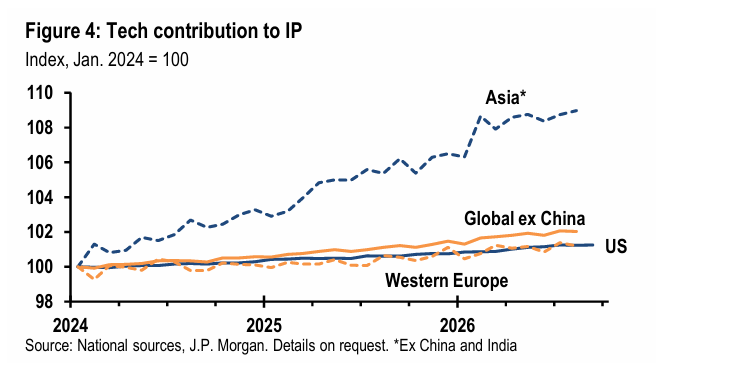
According to the report data, global capital expenditure has increased by about 7% on an annualized basis since the beginning of 2025, and US technology capital expenditure has increased by about 30% in the past year. A large amount of equipment depends on imports, so that the contribution of investment expenditure to US GDP is partially offset by imports, while the profits from the manufacturing process flow more to Asia. According to the report's caliber, the global manufacturing industry has grown 5.6% since 2024, with Asia contributing 4.7 percentage points; China and India are excluded from the Asian range in the relevant chart.
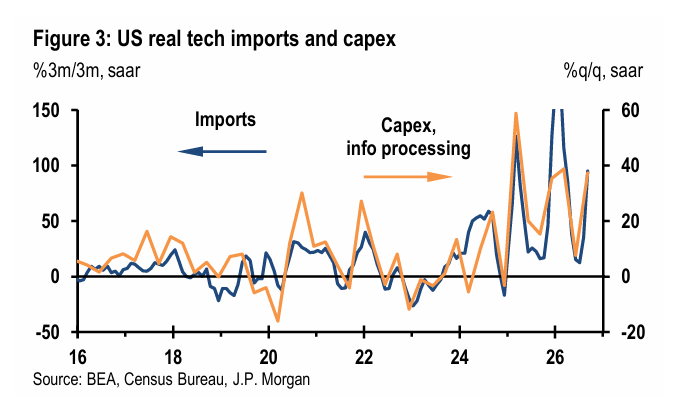
The recent disclosure of the industrial chain coincides with this timeline. Microsoft's October 28 phone call showed that quarterly capital expenditure reached 45.2 billion US dollars, about three-quarters of which is used for assets with a short lifespan such as CPUs and GPUs, and clearly includes higher memory and storage costs. On November 4, TrendForce still observed an increase in server DRAM contract prices, an increase in HBM4 volume, and the share of long-term agreements. At the same time, it indicated that the momentum in the retail market was weak. The price increase and revenue of suppliers are the procurement costs of cloud vendors; the upstream boom can fully realize the return on investment ahead of the downstream.
This also explains why the improved productivity figures did not immediately lift inflationary pressure. More intensive use of equipment and personnel may increase overtime, maintenance, and wear and tear costs; although additional capital increases supply, demand is likely to grow faster during construction. J.P. Morgan further pointed out that while demand for investment and financing is rising, the wealth effect also encourages consumer spending, the economy may need higher neutral real interest rates to attract savings and support capital formation. It is worth noting that J.P. Morgan Chase is discussing changes in equilibrium interest rates, which means that even if inflation falls in the future, the financing environment will not necessarily quickly return to its previous low interest rate state.
The J.P. Morgan Chase Research Report also proposed a condition that can easily be overshadowed by AI narratives: consumption cannot be maintained by rising stock prices and falling savings for a long time; expansion will eventually require labor income to take over. The agency anticipates a cyclical recovery in recruitment, but weak labor supply may make it harder for inflation to fall.
Derived from this framework, J.P. Morgan's research report shows that the future investment focus of the entire AI industry chain should focus on whether orders can be converted into cash, whether customers can continue to finance, and whether improvements in terminal efficiency can support the next round of procurement. Profit growth from storage, power, and interconnect suppliers can offset some of the valuation pressure; platforms and application companies that can turn AI investment into verifiable revenue or cost savings are more in a position to support long-term valuations. Growth brought about by simply increasing capital investment. Once expansion slows down, the contribution to economic growth will also weaken.