


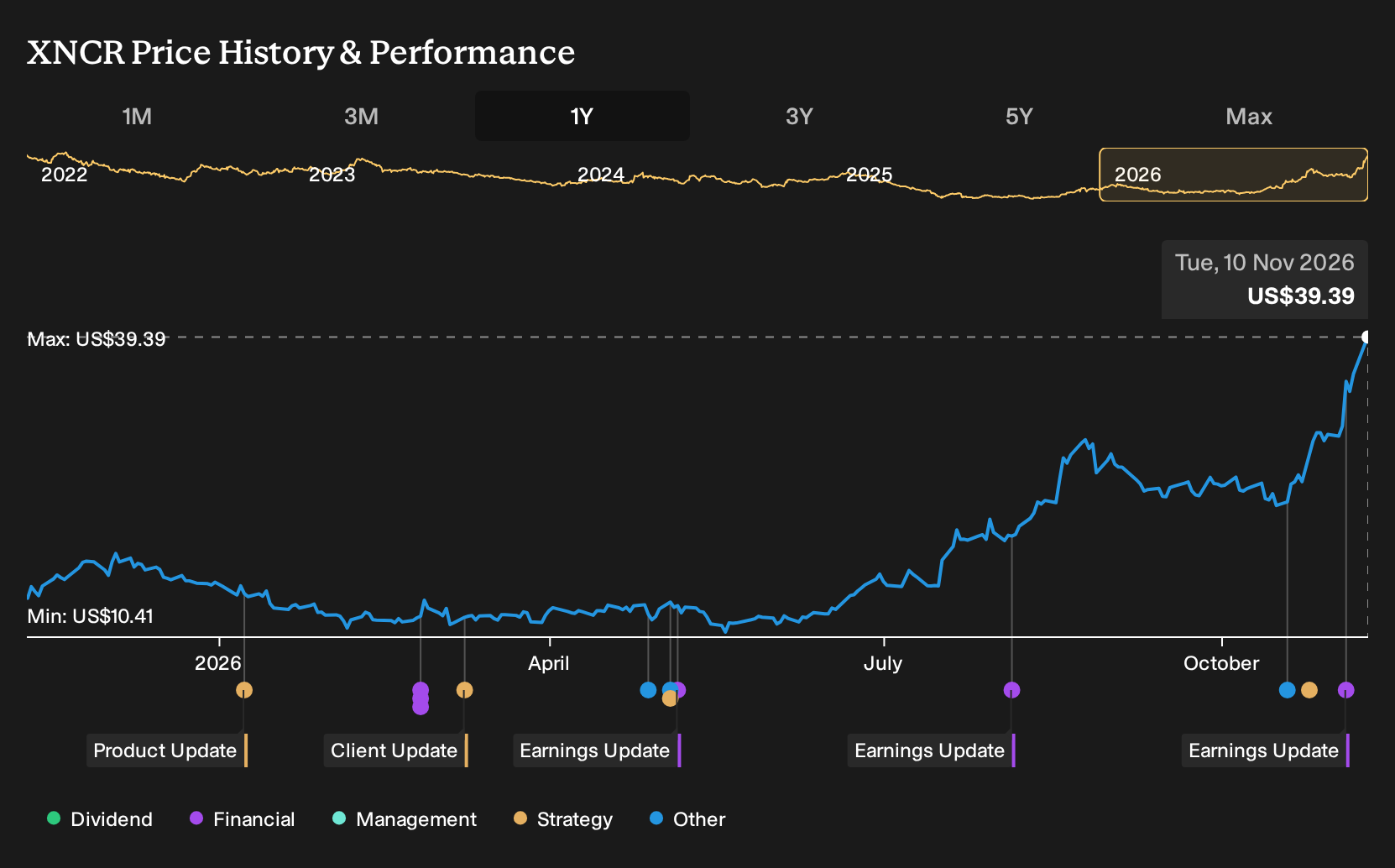
- Xencor reported third quarter 2026 net income of US$39.44 million, with basic earnings per share of US$0.52, while also sharing initial Phase 1b plamotamab data in rheumatoid arthritis and a timing update for the first in human study of XmAb657.
- The combination of positive autoimmune trial signals for plamotamab and clarity on XmAb657 development sharpened investor focus on how Xencor’s bispecific platform might translate into a broader, clinically validated pipeline.
- This article now examines how Xencor’s investment narrative could be affected by the early plamotamab rheumatoid arthritis data and pipeline progress.
Xencor Investment Narrative Recap
To own Xencor, you need to buy into a story where bispecific antibody engineering turns into durable autoimmune and oncology products, not just one off licensing deals. The analyst consensus Narrative on Simply Wall St already framed the big swing around XmAb942 and the broader XmAb platform. The latest quarter flipped to net income of US$39.44 million, but nine month figures still show a loss, so the short term focus stays on pipeline execution and cash burn rather than one quarter of earnings.
The most important near term catalyst still sits with clear, differentiated data from autoimmune programs like XmAb942 and plamotamab that can stand up in a crowded TL1A and B cell space. The biggest risk remains execution in expensive late stage trials without guaranteed partners. Recent results do not fundamentally change that balance. They simply give Xencor a bit more financial breathing room while investors watch for proof that these bispecifics can secure regulatory traction and payer acceptance.
The Phase 1b plamotamab rheumatoid arthritis readout is the clearest link between this quarter and the longer term story. Deep B cell depletion with reductions in disease activity shows that Xencor’s autoimmune thesis is at least functioning biologically in patients. That supports the idea that the XmAb platform is not limited to oncology, even while commercial products like Monjuvi remain core to current revenue.
For catalysts, that early plamotamab signal plus an updated start window for the first in human XmAb657 trial in early 2027 gives investors firmer timelines to track. These are still small, early datasets, and the risk list around competition, trial complexity and unproven differentiation in TL1A and other pathways has not gone away. The question is whether Xencor can turn this growing autoimmune toolkit into late stage programs fast enough to justify sustained R&D intensity and its current P/S premium to the broader biotech sector.
Xencor's narrative projects US$174.2 million revenue and US$34.5 million earnings by 2029. This projection builds on analyst expectations for revenue to decline 4.6% per year and implies an earnings increase of about US$152.4 million from the current loss of US$117.9 million.
Uncover how Xencor's fair value indicates an 8% potential upside to its current price that could narrow quickly if sentiment shifts toward Xencor.
Exploring Other Perspectives
One alternate view focuses less on Xencor’s autoimmune pipeline upside and more on how much revenue risk bearish analysts were already modeling. Before this earnings and plamotamab update, that group was assuming revenue would decline 37.3% a year and only reach about US$49.4 million by 2029. This outlook is far more cautious than the consensus and could change if sentiment toward these trial updates shifts.
The Verdict Is Yours
Disagree with existing narratives? Extraordinary investment returns rarely come from following the herd, so go with your instincts.
- A great starting point for your Xencor research is our analysis highlighting 1 key reward and 2 important warning signs that could impact your investment decision.
- See our latest analysis for Xencor. The report includes a comprehensive fundamental analysis summarized in a single visual, the Snowflake, making it easy to evaluate Xencor's overall financial health at a glance.
Looking For More Investment Ideas Beyond Xencor?
If Xencor has sharpened your interest in complex biology and future cash flow potential, it can be useful to line it up against other opportunities with different risk and income profiles. The Simply Wall St Screener lets you quickly sort through businesses by quality, balance sheet strength, income potential and more so you can build a shortlist that matches your own approach.
- For investors who want potential upside without ignoring financial quality, review our curated 20 high quality undiscovered gems that couple solid fundamentals with under followed stories.
- If capital preservation and consistency rank high for you, filter for resilient companies through the 30 resilient stocks with low risk scores and focus on businesses with steadier risk profiles.
- When income is the priority, scan a focused universe of 5 dividend fortresses to see which payouts might suit your return objectives.
Have feedback on this article? Concerned about the content? Get in touch with us directly. Alternatively, email editorial-team@simplywallst.com