


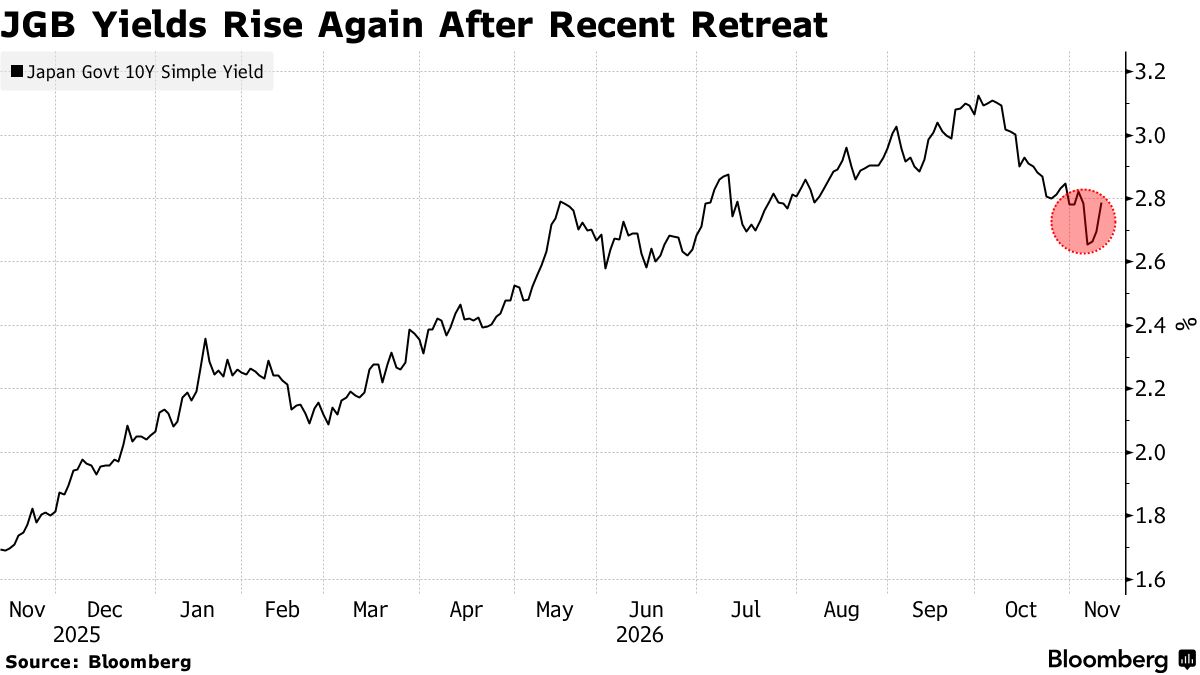
The Zhitong Finance App learned that US treasury bonds were sold off on Tuesday because the US CPI data for October was higher than expected, and the US treasury bonds were sold off on Tuesday, and Japanese treasury bonds followed the overnight decline in the US treasury bond market on Wednesday. The yield on Japan's benchmark 10-year treasury bond rose sharply by 10.5 basis points to 2.795%; the yield on 5-year treasury bonds rose 9.5 basis points to 2.195%; the yield on 2-year treasury bonds, which are more sensitive to monetary policy, climbed 8.5 basis points to 1.86%.
The overall and core CPI monthly rates of the US in October were higher than market expectations, indicating that price pressure is still high, strengthening the reasons for the Federal Reserve to continue to raise interest rates. According to data released by the US Department of Labor (BLS) on Tuesday, the US CPI rose 0.4% month-on-month, higher than market expectations of 0.3%, and the previous value was 0.6%; excluding volatile projects such as energy and food, the core CPI rose 0.3% month-on-month, higher than market expectations of 0.2%. The previous value was 0.3% (CPI and core CPI for October had no year-on-year data due to the shutdown of the US federal government in October last year).
This CPI data is the last CPI data before the Federal Reserve's December 8-9 interest rate meeting (the November CPI is scheduled to be announced on December 10, the day after the resolution, and the year-on-year standard will resume at that time). In October, which was announced last week, 165,000 new jobs were added, far exceeding expectations. The unemployment rate fell to 4.1%. Combined with the fact that core inflation has not cooled down, the market focus has turned to whether the December rate hike was 25 or 50 basis points.
After the release of the US CPI data for October, the market raised its bet on the Fed's interest rate hike. In addition to the almost 100% pricing that the Federal Reserve will raise interest rates in December, the market has raised the bet that the Fed will raise interest rates by 50 basis points next month, and further increased the bet that the Fed will raise interest rates at least twice by mid-2027.
The reaction of the US Treasury bond market was particularly clear. After the inflation data was released, short-term US bond yields rose rapidly. Among them, the 2-year US Treasury yield, which is most sensitive to the Fed's policy expectations, once rose sharply by 18 basis points, reflecting that investors are re-evaluating the interest rate path for the next few months. Meanwhile, 10-year US Treasury yields have also risen markedly, and market concerns that the Federal Reserve may extend its austerity cycle are heating up again.
The current decline in Japanese bonds reflects the increasingly close linkage between global bond markets. US inflation data has reignited market concerns about the Federal Reserve's further tightening of monetary policy, driving a rapid rise in US Treasury yields, and putting spillover pressure on Japanese and other Asian bond markets. Since US Treasury yields are an important pricing benchmark for global financial markets, their rise will often raise the yield requirements of other major economies' bonds, especially in the context of global investors re-evaluating the policy path of major central banks.
As far as Japanese treasury bonds are concerned, the impact of rising US yields is not limited to short-term market sentiment. The spread between the US and Japan is an important factor affecting the yen exchange rate and cross-border capital allocation. When US interest rate expectations rise and the Bank of Japan continues to gradually adjust monetary policy, the spread between the US and Japan may widen again, which in turn affects the willingness of investors in Japan and abroad to allocate yen assets. If US Treasury yields continue to rise, Japanese treasury bonds will need to provide more attractive yields in order to maintain their appeal to investors to a certain extent.
This sell-off also marks a reversal in the trend of the Japanese treasury bond market. In previous trading days, Japanese treasury bonds continued to rebound as the sharp decline in the US stock market triggered safe-haven demand and prompted traders to lower their expectations of the Bank of Japan's interest rate hike.
Kadota Shinichiro, head of foreign exchange and interest rate strategy at Barclays Bank in Japan, said that the overall recovery in risk sentiment “indicates that the market is shifting from the previous sharp decline in yield to a reversal trend.” He described the previous decline in Japanese treasury yields as “somewhat excessive,” and believes that there is still room for a further recovery in yield to recover some of the previous declines.
Japanese bonds face pressure from local policies. Fiscal and bond supply and demand factors also require attention
In addition to the spillover effects of the US treasury bond market, the Bank of Japan's monetary policy direction is also an important factor in determining the yield on Japanese treasury bonds. The Bank of Japan raised the policy interest rate to 1.25% in September and kept the interest rate unchanged at the monetary policy meeting at the end of October. However, the Bank of Japan also sent a signal that it is paying more attention to the upward risk of inflation, suggesting that there is still room for further interest rate hikes in the future. Bank of Japan Governor Kazuo Ueda said that the central bank will discuss interest rate issues at every policy meeting, including the next meeting in December, without promising a fixed pace of interest rate hikes in advance.
The “Economic and Price Situation Outlook” report released by the Bank of Japan in October indicates that Japan's potential inflation has roughly reached the price stability target of 2%. The Bank of Japan believes that corporate wages and pricing behavior and household and corporate inflation expectations are gradually changing, and inflation is shifting from being mainly driven by external cost shocks in the past to a more sustainable state. The Bank of Japan said that as potential inflation approaches the target level, monetary policy needs to focus on preventing the risk that inflation will further exceed the target.
This policy signal means that the stage at which the Bank of Japan maintains an ultra-loose monetary policy for a long time has changed. As inflation gradually stabilized around 2%, the market began to pay more attention to when the Bank of Japan will raise interest rates in the future and the final interest rate level. The minutes of the Bank of Japan's September meeting show that many policymakers support continuing to raise interest rates. Some members even believe that if inflation exceeds expectations, the central bank may need to speed up the pace of interest rate hikes. As a result, the market sees another rate hike in December as an important option.
The Bank of Japan's normalization of monetary policy has also caused the Japanese treasury bond market to face a different pricing environment than in the past. Over the past few years, the Bank of Japan has lowered long-term borrowing costs through large-scale debt purchases and yield curve control policies, keeping the yield on Japanese treasury bonds at a very low level for a long time. Now, as policy interest rates rise and the Bank of Japan gradually adjusts debt purchase arrangements, the market needs to re-evaluate the reasonable yield level of Japanese treasury bonds. Investors' expectations for future policy interest rates, changes in the central bank's balance sheet, and the market's judgment on long-term inflation may all drive further fluctuations in treasury bond yields.
It is worth noting that the rise in Japanese treasury yields was not entirely driven by the Bank of Japan's policy expectations. Bank of Japan Governor Junko Koeda pointed out earlier that long-term interest rates are also affected by multiple factors such as inflation risk premiums, fiscal policy risks, and the relationship between supply and demand for treasury bonds. For example, the rise in international crude oil prices may heighten market concerns about global inflation and push up long-term interest rates in Japan through the linkage of the global bond market.
At the same time, changes in the supply scale of government bonds, investor demand, and the size of treasury bonds held by the Bank of Japan will also affect the risk premium required by the market. The Japanese treasury bond market is under pressure from changes in fiscal conditions and the supply and demand structure of long-term bonds. The size of Japanese government debt has been at a high level for a long time. When the market begins to worry that the government may expand fiscal spending or increase bond issuance in the future, investors tend to demand higher yields to cover potential fiscal and maturity risks.
Overall, the current decline in Japanese treasury bonds is the result of a combination of external interest rate shocks and expectations of normalization of domestic monetary policy. In the short term, US inflation data and the Federal Reserve's policy signals will still dominate global bond market sentiment. If US bond yields continue to rise, they may further boost Japanese treasury yields. In the medium to long term, the Bank of Japan's gradual withdrawal from the ultra-loose monetary policy, the continued increase in domestic inflation, and changes in term premiums due to fiscal and bond supply and demand factors all mean that the yield on Japanese treasury bonds may remain at a higher level than in the past period of long-term low interest rates.