


- Casey's General Stores recently started rebranding the 24 Pak-A-Sak locations acquired earlier this year, converting stores in Amarillo and the broader Texas Panhandle to the Casey's banner.
- The shift brings Casey's food-led convenience model into a new region, integrating fresh prepared items, beverages and fuel under a single, scaled operating playbook.
- We will now look at how Casey's General Stores' expansion into Pak-A-Sak markets affects the longer term investment narrative.
Compare Casey's General Stores' expansion story with other retailers using our hand picked 35 high quality undervalued stocks that combine balance sheet strength with cash flow support.
Casey's General Stores Investment Narrative Recap
To own Casey's General Stores, you need to believe that its food led convenience model, especially prepared foods and beverages, can keep pulling more profit from each store even as operating costs rise. The analyst consensus Narrative on Simply Wall St leans on that mix shift and a large pipeline of remodels and new units. The Pak A Sak rebranding fits that story, but the conversion is relatively small and does not change the near term thesis by itself.
The more immediate swing factor is whether higher expenses, including labor, card fees and new unit costs, stay ahead of inside sales growth. That is already showing up in Q1 FY27 operating expense trends. The biggest risk is that fuel margins or inside volume soften at the same time Casey's keeps spending heavily on growth and remodels, which could strain free cash flow.
The Pak A Sak rollout connects directly to one of the clearest catalysts. Analysts in the consensus Narrative see value in Casey's adding stores and converting acquired sites to the full kitchen model, with prior CEFCO conversions linked to stronger prepared food and beverage sales. Texas Panhandle locations now moving under the Casey's brand extend exactly that playbook into a new geography.
Where this gets tested is execution. Integrating 24 stores is operationally manageable, but it still adds to capital spending and to the expense base that already grew faster than inside sales in Q1 FY27. If the Amarillo and broader Texas sites do not scale prepared foods, or if fuel margins soften while these stores are ramping, the conversion program could weigh on free cash flow rather than support it.
Casey's General Stores' current analyst narrative points to revenues of US$22.2b and earnings of US$979.7m by 2029, based on 5.9% yearly revenue growth and an earnings increase of about US$207m from US$772.8m today.
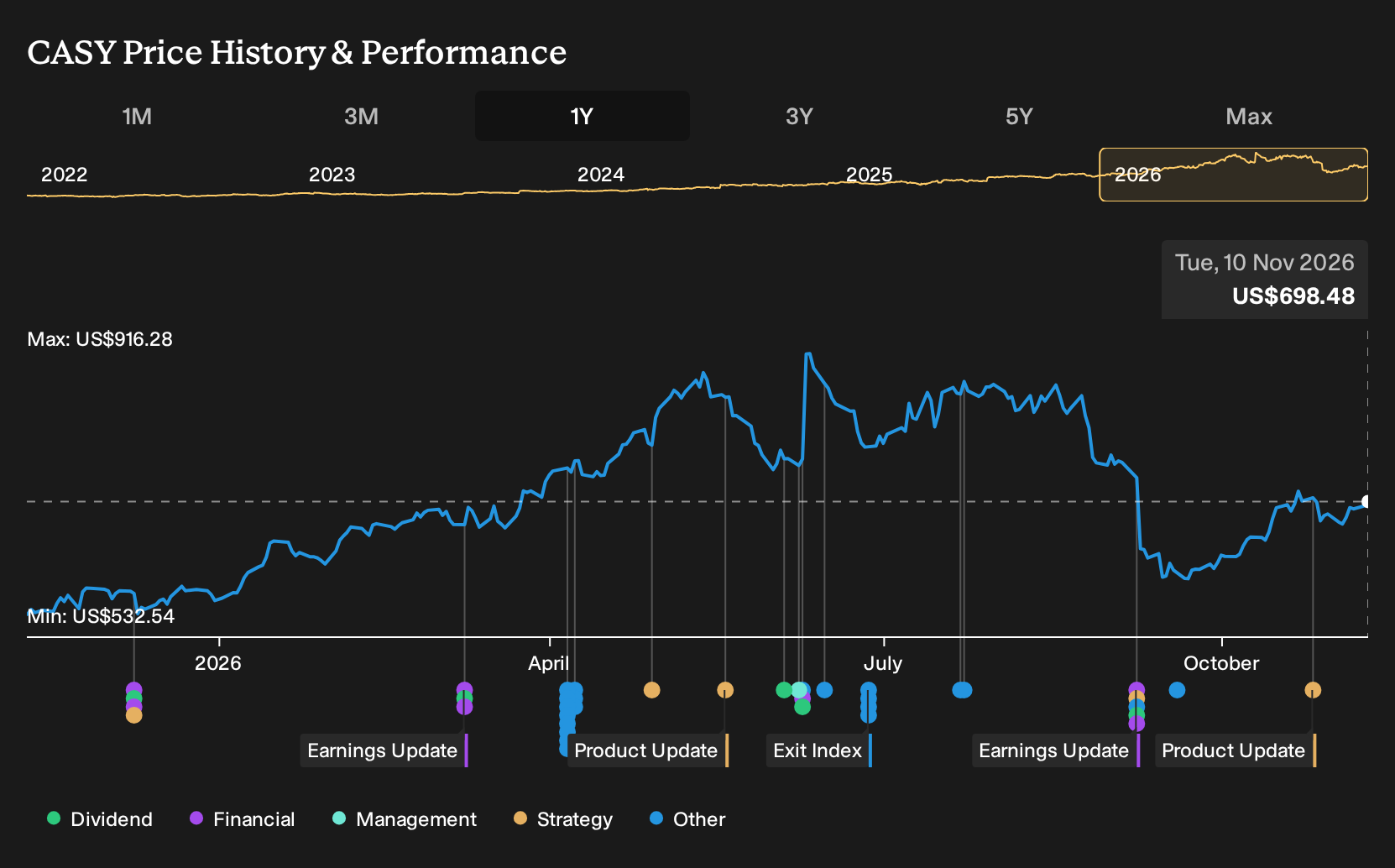
Uncover how Casey's General Stores' fair value indicates a 14% potential upside to its current price, which could narrow quickly if Casey's General Stores continues to execute on this rollout.
Exploring Other Perspectives
Some of the most optimistic analysts frame the Pak A Sak move as a proof point for a more aggressive revenue path. Before this news, the bullish camp was already penciling in about US$25.3b of revenue and US$1.1b of earnings by 2029. That view leans on acquisitions like this. Your own takeaway might differ, so treat these forecasts as one of several narratives to explore, not a final verdict that will necessarily hold once the rebrand fully lands.
Explore 3 other Casey's General Stores fair value estimates, including one that suggests as much as 34% upside from the current price.
Decide For Yourself
Don't just follow the ticker; dig into the data and build a conviction that's truly your own.
- A great starting point for your Casey's General Stores research is our analysis highlighting 3 key rewards and 1 important warning sign that could impact your investment decision.
- See our latest analysis for Casey's General Stores. The report includes a comprehensive fundamental analysis summarized in a single visual, the Snowflake, making it easy to evaluate Casey's General Stores' overall financial health at a glance.
Looking for more investment ideas beyond Casey's General Stores?
Once you are comfortable with where Casey's General Stores fits in your portfolio, it can help to line it up against other opportunities that share some of the qualities you value most, whether that is balance sheet strength, income potential or a focus on future growth.
- If you want to balance opportunity with resilience, take a look at a 30 resilient stocks with low risk scores that screens for companies with more measured risk profiles and sturdier fundamentals.
- For investors who care most about financial stability and staying power, start with a list of solid balance sheet and fundamentals (24 results) that highlights businesses with strong capital structures and healthier leverage metrics.
- Income focused investors can widen their watchlist using a 5 dividend fortresses that filters for higher yielding stocks with the potential to support regular payouts.
Have feedback on this article? Concerned about the content? Get in touch with us directly. Alternatively, email editorial-team@simplywallst.com