


The Zhitong Finance App learned that according to TrendForce Jibang Consulting's latest memory industry research, memory prices have been rising for more than a year, and the cost pressure on the consumer electronics industry is increasing day by day. Among them, notebook shipments are estimated to have declined markedly from the third quarter of 2026. PC OEMs are facing the dual challenges of weak sales and high machine inventories. Some manufacturers have already planned to adjust the scale of memory procurement for the fourth quarter of 2026 and even the first quarter of 2027, and may increase the proportion of OEM model shipments.
TrendForce Jibang Consulting said that in order to cope with rising memory prices, PC OEMs will advance some demand to the first half of the year in 2026 to prepare for production. However, sales in Asia and Europe have weakened due to the increase in terminal sales prices. Currently, OEM and North American channel complete machine inventories are gradually rising. Notebook shipments in the third quarter fell 15.8% quarterly, and it is estimated that there may still be a single-digit percentage decline in the fourth quarter. This situation prompted some OEMs to re-evaluate their complete product plans, with the intention of increasing the proportion of OEM models shipped in 2027, and incorporating downsized particles and lower-core CPUs.
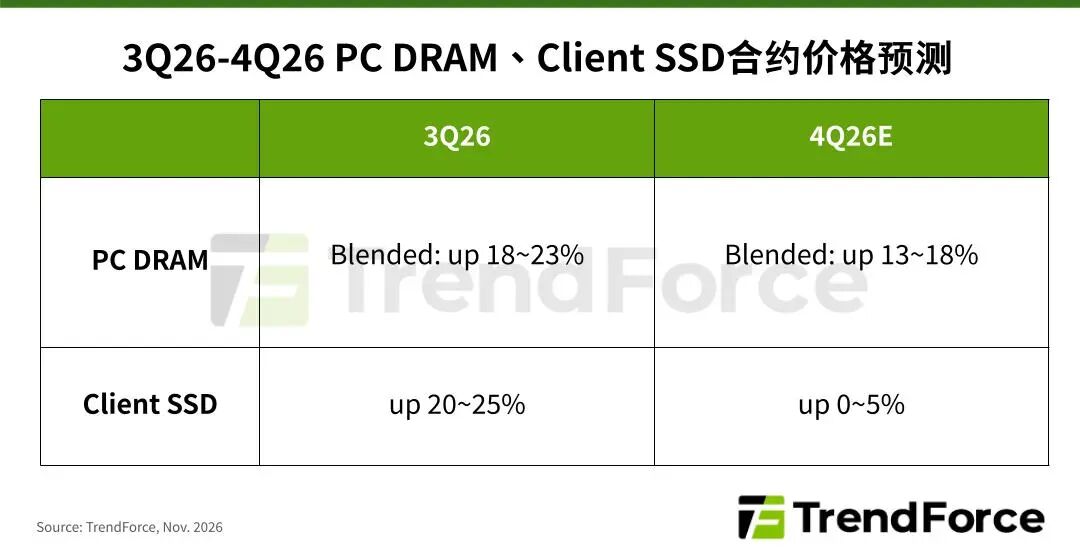
It is estimated that 4Q26 PC DRAM prices will increase 13% to 18% quarterly, and client SSD will increase within 5%
Looking at the DRAM demand of PC OEMs, some brands previously overordered due to sharp price increases. Overall, OEM-side DRAM inventory weeks have increased since the third quarter due to the decline in machine shipments, and it is estimated that it will continue to pile up in the fourth quarter. Currently, manufacturers have rediscussed the 2027 demand mix with original memory manufacturers.
On the DRAM supply side, due to steady demand for AI applications, the original manufacturer has initially planned to reduce PC DRAM supply in 2027. However, due to the low pressure to absorb related production capacity and the long-term layout of edge AI applications, the original manufacturer still needs to maintain strategic cooperation with customers and is flexible enough to reduce price increases slightly. Combining the above factors, TrendForce Jibang Consulting estimates that PC DRAM contract prices for the fourth quarter of 2026 will increase by 13% to 18% quarterly, a reduction from the previous quarter.
Analyzing the client SSD demand of PC OEMs, due to the overall increase in BOM cost (material cost of the whole machine), increasing terminal sales prices has affected consumer intentions. OEMs can only carry out strict cost control on components such as SSDs, and at the same time, they will never accept price increases. In the face of weak demand for terminals and high inventory of complete machines, brand companies' purchases of client SSDs declined across the board in the fourth quarter of 2026. They only needed to maintain basic production schedules, and the procurement plan for the first quarter of 2027 was also revised.
On the other hand, the production capacity of client SSDs continues to be squeezed out by AI applications. The original manufacturer aims to reduce the proportion of small-capacity products with low production efficiency and increase their price increase ratio to counterbalance demand. In the mainstream capacity segment, due to the lower price increase of some manufacturers, more orders were received, diluting the impact of other original manufacturers maintaining higher prices on the overall price. TrendForce Jibang Consulting estimates that the quarterly increase in client SSD contract prices in the fourth quarter was within 5%, which is a significant reduction from the previous quarter.