


The Zhitong Finance App has learned that the 2026 sovereign bond storm may be dissipating. The war between the US and Iran showed clear signs of downgrade. This gave investors, who had experienced months of oil price turbulence, to see the dawn of calm for the first time.
Oil dominated the bond market trend this year. Since last week's midterm elections, the shift in Washington's attitude towards the Iranian conflict may be the biggest catalyst for the future market. US President Trump said several times this week that the war is “essentially over,” and his administration also seems anxious to accept the wishes of the voters.
The war was extremely unpopular mainly because it drove up US crude oil and fuel costs, which in turn penetrated into broader inflation, and ultimately led the Federal Reserve to raise interest rates since September. The combination of fuel-induced inflation and rising borrowing costs is extremely damaging at the political level. The most recent example is the 2024 White House race, which is how Trump won the vote.
But if this war actually comes to an end, and the risk premium on oil prices gradually subsides, can bond investors regard this eight-month round of conflict as a phased disturbance and buy large amounts of bonds with current decades-high yields? This issue has become a central consideration in many forward-looking strategies.
Falling oil prices and concerns about inflation: can the bond market usher in a resuscitation?
The US and Israel raids on Iran in February caused oil prices to soar because one-fifth of the world's crude oil supply needed to be transported through the Persian Gulf, and the raid blocked this channel. Brent crude oil futures surged more than 70% in April, reaching a four-year high of 120 US dollars per barrel, and fell below 90 US dollars this week. However, this is still nearly 30% higher than in February.
An agreement to keep the Strait of Hormuz open could quickly eliminate the remaining war premiums, but tight refining capacity means fuel prices may take longer to fall. According to data from the American Automobile Association (AAA), the average retail price of regular gasoline in the US fell below $4 per gallon on Tuesday, the first time since July, but it is still about 35% higher than pre-war levels. Tuesday's data also showed that inflation remains high, almost double the Federal Reserve's target.
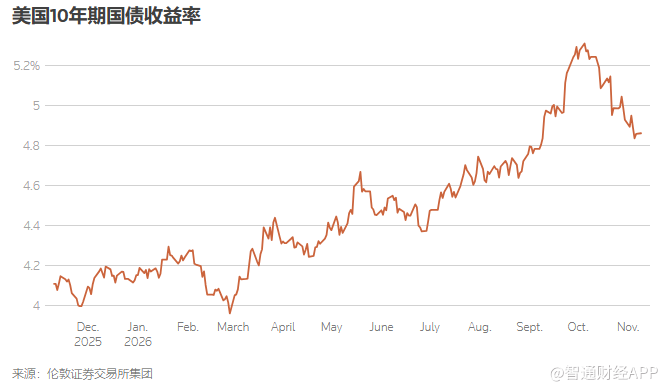
Since this year, the US Treasury bond market has closely followed the trend of oil prices, and yields have fallen far below the decades-long peak set more than a month ago. Like energy costs, which are still high, two-year US Treasury yields are still a full 150 basis points higher than pre-war levels. The 10-year yield is about 5%, which is about 100 basis points higher than in February.
Policy trends: Federal Reserve officials hint at a bigger rate hike
If the war subsides, will energy and debt costs fall as well?
Ahead of the worrying October CPI report on Tuesday, Federal Reserve Governor Christopher Waller said tougher measures may be needed. Waller said that the 0.3% increase in core CPI in October will prompt him to consider raising interest rates by 50 basis points at the December 8-9 meeting, which is double the amount of the Federal Reserve's regular rate hike. The data released later in the day is exactly this reading, prompting the possibility that the Fed's futures market will raise interest rates by more than 25 basis points next month.
Waller believes that officials have misjudged the impact of the policy on the economy: the current restrictions are far from sufficient to bring inflation back to target levels, especially as the labor market tightens again. The current overall annual inflation rate is close to double the Fed's target, while the unemployment rate is only 4.1%, the economic growth rate may exceed 3%, and financial conditions are still at a historically relaxed level. Against this backdrop, the Fed's actual policy interest rate is still close to zero.
Waller said, “It looks like inflation is starting to drift away from our target rather than getting close to it. Then we must adopt a more aggressive monetary policy.” Dallas Federal Reserve Chairman Lori Logan also said later that the policy is still about 50 basis points below the level of moderately restrictive requirements. She said it is possible to “move faster” this winter to reach that level.
These statements may reflect the Federal Reserve's consideration of suspending interest rate hikes before last month's midterm elections, but even if oil prices fall sharply, they won't change their final interest rate target too much. Both officials acknowledged a drop in energy prices after the election, but insisted that energy was not the only factor driving up inflation. Waller also stressed that damage to refining capacity may slow the transmission of a further decline in crude oil prices to retail and commercial fuel costs.
Larger interest rate hikes in the next two months may cool down the economy faster and clear barriers to next year's bond market.
Deep concerns: deficit pressure and AI borrowing frenzy
In addition to oil prices, the bond market also faces other problems.
Expanding annual budget deficits and debts are raising questions about debt sustainability and driving up associated risk premiums, and there is little political will to address these issues. Furthermore, the economic boom brought about by the AI investment boom has intensified inflation and triggered a borrowing frenzy of so-called “hyperscale enterprises,” a bond boom that competes with the government for capital.
The political earthquake in the US midterm elections could also slow the construction of data centers, thereby slowing spending, borrowing, and GDP growth.
BlackRock strategists said this week that post-election issues surrounding artificial intelligence construction caused “two-way uncertainty,” which is one of the reasons they were more optimistic about US Treasury bonds last month. They said: “Although the possibility of a sharp economic slowdown in 2027 is far from certain, it could have a significant negative impact on the market. However, the economic slowdown may also ease capital competition and reduce bond yields, and its economic impact may also ease policy measures.”
According to the annual debt sustainability analysis released by Morgan Stanley last week, despite widespread concerns in the sovereign bond market this year, AI spending and nominal growth brought about by higher inflation have actually improved the short-term sustainability model assessment results of many economies. However, the report also added that with the gradual refinancing of debt, the increase in debt repayment costs linked to high bond yields will lag behind, and many countries still urgently need to revise their budgets.
Lowering yields is critical to maintaining the smooth operation of the bond market, which will return the focus of the market to oil and central bank policies. However, the sense of crisis in the bond market may have finally begun to subside this year.