


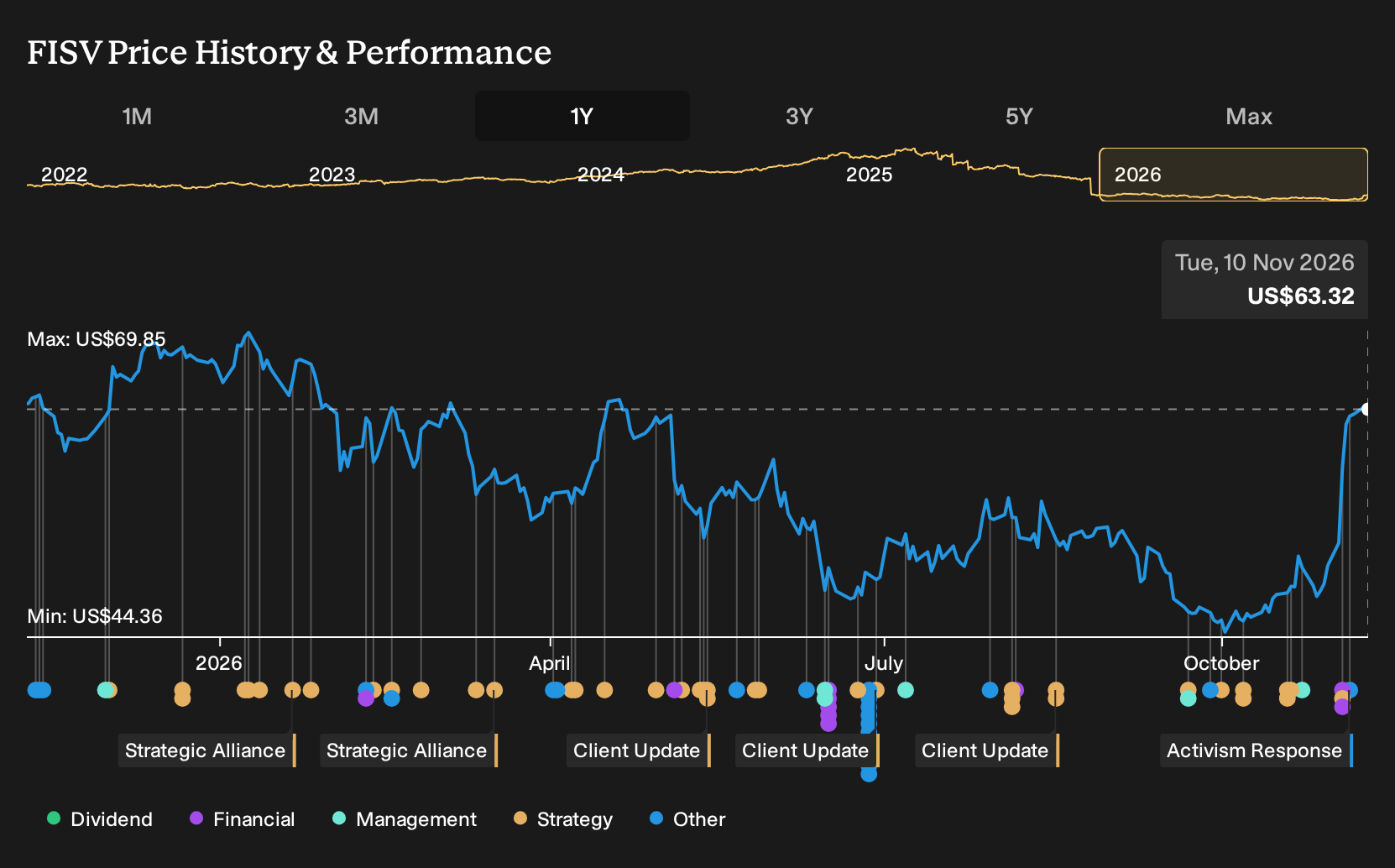
- Fiserv disclosed that since June 2026 it has cut 3,000 employees and contractors, trimmed senior management by more than 10%, lifted its Project Elevate savings target to US$1b, and reported a third quarter goodwill impairment charge of US$6.45b alongside GAAP revenue guidance for 2026 of a 1.5% to 0.5% decline.
- Investor pressure from Jana Partners is now directly shaping how Fiserv tackles cost structure, portfolio focus, and executive bench strength. This goes to the heart of the earlier investment case built on a cleaner earnings base and tighter operational discipline.
- We will now examine how Fiserv's accelerated US$1b cost program under Jana's activism could reshape the earlier investment narrative.
Fiserv Investment Narrative Recap
For a shareholder in Fiserv, the core belief is that a scaled payments and banking technology provider can clean up its operations and restore earnings after a period of missteps. According to Hidden_Rock_Capital, an investor in the Simply Wall St Community, the appeal is a mix of recurring revenue, pricing power and exposure to digital payments across Merchant and Financial Solutions.
The recent quarter cuts against that thesis in the short run. Fiserv reported a third quarter net loss of US$5.94b and a US$6.45b goodwill impairment, with 2026 GAAP revenue guided to decline 1.5% to 0.5%. The near term catalyst is clearer delivery on Project Elevate savings. The biggest current risk is execution on cost cuts without hurting key platforms.
The most relevant new development is Project Elevate. Management has lifted its savings target to US$1b in response to Jana Partners pressing for US$1.25b. That is a material reset to the cost base and directly ties into the earlier Hidden_Rock_Capital focus on cleaner earnings and margin repair as a re rating trigger.
For you as an investor, the question is whether these cuts and management reductions improve Fiserv’s ability to invest in Clover, core banking technology and new AI ecommerce tools while still servicing debt, especially with interest payments not well covered by current earnings. Execution on this cost program now sits alongside earnings stabilization as the main near term catalyst.
On Hidden_Rock_Capital’s numbers, Fiserv reaches a fair value of US$119.99 through a blend of 27.1% annual revenue growth and a future profit margin of 15.2%. Together, these factors underpin the narrative that the business can support a materially higher earnings base than today.
Uncover why Fiserv's fair value indicates an 89% potential upside to its current price that could narrow quickly.
Exploring Other Perspectives
One alternate view on Fiserv leans heavily on Project Elevate as a catalyst rather than a risk. Before this news, the most optimistic analysts were assuming revenue growth of about 1.5% a year and earnings of US$5.7b by 2029. That is far more upbeat, and it may shift again as you compare different forecasts.
Explore 13 other Fiserv fair value estimates, including one that suggests as much as 89% upside from the current price!
Decide For Yourself
Don't just follow the ticker. Dig into the data and build a conviction that's truly your own.
- A great starting point for your Fiserv research is our analysis highlighting 3 key rewards and 1 important warning sign that could impact your investment decision.
- See our latest analysis for Fiserv. The report includes a comprehensive fundamental analysis summarized in a single visual, the Snowflake, making it easy to evaluate Fiserv's overall financial health at a glance.
Looking for more investment ideas beyond Fiserv?
Once the Fiserv story is on your radar, it often helps to widen the lens and compare it with other opportunities that share similar qualities in cash flow strength, balance sheet resilience, or income potential. The Simply Wall St screener can surface a range of stocks that fit those themes so you can pressure test your thesis across a broader watchlist.
- If you want a broader group of quality companies with room for improvement in price, scan a curated set of potential value ideas through our 35 high quality undervalued stocks.
- For readers who care most about capital preservation and smoother ride potential, filter for companies that score strongly on resilience using the 30 resilient stocks with low risk scores.
- If you are hunting for strong fundamentals backed by sturdy balance sheets, build a comparison list with the list of solid balance sheet and fundamentals (24 results).
Have feedback on this article? Concerned about the content? Get in touch with us directly. Alternatively, email editorial-team@simplywallst.com